Adam's Dream
They say the first dream Adam our father had
After his agelong daydream in the Garden
When heaven and sun woke in his wakening mind,
The earth with all its hills and woods and waters,
The friendly tribes of trees and animals,
And earth's last wonder Eve (the first great dream
Which is the ground of every dream since then) --
They say he dreamt lying on the naked ground,
The gates shut fast behind him as he lay
Fallen in Eve's fallen arms, his terror drowned
In her engulfing terror, in the abyss
Whence there's no further fall, and comfort is--
That he was standing on a rocky ledge
High on the mountainside, bare crag behind,
In front a plain as far as eye could reach,
And on the plain a few small figures running
That were like men and women, yet were so far away
He could not see their faces. On they ran,
And fell, and rose again, and ran, and fell,
And rising were the same yet not the same,
Identical or interchangeable,
Different in indifference. As he looked
Still there were more of them, the plain was filling
As by an alien arithmetical magic
Unknown in Edenm a mechanical
Addition without meaning, joining only
Number to number in no mode or order,
Weaving no pattern. For these creatures moved
Towards no fixed mark even when in growing bands
They clashed against each other and clashing fell
In mounds of bodies. For they rose again,
Identical or interchangeable,
And went their way that was not like a way;
Some back and forward, back and forward, some
In a closed circle, wide or narrow, others
In zigzags on the sand. Yet all were busy,
And tense with purpose as they cut the air
Which seemed to press them back. Sometimes they paused
While one stopped one -- fortuitous assignations
In the disorder, whereafter two by two
They ran awhile,
Then parted and again were single. SOme
Ran straight against the frontier of the plain
Till the horizon drove them back. A few
Stood still and never moved. Then Adam cried
Out of his dream, "What are you doing there?"
And the crag answered "Are you doing there?"
"What are you doing there" -- "you doing there?"
The animals had withdrawn and from the caves
And woods stared out in fear or condemnation,
Like outlaws or judges. All at once
Dreaming or half-remembering, "This is time,"
Thought Adam in his dream, and time was strange
To one lately in Eden. "I must see,"
He cried, "the faces. Where are the faces? Who
Are you all out there? Then in his changing dream
He was a little nearer, and he saw
They were about some business strange to him
That had a form and sequence past their knowledge;
And that was why they ran so frenziedly.
Yet all, it seemed, made up a story, illustrated
By these the living, the unknowing, cast
Each singly for his part. But Adam longed
For more, not this mere moving pattern, not
This illustrated storybook of mankind
Always-a-making, improvised on nothing,
At that he was among them, and saw each face
Was like his face, so that he would have hailed them
As sons of God but that something restrained him.
And he remembered all, Eden, the Fall,
The Promise, and his place, and took their hands
That were his hands, his and his children's hands,
Cried out and was at peace, and turned again
In love and grief in Eve's encircling arms.
Edwin Muir 1950, 1952
Lovely evening friends and family! Why must we always choose words like "good" for greetings. How about "luminous" or "phantasmoragic" or "quivering"? Sounds like a plan to me! Anyway, if you'll excuse the ramble, I want to go ahead and congratulate whoever finished this poem. It's the longest PotW yet, and I had to type it twice. I actually enjoy having to type out the poems; it forces one to slow down and absolutely pay attention to every word.
That said, I left off doing the close read for this PotW for a while, because
That said, this is another one of those poems that I am postponing the close-read on. I have to read and sleep, besides the fact that I want to actually tackle this poem and my writing's feeling sub-par tonight. I have written a lot today, and a lot is enough for one day. But it will come out in time, and I hope you all have a phantasmoragic evening!
Sarah
Monday, September 05, 2005

Monday, August 29, 2005
Poem of the Week 8/29/05: from The Tempest
from The Tempest
Epilouge
Spoken by Prospero
Now my charms are all o'erthrown,
And what strength I have's mine own;
Which is most faint: now, 'tis true,
I must be here confin'd by you,
Or sent to Naples. Let me not,
Since I have my dukedom got,
And pardon'd the deciever, dwell
In this bare island, by your spell;
But release me from my bands,
With the help of your good hands.
Gentle breath of yours my sails
Must fill, or else my project fails,
Which was to please. Now I want
Spirits to enforce, art to enchant;
And my ending is despair,
Unless I be reliev'd by prayer,
Which pierces so, that it assualts
Mercy itself, and frees all faults.
As you from crimes would pardon'd bem
Let your indulgence set me free.
William Shakespeare 1611
Hello friends and family! I have to say that The Tempest is my favorite Shakespeare play thanks to its whimsy, its energy, its passion, and this farewell. It was Shakespeare's final play, so this epilouge is the last part of a play he ever wrote. A teacher in high school told my class that this can be read as Shakespeare's final bow, a statement which has stuck with me ever since. Even if my teacher's assertion was not true, I find it powerful and relevant to read it as such. Great poetry is what we make of it, and thinking of this as Shakespeare's goodbye personalizes it in a way that Prospero's farewell never could. I get the same feeling reading it as I do listening to Mozart's requiem: it is the final work written by a great man knowing death is imminent.
In the poem, we see some fairly typical Shakespeare devices (with slight variations): iambic pentameter and rhyming couplets. Neither elements are rhetorically significant (other than having been skillfully executed), so we will move on to other things.
It may at first seem confusing that he writes "what strength I have's mine own" when the poem continues about how we must be on his side. I believe he says, instead of "The power is mine - wait - actually it's yours," that his "say," as it were, is done. He has given the world his tools, and it is our responsibility to give them flesh or not. Like Prospero, he can no longer choose to influence the island (which is the world of literature). It is like he has left an empty government with his instructions, and we can fill what seats and enact what laws as we will.
Perhaps more striking in the poem are the fears about death, the good will, and the characterizations of immortality. He says that, by (literally) reenacting his work, we set him free. So, this immortality is a sort of freedom. This threw me for a loop momentarily, because I was always under the impression that freedom and personal choice are synonomous. And yet Shakespeare talks of us having the power to choose where and when he lives again. The answer lies earlier in the poem, however. He could be "confin'd" should we decide to burn his plays and ignore his legacy. So the underlying metaphor is that he will either be caged or free. In dying and losing his work, Shakespeare's consciousness (implicit in his canon), is locked into its own time period. However, should people continute to perform and love his plays, his consciousness is free to roam the earth. It enters our bodies as we act the characters and leaves our mouths when we read his sonnets.
I realize here that I have irrevocably mixed author and speaker, going so far as to claim that Shakespeare's consciousness actually resides in his poetry and prose. I don't make this claim lightly, though I could very well be wrong. There may one day be an earthquake in the PotWs where I actually separate poet and speaker. For now, it is what it is. There is a wonderful essay I have recommended several times before called "Criticism and the Experience of Interiority" wherein Georges Poulet talks of reading as a peculiar act. When you read, he argues, you are astonishingly "thinking another person's thoughts." Thus, a part of the speaker's (and before that the author's) thoughts actually inhabit you. Since you are you and could never be the speaker (or the author), this meeting produces a new, ephemeral consciousness. In this way, a piece of Shakespeare's consciousness enters anyone who says "Romeo, Romeo, wherefore art thou Romeo!" and so on and so forth.
So that's all for this week! I think I am going to start including bibliographical information with each poem. The Tempest is fairly standard, so I am going to let this one slide, but look for it in the future. Oh! And I promise that I will eventually get to the Aug. 15 and Aug 22 poems; doing the PotW is much easier at school. It seems a welcome rest from homework rather than actual homework when I am at school. A productive procrastination tool, if you well. So goodnight!
Epilouge
Spoken by Prospero
Now my charms are all o'erthrown,
And what strength I have's mine own;
Which is most faint: now, 'tis true,
I must be here confin'd by you,
Or sent to Naples. Let me not,
Since I have my dukedom got,
And pardon'd the deciever, dwell
In this bare island, by your spell;
But release me from my bands,
With the help of your good hands.
Gentle breath of yours my sails
Must fill, or else my project fails,
Which was to please. Now I want
Spirits to enforce, art to enchant;
And my ending is despair,
Unless I be reliev'd by prayer,
Which pierces so, that it assualts
Mercy itself, and frees all faults.
As you from crimes would pardon'd bem
Let your indulgence set me free.
William Shakespeare 1611
Hello friends and family! I have to say that The Tempest is my favorite Shakespeare play thanks to its whimsy, its energy, its passion, and this farewell. It was Shakespeare's final play, so this epilouge is the last part of a play he ever wrote. A teacher in high school told my class that this can be read as Shakespeare's final bow, a statement which has stuck with me ever since. Even if my teacher's assertion was not true, I find it powerful and relevant to read it as such. Great poetry is what we make of it, and thinking of this as Shakespeare's goodbye personalizes it in a way that Prospero's farewell never could. I get the same feeling reading it as I do listening to Mozart's requiem: it is the final work written by a great man knowing death is imminent.
In the poem, we see some fairly typical Shakespeare devices (with slight variations): iambic pentameter and rhyming couplets. Neither elements are rhetorically significant (other than having been skillfully executed), so we will move on to other things.
It may at first seem confusing that he writes "what strength I have's mine own" when the poem continues about how we must be on his side. I believe he says, instead of "The power is mine - wait - actually it's yours," that his "say," as it were, is done. He has given the world his tools, and it is our responsibility to give them flesh or not. Like Prospero, he can no longer choose to influence the island (which is the world of literature). It is like he has left an empty government with his instructions, and we can fill what seats and enact what laws as we will.
Perhaps more striking in the poem are the fears about death, the good will, and the characterizations of immortality. He says that, by (literally) reenacting his work, we set him free. So, this immortality is a sort of freedom. This threw me for a loop momentarily, because I was always under the impression that freedom and personal choice are synonomous. And yet Shakespeare talks of us having the power to choose where and when he lives again. The answer lies earlier in the poem, however. He could be "confin'd" should we decide to burn his plays and ignore his legacy. So the underlying metaphor is that he will either be caged or free. In dying and losing his work, Shakespeare's consciousness (implicit in his canon), is locked into its own time period. However, should people continute to perform and love his plays, his consciousness is free to roam the earth. It enters our bodies as we act the characters and leaves our mouths when we read his sonnets.
I realize here that I have irrevocably mixed author and speaker, going so far as to claim that Shakespeare's consciousness actually resides in his poetry and prose. I don't make this claim lightly, though I could very well be wrong. There may one day be an earthquake in the PotWs where I actually separate poet and speaker. For now, it is what it is. There is a wonderful essay I have recommended several times before called "Criticism and the Experience of Interiority" wherein Georges Poulet talks of reading as a peculiar act. When you read, he argues, you are astonishingly "thinking another person's thoughts." Thus, a part of the speaker's (and before that the author's) thoughts actually inhabit you. Since you are you and could never be the speaker (or the author), this meeting produces a new, ephemeral consciousness. In this way, a piece of Shakespeare's consciousness enters anyone who says "Romeo, Romeo, wherefore art thou Romeo!" and so on and so forth.
So that's all for this week! I think I am going to start including bibliographical information with each poem. The Tempest is fairly standard, so I am going to let this one slide, but look for it in the future. Oh! And I promise that I will eventually get to the Aug. 15 and Aug 22 poems; doing the PotW is much easier at school. It seems a welcome rest from homework rather than actual homework when I am at school. A productive procrastination tool, if you well. So goodnight!
Monday, August 22, 2005
Poem of the Week 8/22/2005: Landscape with the Fall of Icarus
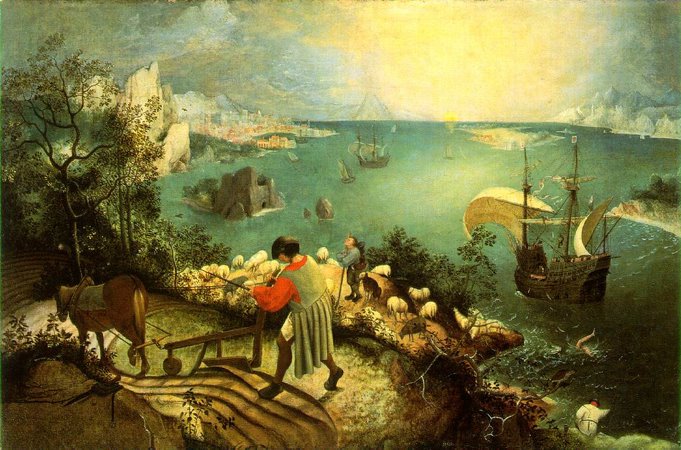
from Pictures from Brueghel
II Landscape with the Fall of Icarus
According to Brueghel
when Icarus fell
it was spring
a farmer was ploughing
his field
the whole pageantry
of the year was
awake tingling
with itself
sweating in the sun
that melted
the wings' wax
unsignificantly
off the coast
there was
a splash quite unnoticed
this was
Icarus drowning
William Carlos Williams 1965
will finish tomorrow (again... sorry!) Have a great night all!
Monday, August 15, 2005
Poem of the Week 8/15/2005: You Begin
You Begin
You begin this way:
this is your hand,
this is your eye,
this is a fish, blue and flat
on the paper, almost
the shape of an eye
This is your mouth, this is an O
or a moon, whichever
you like. This is yellow.
Outside the window
is the rain, green
because it is summer, and beyond that
the trees and then the world,
which is round and has only
the colors of these nine crayons.
This is the world, which is fuller
and more difficult to learn than I have said.
You are right to smudge it that way
with the red and then
the orange: the world burns.
Once you have learned these words
you will learn that there are more
words than you can ever learn.
The word hand floats above your hand
like a small cloud over a lake.
The word hand anchors
your hand to this table
your hand is a warm stone
I hold between two words.
This is your hand, these are my hands, this is the world,
which is round but not flat and has more colors
than we can see.
It begins, it has an end,
this is what you will
come back to, this is your hand.
Margaret Atwood 1978
"You Begin," one of my all time favorite poems, plays with language, feelings of childhood, nostalgia, and love, and the state of the world. Atwood gives the poem a rise and fall: the kind of circularity that makes me ache. That it is titled "You Begin" emphasizes hope, I think, which the inclusion of the child does as well. She builds to that point, and part of that building process serves to invest the reader in the poem. The "you" in the poem could be any "you," though it seems to be addressed to a child drawing on a page.
The first stanza is light and whimsical, with clear, direct statements. There is something about naming things that I love - identifying them against the backdrop of the world provides some surety that is comforting. We can see the narrator smiling when she notes that the drawn fish is, indeed, not a great illustration - "blue and flat - on the paper." But this is done lightly, and the speaker engages the child's imagination by providing "almost the shape of an eye." She does the same with the mouth - "an O / or a moon, whichever / you like." These lines give us early on the confusion between drawing and world, for the speaker connects the image of an open mouth with the drawn circle on the paper. She backs off with the next statement, "This is yellow.," though.
In the second stanza, the narrator seems to be entertained by this naming/imagining process. She leaves the paper and starts describing the world - the rain is "green / because it is summer, and beyond that / the trees and then the world." A sense of curiousity and sadness comes through in the lines "the world / which is round and has only / the colors of these nine crayons." It is as if the narrator is looking askance at this statement, conscious of an innocent way of looking at the world. Also, by now the repetition of the phrases "it is" and "this is" has become apparent. This sense of naming becomes more and more strange, and its declarativeness forces us into the present.
The narrator starts to realize the strangeness of this reductive way of describing the world, saying, "This is the world, which is fuller / and more difficult to learn than I have said." On the surface, we may read this as the fact that things inevitably become more complicated than our language can express. On a deeper level, it is an expression of smallness, I think, and a kind of helplessness in the face of the endless web of complexity and problems in the world: "the world burns." Indeed, the next lines reiterate this, for "Once you have learned these words, / you will learn that there are more /words than you can ever learn."
Here Atwood begins her discussion of language, my favorite part of the poem. Words position us within the world. They are labels, floating above things "like a small cloud over a lake." They triangulate us. Just as "the word hand anchors / your hand to this table," so words bring us into relation to one-another. They interact with objects; the narrator says "your hand is a warn stone / I hold between two words." Words hug us, surround us, connect us, define us. Humans are a relation of words.
A lot of recent theory wants to say that words are thin shells of the real things, that the word "hand" could never be so solid as my fingers that are typing this, or yours as they rest in your lap. But to call it (and every one like it) a hand brings our hands into relation, sitting as a signal for all of the hands in the world. Maybe the inexactitude theorists like Derrida see as an expression of meaningless is actually a freedom, an opportunity for the imagination to link hands. The thing is, words do mean something. If they didn't, we would be forever making sounds at one another and marks on pages that meant nothing.
Lines 30-32 take the narrator from words to the world. The naming process sketches the huge and complex world. Hm - there is a paradox here. Words bring us into relation in the particular, helping us understand and make sense of the world, but on a meta level, their open-endedness allows for intricacy.
The last stanza is a cry of love and finitude. Perhaps the unknownness of things does get to the speaker. Or perhaps she acknowledges it... perhaps she sees that meaning resides in the particular, in the individual. Though there seems to be an infinity of the world, this specific world has a beginning and an end, and finitude is what we come back to. Ultimately, importance rests in a single person, in one hand. If you think about it, any relation of something to anything else (a hand to the other hands in the world, this desk to the floor to the earth), starts with the thing. The center of a web of complexity is here, always in the finite, always in the particular...
Maybe that is why I like this poem so much - the idea the infinite rests in the particular, or at least that the particular gives us access to the infinite. My friend loves to say that language is a finite tool used for infinite means (I think he's quoting Noam Chomsky, or at least drawing from him), and this is what can make words so magical. They are paradoxical, constantly bringing us into relation with one-another, with the world, with ourselves, but those relations are endless. I love this poem for its circularity - it includes the entire realm of things in its hands (line 2 and line 35, the last line), it holds us like a warm stone between two words...
***** This is the original posting (with additions to my favorite poems. It is nice to have them listed, if for no other reason than to remind oneself of them)*******
This poem is my second repeat author (I told you to watch for Atwood), but I choose it now because it is one of my all time top five favorite poems in the world and it is my birthday. So I can do what I want for another hour and seven minutes! Hm! But I choose it for a birthday day because I believe that it is full of passion and hope and love: the kind of tenacious tenderness that exists only in the deepest bonds (and the greatest grief). The form is impeccable and the emotion exquisitely controlled. Its rhetorical complexity is astounding, not least thanks to its "economy of words" (a term one of my lit professors used to describe good poetry). I am exhausted now, but will close-read this poem for all of you tomorrow. There is so much going on that I want to give it the attention that it deserves. For now, I am going to settle into bed with my blanket and my 19 year old self and read my all time top five favorite poems. In case you are curious, here is a list in no particular order.
Wild Geese by Mary Oliver
Punishment by Seamus Heaney
You Begin by Margaret Atwood
Caedmon by Denise Levertov
Love Calls Us to the Things of This World by Richard Wilbur
The Illiterate by William Meredith
Sonnet 14 by John Donne
The Prelude by William Wordsworth (esp. parts of Book 13)
Sea of Faith by John Brehm
(additions since then):
The Rime of the Ancient Mariner by Samuel Taylor Coleridge
Kubla Khan by Coleridge
Mt. Blanc by Percy Bysshe Shelley
Ode to a Nightingale by John Keats
The Marriage of Heaven and Hell by William Blake
The Simple Truth by Philip Levine
Elegy for Jane by Theodore Roethke
Adam’s Dream by Edwin Muir
Okay, so that was more than five, but I started going and got all excited about the poems that I love. Incidentally, all have been PotWs, so you are free to look them up. Also, in order to make you all a special part of the Poem of the Week, and to remind you to read the poems, I am still going to email you every Monday with the poem text and a link to this blog. I hope that you are enjoying the new easier-to-read PotWs, and that you all have wonderful nights!
Love Sarah
You begin this way:
this is your hand,
this is your eye,
this is a fish, blue and flat
on the paper, almost
the shape of an eye
This is your mouth, this is an O
or a moon, whichever
you like. This is yellow.
Outside the window
is the rain, green
because it is summer, and beyond that
the trees and then the world,
which is round and has only
the colors of these nine crayons.
This is the world, which is fuller
and more difficult to learn than I have said.
You are right to smudge it that way
with the red and then
the orange: the world burns.
Once you have learned these words
you will learn that there are more
words than you can ever learn.
The word hand floats above your hand
like a small cloud over a lake.
The word hand anchors
your hand to this table
your hand is a warm stone
I hold between two words.
This is your hand, these are my hands, this is the world,
which is round but not flat and has more colors
than we can see.
It begins, it has an end,
this is what you will
come back to, this is your hand.
Margaret Atwood 1978
"You Begin," one of my all time favorite poems, plays with language, feelings of childhood, nostalgia, and love, and the state of the world. Atwood gives the poem a rise and fall: the kind of circularity that makes me ache. That it is titled "You Begin" emphasizes hope, I think, which the inclusion of the child does as well. She builds to that point, and part of that building process serves to invest the reader in the poem. The "you" in the poem could be any "you," though it seems to be addressed to a child drawing on a page.
The first stanza is light and whimsical, with clear, direct statements. There is something about naming things that I love - identifying them against the backdrop of the world provides some surety that is comforting. We can see the narrator smiling when she notes that the drawn fish is, indeed, not a great illustration - "blue and flat - on the paper." But this is done lightly, and the speaker engages the child's imagination by providing "almost the shape of an eye." She does the same with the mouth - "an O / or a moon, whichever / you like." These lines give us early on the confusion between drawing and world, for the speaker connects the image of an open mouth with the drawn circle on the paper. She backs off with the next statement, "This is yellow.," though.
In the second stanza, the narrator seems to be entertained by this naming/imagining process. She leaves the paper and starts describing the world - the rain is "green / because it is summer, and beyond that / the trees and then the world." A sense of curiousity and sadness comes through in the lines "the world / which is round and has only / the colors of these nine crayons." It is as if the narrator is looking askance at this statement, conscious of an innocent way of looking at the world. Also, by now the repetition of the phrases "it is" and "this is" has become apparent. This sense of naming becomes more and more strange, and its declarativeness forces us into the present.
The narrator starts to realize the strangeness of this reductive way of describing the world, saying, "This is the world, which is fuller / and more difficult to learn than I have said." On the surface, we may read this as the fact that things inevitably become more complicated than our language can express. On a deeper level, it is an expression of smallness, I think, and a kind of helplessness in the face of the endless web of complexity and problems in the world: "the world burns." Indeed, the next lines reiterate this, for "Once you have learned these words, / you will learn that there are more /words than you can ever learn."
Here Atwood begins her discussion of language, my favorite part of the poem. Words position us within the world. They are labels, floating above things "like a small cloud over a lake." They triangulate us. Just as "the word hand anchors / your hand to this table," so words bring us into relation to one-another. They interact with objects; the narrator says "your hand is a warn stone / I hold between two words." Words hug us, surround us, connect us, define us. Humans are a relation of words.
A lot of recent theory wants to say that words are thin shells of the real things, that the word "hand" could never be so solid as my fingers that are typing this, or yours as they rest in your lap. But to call it (and every one like it) a hand brings our hands into relation, sitting as a signal for all of the hands in the world. Maybe the inexactitude theorists like Derrida see as an expression of meaningless is actually a freedom, an opportunity for the imagination to link hands. The thing is, words do mean something. If they didn't, we would be forever making sounds at one another and marks on pages that meant nothing.
Lines 30-32 take the narrator from words to the world. The naming process sketches the huge and complex world. Hm - there is a paradox here. Words bring us into relation in the particular, helping us understand and make sense of the world, but on a meta level, their open-endedness allows for intricacy.
The last stanza is a cry of love and finitude. Perhaps the unknownness of things does get to the speaker. Or perhaps she acknowledges it... perhaps she sees that meaning resides in the particular, in the individual. Though there seems to be an infinity of the world, this specific world has a beginning and an end, and finitude is what we come back to. Ultimately, importance rests in a single person, in one hand. If you think about it, any relation of something to anything else (a hand to the other hands in the world, this desk to the floor to the earth), starts with the thing. The center of a web of complexity is here, always in the finite, always in the particular...
Maybe that is why I like this poem so much - the idea the infinite rests in the particular, or at least that the particular gives us access to the infinite. My friend loves to say that language is a finite tool used for infinite means (I think he's quoting Noam Chomsky, or at least drawing from him), and this is what can make words so magical. They are paradoxical, constantly bringing us into relation with one-another, with the world, with ourselves, but those relations are endless. I love this poem for its circularity - it includes the entire realm of things in its hands (line 2 and line 35, the last line), it holds us like a warm stone between two words...
***** This is the original posting (with additions to my favorite poems. It is nice to have them listed, if for no other reason than to remind oneself of them)*******
This poem is my second repeat author (I told you to watch for Atwood), but I choose it now because it is one of my all time top five favorite poems in the world and it is my birthday. So I can do what I want for another hour and seven minutes! Hm! But I choose it for a birthday day because I believe that it is full of passion and hope and love: the kind of tenacious tenderness that exists only in the deepest bonds (and the greatest grief). The form is impeccable and the emotion exquisitely controlled. Its rhetorical complexity is astounding, not least thanks to its "economy of words" (a term one of my lit professors used to describe good poetry). I am exhausted now, but will close-read this poem for all of you tomorrow. There is so much going on that I want to give it the attention that it deserves. For now, I am going to settle into bed with my blanket and my 19 year old self and read my all time top five favorite poems. In case you are curious, here is a list in no particular order.
Wild Geese by Mary Oliver
Punishment by Seamus Heaney
You Begin by Margaret Atwood
Caedmon by Denise Levertov
Love Calls Us to the Things of This World by Richard Wilbur
The Illiterate by William Meredith
Sonnet 14 by John Donne
The Prelude by William Wordsworth (esp. parts of Book 13)
Sea of Faith by John Brehm
(additions since then):
The Rime of the Ancient Mariner by Samuel Taylor Coleridge
Kubla Khan by Coleridge
Mt. Blanc by Percy Bysshe Shelley
Ode to a Nightingale by John Keats
The Marriage of Heaven and Hell by William Blake
The Simple Truth by Philip Levine
Elegy for Jane by Theodore Roethke
Adam’s Dream by Edwin Muir
Okay, so that was more than five, but I started going and got all excited about the poems that I love. Incidentally, all have been PotWs, so you are free to look them up. Also, in order to make you all a special part of the Poem of the Week, and to remind you to read the poems, I am still going to email you every Monday with the poem text and a link to this blog. I hope that you are enjoying the new easier-to-read PotWs, and that you all have wonderful nights!
Love Sarah
Monday, August 08, 2005
Poem of the Week 8/8/2005: Touch Me
Touch Me
Summer is late, my heart.
Words plucked out of the air
some forty years ago
when I was wild with love
and torn almost in two
scatter like leaves this night
of whistling wind and rain.
It is my heart that's late,
it is my song that's flown.
Outdoors all afternoon
under a gun-metal sky
staking my garden down,
I kneeled to the crickets trilling
underfoot as if about
to burst from their crusty shells;
and like a child again
marveled to hear so clear
and brave a music pour
from such a small machine.
What makes the engine go?
Desire, desire, desire.
The longing for the dance
stirs in the buried life.
One season only,
and it's done.
So let the battered old willow
thrash against the windowpanes
and the house timbers creak.
Darling, do you remember
the man you married? Touch me,
remind me who I am.
Stanley Kunitz 1990
Good evening lovely PotW contacts (I couldn't think of what else to call you)! A thought to begin: Stanley Kunitz was 85 when he wrote this poem; he was born in 1905. I think his age is crucial to understanding the poem, as it deals so directly with disintegration, age, and memory. Thinking of even a 60 year old man writing this alters the meaning a bit. And, again, I know I am mixing speaker and poet, but it at least provides a constant frame of reference. If you see the speaker's age (or even gender) differently, feel free to write back with your thoughts!
At any rate, Kunitz opens the text with two whole entities that crumble. "Summer," something clear and bright, begins the poem. However, he immedately disjoints this idea, telling us that it is late. The first line is also important because it nods towards the nostalgia that is present throughout this work. This is, I think, a love poem. It is perhaps a cry-out love poem, but Kunitz weaves the affection and desperation together throughout the work. Diction that includes "wild," "torn", "trilling," "my heart," "marveled," "brave," and "thrash" serves to heighten the passion and urgency of the call. Of course, the speaker's age may have something to do with this urgency.
"Touch Me"'s second image is that of a word being plucked, fruit-like, and then scattering in the wind. That established, lines 8 and 9 are key; Kunitz writes that "It is my heart that's late, / it is my heart that's flown." In other words, his heart, like a late summer, is something (potentially) ripe and bright and pure that has not come to fruit. His heart, too, is crumbling like chalk.
Just as the opening images of the poem are of loss/disintegration, the bulk of the poem is chock-full of death images. The sky is gun-colored, and he "stakes" his garden down as if it was going to escape somewhere. Furthermore, the poem's central metaphor, the garden crickets, typifies this cycle of destruction. Their presence within the poem, however, reveals somewhat more about the narrator's hopes and fears than do the other entropic elements. These crickets, the speaker notes, will certainly die soon. They have only one season to live (an observation perfectly aligned with the opening statement, "Summer is late, my heart."), and yet they trill away. They live thanks to a tri-pel-et chugging "desire, desire, desire." Evidently, Kunitz sees several imporant things about these crickets. Both their "crusty shells" and their short life span allow him to empathize with them; they are ephemeral shells, as is he. Secondly, they sing nonetheless. Their desire to live, to mate, to whatever, keeps them going.
For Kunitz, I think it's his desire for his wife's love, body, and soul. Or hers for him. Their shared desire. I love the howling quality of the final stanza - the wind and trees are beating at the windows, death is certainly out there, but he does not need to be a shell. He can be again if she will only touch him. Desire will anchor him to life and identity again, just as it did for the tiny unflappable crickets. Oh me I love this poem. It's quite beautiful. There are several ways to read the question "Darling do you remember / the man you married?". He could be assuming that she does, in which case the inquiry is a triumphant sound. On another note, it could be the tender wail of despair, born of he not knowing whether she *does* remember or not. Or maybe it's neither of those things - it's up to you to decide.
Before I go, I have a couple of notes. I wanted to mention something my dad told me about emotional memory that is part of the reason this poem is so explosive to me. He said that emotional memory has no sense of time, so if you get truly triggered, that's it! You're back exactly when you felt the first emotion, experiencing it again. This poem somehow makes me care for the speaker in very few words, because here, again, is a very real person. One who hurts and loves and fears... do any of you remember the "Flowers" by Wendy Cope edition of the PotW? I still believe that seeing someone's fears can make them empathetic. And this man seems so real and vulnerable. This love poem is tender because it fears death and entropy and old age and, most of all, a total loss of the speaker's desire for his wife.
And one more thing: I didn't mean to sound embittered and whiny in the last PotW - I was just feeling a little consumed after an extremely long night's work. Though I do like updating some of my friends/family who I haven't talked to in a long time about things. For now, I hope you enjoy the new blog format and I am done chatting your ears off. Thanks for reading, and Good Night!!!
Sarah
Summer is late, my heart.
Words plucked out of the air
some forty years ago
when I was wild with love
and torn almost in two
scatter like leaves this night
of whistling wind and rain.
It is my heart that's late,
it is my song that's flown.
Outdoors all afternoon
under a gun-metal sky
staking my garden down,
I kneeled to the crickets trilling
underfoot as if about
to burst from their crusty shells;
and like a child again
marveled to hear so clear
and brave a music pour
from such a small machine.
What makes the engine go?
Desire, desire, desire.
The longing for the dance
stirs in the buried life.
One season only,
and it's done.
So let the battered old willow
thrash against the windowpanes
and the house timbers creak.
Darling, do you remember
the man you married? Touch me,
remind me who I am.
Stanley Kunitz 1990
Good evening lovely PotW contacts (I couldn't think of what else to call you)! A thought to begin: Stanley Kunitz was 85 when he wrote this poem; he was born in 1905. I think his age is crucial to understanding the poem, as it deals so directly with disintegration, age, and memory. Thinking of even a 60 year old man writing this alters the meaning a bit. And, again, I know I am mixing speaker and poet, but it at least provides a constant frame of reference. If you see the speaker's age (or even gender) differently, feel free to write back with your thoughts!
At any rate, Kunitz opens the text with two whole entities that crumble. "Summer," something clear and bright, begins the poem. However, he immedately disjoints this idea, telling us that it is late. The first line is also important because it nods towards the nostalgia that is present throughout this work. This is, I think, a love poem. It is perhaps a cry-out love poem, but Kunitz weaves the affection and desperation together throughout the work. Diction that includes "wild," "torn", "trilling," "my heart," "marveled," "brave," and "thrash" serves to heighten the passion and urgency of the call. Of course, the speaker's age may have something to do with this urgency.
"Touch Me"'s second image is that of a word being plucked, fruit-like, and then scattering in the wind. That established, lines 8 and 9 are key; Kunitz writes that "It is my heart that's late, / it is my heart that's flown." In other words, his heart, like a late summer, is something (potentially) ripe and bright and pure that has not come to fruit. His heart, too, is crumbling like chalk.
Just as the opening images of the poem are of loss/disintegration, the bulk of the poem is chock-full of death images. The sky is gun-colored, and he "stakes" his garden down as if it was going to escape somewhere. Furthermore, the poem's central metaphor, the garden crickets, typifies this cycle of destruction. Their presence within the poem, however, reveals somewhat more about the narrator's hopes and fears than do the other entropic elements. These crickets, the speaker notes, will certainly die soon. They have only one season to live (an observation perfectly aligned with the opening statement, "Summer is late, my heart."), and yet they trill away. They live thanks to a tri-pel-et chugging "desire, desire, desire." Evidently, Kunitz sees several imporant things about these crickets. Both their "crusty shells" and their short life span allow him to empathize with them; they are ephemeral shells, as is he. Secondly, they sing nonetheless. Their desire to live, to mate, to whatever, keeps them going.
For Kunitz, I think it's his desire for his wife's love, body, and soul. Or hers for him. Their shared desire. I love the howling quality of the final stanza - the wind and trees are beating at the windows, death is certainly out there, but he does not need to be a shell. He can be again if she will only touch him. Desire will anchor him to life and identity again, just as it did for the tiny unflappable crickets. Oh me I love this poem. It's quite beautiful. There are several ways to read the question "Darling do you remember / the man you married?". He could be assuming that she does, in which case the inquiry is a triumphant sound. On another note, it could be the tender wail of despair, born of he not knowing whether she *does* remember or not. Or maybe it's neither of those things - it's up to you to decide.
Before I go, I have a couple of notes. I wanted to mention something my dad told me about emotional memory that is part of the reason this poem is so explosive to me. He said that emotional memory has no sense of time, so if you get truly triggered, that's it! You're back exactly when you felt the first emotion, experiencing it again. This poem somehow makes me care for the speaker in very few words, because here, again, is a very real person. One who hurts and loves and fears... do any of you remember the "Flowers" by Wendy Cope edition of the PotW? I still believe that seeing someone's fears can make them empathetic. And this man seems so real and vulnerable. This love poem is tender because it fears death and entropy and old age and, most of all, a total loss of the speaker's desire for his wife.
And one more thing: I didn't mean to sound embittered and whiny in the last PotW - I was just feeling a little consumed after an extremely long night's work. Though I do like updating some of my friends/family who I haven't talked to in a long time about things. For now, I hope you enjoy the new blog format and I am done chatting your ears off. Thanks for reading, and Good Night!!!
Sarah
Monday, August 01, 2005
Poem of the Week 8/1/2005: Kingfisher
Kingfisher
That kingfisher jewelling upstream
seems to leave a streak of itself
in the bright air. The trees
are all the better for its passing.
It's not a mineral eater, though it looks it.
It doesn't nip nicks out of the edges
of rainbows. - It dives
into the burly water, then, perched
on a Japanese bough, gulps
into its own incandescence
a wisp of minnow, a warrior stickleback.
- Or it vanishes into its burrow, resplendent
Samurai, returning home
to his stinking slum.
Norman MacCaig
Good Evening to my wonderful friends and family! How are you all? Had a pleasant night? I hope so! Mine was long and tiring, and I have to go right back to work bright and early tomorrow morning. This might seem like the worst time to launch into a Poem of the Week close-read, but it is, in fact, probably the best. There are things more refreshing than sleep for me, and reading poetry is one of them. Plus, if I don't do something like this after working so much, I begin to stop feeling... anything. Anything other than some form of bland resentment and mechanical movement. Sometimes I feel like all I do at work is move; it's purposeless. So reading a poem will be the best remedy for that. Plus, I miss the poem of the week!
I mention the pointless motion inherent server assistant-ing because it clarifies what "Kingfisher" does for me, and why. First and foremost, it rattles me. My job's mindlessness highlights the intensely original, vivid diction and imagery; who knew "jewel" was a verb? And what might it mean to jewel? Actually, "jewel" is a verb, but usually only for an actual jeweler. The kingfisher jewels by leaving "streak
[s] of itself," which implies that it is a jewel. Jeweling along could also be a pun on "tooling along." Just a thought. The following lines "The trees / are all the better for its passing" does several things. As an image, we can imagine that perhaps the flying bird has left strings of gems or even simply color across the forest. It also brings to light the lasting effect something truly beautiful can have. Sunsets, people, ruins, ocean, stars, kingfishers: these things stick with us. Perhaps beauty is over-rated, or can be, but why not let it be? I know that imagining a kingfisher nicking the edges of a rainbow enriches my life and my senses, so let's overrate it. Just for now.
Some people may not like the end of this poem; after the earth/air images preceding it, the thought of a "stinking slum" is not necessarily welcome. However, this may be MacCaig's way of grounding the beauty. Or perhaps his idea of true beauty is a grace and verve with a base, with a frame of reference. This isn't all he could be doing, however. Cynically, he could be trying to sour the entire poem, showing us that, in the end, beauty is a facade. It has no bearing on a life's core and distracts us from the way of things. And, alas, this can easily be true. But where would this poem be without the exquisite imagery? What I take from "Kingfisher" is that beauty is literally vital, but it requires some kind of ballast or reference point.
Thank you all for chugging along through my sentences (I know they get wordier as I get tireder), and I hope that you enjoyed the latest installment of the poem of the week! The next ones will certainly be actually on time.
Sarah
That kingfisher jewelling upstream
seems to leave a streak of itself
in the bright air. The trees
are all the better for its passing.
It's not a mineral eater, though it looks it.
It doesn't nip nicks out of the edges
of rainbows. - It dives
into the burly water, then, perched
on a Japanese bough, gulps
into its own incandescence
a wisp of minnow, a warrior stickleback.
- Or it vanishes into its burrow, resplendent
Samurai, returning home
to his stinking slum.
Norman MacCaig
Good Evening to my wonderful friends and family! How are you all? Had a pleasant night? I hope so! Mine was long and tiring, and I have to go right back to work bright and early tomorrow morning. This might seem like the worst time to launch into a Poem of the Week close-read, but it is, in fact, probably the best. There are things more refreshing than sleep for me, and reading poetry is one of them. Plus, if I don't do something like this after working so much, I begin to stop feeling... anything. Anything other than some form of bland resentment and mechanical movement. Sometimes I feel like all I do at work is move; it's purposeless. So reading a poem will be the best remedy for that. Plus, I miss the poem of the week!
I mention the pointless motion inherent server assistant-ing because it clarifies what "Kingfisher" does for me, and why. First and foremost, it rattles me. My job's mindlessness highlights the intensely original, vivid diction and imagery; who knew "jewel" was a verb? And what might it mean to jewel? Actually, "jewel" is a verb, but usually only for an actual jeweler. The kingfisher jewels by leaving "streak
[s] of itself," which implies that it is a jewel. Jeweling along could also be a pun on "tooling along." Just a thought. The following lines "The trees / are all the better for its passing" does several things. As an image, we can imagine that perhaps the flying bird has left strings of gems or even simply color across the forest. It also brings to light the lasting effect something truly beautiful can have. Sunsets, people, ruins, ocean, stars, kingfishers: these things stick with us. Perhaps beauty is over-rated, or can be, but why not let it be? I know that imagining a kingfisher nicking the edges of a rainbow enriches my life and my senses, so let's overrate it. Just for now.
Some people may not like the end of this poem; after the earth/air images preceding it, the thought of a "stinking slum" is not necessarily welcome. However, this may be MacCaig's way of grounding the beauty. Or perhaps his idea of true beauty is a grace and verve with a base, with a frame of reference. This isn't all he could be doing, however. Cynically, he could be trying to sour the entire poem, showing us that, in the end, beauty is a facade. It has no bearing on a life's core and distracts us from the way of things. And, alas, this can easily be true. But where would this poem be without the exquisite imagery? What I take from "Kingfisher" is that beauty is literally vital, but it requires some kind of ballast or reference point.
Thank you all for chugging along through my sentences (I know they get wordier as I get tireder), and I hope that you enjoyed the latest installment of the poem of the week! The next ones will certainly be actually on time.
Sarah
Poem of the Week 7/26/2005: Love-Letter Burning
Love-Letter-Burning
The archivist in us shudders at such cold-
blooded destruction of the word, but since
we're only human, we commit our sins
to the flames. Sauve qui peut: fear makes us bold.
Tanka was bolder: when the weather turned
from fair to frigid, he saw his way clear
to build a sacrificial fire
in which a priceless temple Buddha burned.
(The pretext? Simple: what he sought
was legendary Essence in the ask.
But if it shows up only in the flesh - ?
He grinned and said, Let's burn the lot!)
Believers in the afterlife perform
this purifying rite. At last
a match is struck: it's done. The past
will shed some light, but never keep us warm.
Daniel Hall 1990
**close-read coming soon!**
The archivist in us shudders at such cold-
blooded destruction of the word, but since
we're only human, we commit our sins
to the flames. Sauve qui peut: fear makes us bold.
Tanka was bolder: when the weather turned
from fair to frigid, he saw his way clear
to build a sacrificial fire
in which a priceless temple Buddha burned.
(The pretext? Simple: what he sought
was legendary Essence in the ask.
But if it shows up only in the flesh - ?
He grinned and said, Let's burn the lot!)
Believers in the afterlife perform
this purifying rite. At last
a match is struck: it's done. The past
will shed some light, but never keep us warm.
Daniel Hall 1990
**close-read coming soon!**
Monday, July 18, 2005
Poem of the Week 7/18/2005: The Pomegranate
The Pomegranate
The only legend I have ever loved is
the story of a daughter lost in hell.
And found and rescued there.
Love and blackmail are the gist of it.
Ceres and Persephone the names.
And the best thing about the legend is
I can enter it anywhere. And have.
As a child in exile in
a city of fogs and strange consonants,
I read it first and at first I was
an exiled child in the crackling dusk of
the underworld, the stars blighted. Later
I walked out in a summer twilight
searching for my daughter at bed-time.
When she came running I was ready
to make any bargain to keep her.
I carried her back past whitebeams
and wasps and honey-scented buddleias.
But I was Ceres then and I knew
winter was in store for every leaf
on every tree on that road.
Was inescapable for each one we passed.
And for me.
It is winter
and the stars are hidden.
I climb the stairs and stand where I can see
my child asleep beside her teen magazines,
her can of Coke, her plate of uncut fruit.
The pomegranate! How did I forget it?
She could have come home and been safe
and ended the story and all
our heart-broken searching but she reached
out a hand and plucked a pomegranate.
She put out her hand and pulled down
the French sound for apple and the noise of stone and the proof
that even in the place of death,
at the heart of legend, in the midst
of rocks full of unshed tears
ready to be diamonds by the time
the story was told, a child can be
hungry. I could warn her. There is still a chance.
The rain is cold. The road is flint-coloured.
The suburb has cars and cable television.
The veiled stars are above ground.
It is another world. But what else
can a mother give her daughter but such
beautiful rifts in time?
If I defer the grief I will diminish the gift.
The legend will be hers as well as mine. She will enter it. As I have.
She will wake up. She will hold
the papery flushed skin in her hand.
And to her lips. I will say nothing.
Eavan Boland 1994
Good evening Friends and Family! This is one of the first poems I read when I got my Norton Anthology of Poetry, and I loved it so much that I did a research project on Eavan Boland last semester. That means that I have some previous theories about Boland's work, and that this discussion will have some more biographical information than usual, but that does not in the least diminish this poem's power or beauty. I particularly love the last four lines, which are as full of tension and anguish as any lines I have ever read.
A bit of backstory on Boland will be helpful before I dive into this poem. Eavan Boland is a female Irish writer in the second half of the twentieth century. She grew up in England, where she felt as if she never had a country or nation as did the British. Boland deals with problems of representation and marginalization, both in being Irish and being an female Irish poet. Women Irish poets have been dreadfully under-represented in Irish literature for hundreds of years. With the help of such poets as Nuala ni Dhomhnaill (pronounced ni gau-na) and Boland, that trend is slowly changing, but the problem remains dire. An anthology called the Irish Literary Review appeared in 1992 that only incorporated two women poets in nearly one thousand pages of poetry. This fact incenses Boland, who contends that the Irish woman appears in Irish literature only as an emblem. She is either the sturdy washer-woman or the beloved, frail beauty. Boland sees that this (literal) subjugation of women cages real women. Boland is *very* aware of the problems of representation.
It may thus seem strange that she chooses the myth of Ceres and Persephone to illustrate a solution to this problem. After all, myth is perhaps the oldest form of written/aural representation that we have. She, however, states immeadately that this myth is useful because she "can enter it anywhere. And [has]". Boland is Persephone in her youth, learning that the world is not all springtime and flowers, experiencing winter in the form of a lonely English childhood. Throughout Boland's poetry, England appears as "a land of strange consonants," while Ireland is a land of vowels. Just in case you read more of her stuff. Ceres enters the picture when Boland inhabits her as a mother panicking over a lost daughter. Panicking, yes, but still aware that "winter was in store for every leaf... was inescapable for each one we passed/ And for me." In writing this, Boland demonstrates her acceptance that winter will come; despair and grief are inevitable. A character or person who can accept that something bad will happen actually creates room to live and to feel, something a female Irish emblem could never do.
The decision about whether to allow her daughter to eat the pomegranate, thus entering a world of pain and betrayal and fear, becomes the crux of the poem. All a parent wants is for her child to be happy and real, so it could be confusing that Boland chooses to say nothing. However, she would rightfully argue that a life lived in half-feeling, in total ignorance of the real world is worse than a life rife with sadness. Stagnancy is the worst feeling of all, so Boland keeps quiet. By speaking up, she would "defer the grief [and] diminish the gift." The gift is not only a life with a full emotional range, but the gift of being able to enter the myth. Boland keeps the myth itself alive by opening its doors to her daughter. Were she to warn "Persephone," she would have cut off the story's energy. It would simply become a dusty anecdote to be taken down and admired instead of a vivacious and relevant myth. Just as Boland does not want this for any person, so she does not want it for a story or form of representation.
I love many things about this poem, but what strikes me the most is how seamlessly Boland melds her story and that of the ancient myth. I distinctly remember being surprised when the pomegranate jumped out of the millennia-old story onto her daughter's plate. One minute everything was clear about who-was-who-when, and the next the tales got all mashed up. But I loved that - it brought both the poem and the Ceres/Persephone legend to life more powerfully than any storybook ever had or could. By living the story and then telling it honestly and painfully, Boland adds to our own emotional range. This is her goal, and it is one which I hope she will continue to puruse.
Sarah
The only legend I have ever loved is
the story of a daughter lost in hell.
And found and rescued there.
Love and blackmail are the gist of it.
Ceres and Persephone the names.
And the best thing about the legend is
I can enter it anywhere. And have.
As a child in exile in
a city of fogs and strange consonants,
I read it first and at first I was
an exiled child in the crackling dusk of
the underworld, the stars blighted. Later
I walked out in a summer twilight
searching for my daughter at bed-time.
When she came running I was ready
to make any bargain to keep her.
I carried her back past whitebeams
and wasps and honey-scented buddleias.
But I was Ceres then and I knew
winter was in store for every leaf
on every tree on that road.
Was inescapable for each one we passed.
And for me.
It is winter
and the stars are hidden.
I climb the stairs and stand where I can see
my child asleep beside her teen magazines,
her can of Coke, her plate of uncut fruit.
The pomegranate! How did I forget it?
She could have come home and been safe
and ended the story and all
our heart-broken searching but she reached
out a hand and plucked a pomegranate.
She put out her hand and pulled down
the French sound for apple and the noise of stone and the proof
that even in the place of death,
at the heart of legend, in the midst
of rocks full of unshed tears
ready to be diamonds by the time
the story was told, a child can be
hungry. I could warn her. There is still a chance.
The rain is cold. The road is flint-coloured.
The suburb has cars and cable television.
The veiled stars are above ground.
It is another world. But what else
can a mother give her daughter but such
beautiful rifts in time?
If I defer the grief I will diminish the gift.
The legend will be hers as well as mine. She will enter it. As I have.
She will wake up. She will hold
the papery flushed skin in her hand.
And to her lips. I will say nothing.
Eavan Boland 1994
Good evening Friends and Family! This is one of the first poems I read when I got my Norton Anthology of Poetry, and I loved it so much that I did a research project on Eavan Boland last semester. That means that I have some previous theories about Boland's work, and that this discussion will have some more biographical information than usual, but that does not in the least diminish this poem's power or beauty. I particularly love the last four lines, which are as full of tension and anguish as any lines I have ever read.
A bit of backstory on Boland will be helpful before I dive into this poem. Eavan Boland is a female Irish writer in the second half of the twentieth century. She grew up in England, where she felt as if she never had a country or nation as did the British. Boland deals with problems of representation and marginalization, both in being Irish and being an female Irish poet. Women Irish poets have been dreadfully under-represented in Irish literature for hundreds of years. With the help of such poets as Nuala ni Dhomhnaill (pronounced ni gau-na) and Boland, that trend is slowly changing, but the problem remains dire. An anthology called the Irish Literary Review appeared in 1992 that only incorporated two women poets in nearly one thousand pages of poetry. This fact incenses Boland, who contends that the Irish woman appears in Irish literature only as an emblem. She is either the sturdy washer-woman or the beloved, frail beauty. Boland sees that this (literal) subjugation of women cages real women. Boland is *very* aware of the problems of representation.
It may thus seem strange that she chooses the myth of Ceres and Persephone to illustrate a solution to this problem. After all, myth is perhaps the oldest form of written/aural representation that we have. She, however, states immeadately that this myth is useful because she "can enter it anywhere. And [has]". Boland is Persephone in her youth, learning that the world is not all springtime and flowers, experiencing winter in the form of a lonely English childhood. Throughout Boland's poetry, England appears as "a land of strange consonants," while Ireland is a land of vowels. Just in case you read more of her stuff. Ceres enters the picture when Boland inhabits her as a mother panicking over a lost daughter. Panicking, yes, but still aware that "winter was in store for every leaf... was inescapable for each one we passed/ And for me." In writing this, Boland demonstrates her acceptance that winter will come; despair and grief are inevitable. A character or person who can accept that something bad will happen actually creates room to live and to feel, something a female Irish emblem could never do.
The decision about whether to allow her daughter to eat the pomegranate, thus entering a world of pain and betrayal and fear, becomes the crux of the poem. All a parent wants is for her child to be happy and real, so it could be confusing that Boland chooses to say nothing. However, she would rightfully argue that a life lived in half-feeling, in total ignorance of the real world is worse than a life rife with sadness. Stagnancy is the worst feeling of all, so Boland keeps quiet. By speaking up, she would "defer the grief [and] diminish the gift." The gift is not only a life with a full emotional range, but the gift of being able to enter the myth. Boland keeps the myth itself alive by opening its doors to her daughter. Were she to warn "Persephone," she would have cut off the story's energy. It would simply become a dusty anecdote to be taken down and admired instead of a vivacious and relevant myth. Just as Boland does not want this for any person, so she does not want it for a story or form of representation.
I love many things about this poem, but what strikes me the most is how seamlessly Boland melds her story and that of the ancient myth. I distinctly remember being surprised when the pomegranate jumped out of the millennia-old story onto her daughter's plate. One minute everything was clear about who-was-who-when, and the next the tales got all mashed up. But I loved that - it brought both the poem and the Ceres/Persephone legend to life more powerfully than any storybook ever had or could. By living the story and then telling it honestly and painfully, Boland adds to our own emotional range. This is her goal, and it is one which I hope she will continue to puruse.
Sarah
Monday, July 11, 2005
Poem of the Week 7/11/2005: Punishment
Punishment*
I can feel the tug
of the halter at the nape
of her neck, the wind
on her naked front.
It blows her nipples
to amber beads,
it shakes the frail rigging
of her ribs.
I can see her drowned
body in the bog,
the weighing stone,
the floating rods and boughs.
Under which at first
she was a barked sapling
that is dug up
oak-bone, brain-firkin:* *small cask
her shaved head
like a stubble of black corn,
her blindfold a soiled bandage,
her noose a ring
to store
the memories of love.
Little adultress,
before they punished you
you were flaxen-haired,
undernourished, and your
tar-black face was beautiful.
My poor scapegoat,
I almost love you
but would have cast, I know,
the stones of silence.
I am the artful voyeur
of your brain's exposed
and darkened combs,
your muscles' webbing
and all your numbered bones:
I who have stood dumb
when your betraying sisters,
cauled in tar,**
wept by the railings,
who would connive
in civilized outrage
yet understand the exact
and tribal, intimate revenge.
Seamus Heaney 1975
* In 1951, the peat-stained body of a young girl who lived in the late first century was recovered from a bog in Windeby, Germany. As P.V. Glob describes her in "The Bog People" (a 1969 book), she "lat naked in the hole in the peat, a bandage over the eyes and a collar round the neck. The band across the eyes was drawn tight and had cut into the neck and the bast of the nose. We may feel sure that it had been used to close her eyees to this world. There was no mark of strangulation on the neck, so it had not been used for that purpose." Her hair "had been shaved off with a razor on the left side of the head.... When the brain was removed the convolutions and folds of the surface could be clearly seen [Glob reproduces a photograph of her brain].... This girl of only fourteen had had an inadequate winter diet.... To keep the young body under, some birch branches and a big stone were laid upon her." According to the Roman historian Tacitus (ca. 56-ca.120), the Germanic peoples punished adulterous women by shaving off their hair and then scourging them out of the village or killing them. IN more recent times, her "betraying sisters" (line 38) have sometimes been shaved, stripped, tarred, and handcuffed by the Irish Republican Army to the railings of Belfast in punishment for keeping company with British soldiers.
**Wrapped or enclosed. A caul is the inner fetal membrane that at birth, when it is unruptured, sometimes covers the infant's head.
Well, I gave everyone a nice, bright poem for the middle of summer....haaaaa... I hope that is alright. However, this is one of my all-time favorite poems by a Nobel Prize winner, Seamus Heaney. As the extremely long footnote indicates, this poem concerns one of the Bog People - thousand plus year old mummies excavated from (and often executed in) the bogs of Europe. My Longman Anthology of British Literature notes, of Heaney, that he found a metaphor for life and suffering in these people. Here are two websites about that - the second is admittedly more gruesome but a much clearer picture... I bet that whoever reads this will go to the site, unable to look away from the train wreck.
http://www.bogpeople.org
http://www.tornadohills.com/strange/bog_people.htm
That written, I have a confession to make. Heaney is a repeat author, and my first. Until now, I have tried to provide a different poet every week, so this is my first slip-up. I was close to breaking it with Margaret Atwood today, but you all, at least, have not read my Heaney poem as of yet. He was the third Poem of the Week ever, so did not fly out over the internet. "The Otter" was a printed poem, cut out and pasted on black construction paper, then taped to my dorm room door. I highly recommend it... I may send out those old PotW's sometime soon, because they are also some of my all-time favorite poems. So anyway. Expect repeats also by Margaret Atwood and ee cummings.
I picked Heaney (again) today because I wanted to do something great and comfortable for me. That is not to say that there aren't great poets I haven't covered yet (i.e. Keats, Milton, Poe, Browning, Tennyson, Petrarch, Coleridge, Pope, Blake, Pound, Eliot, St. Vincent Millay, Shakespeare!!!), but I love this poem. Ahhh seeing that list is making me rethink picking Heaney, but hey. I typed all of this already. So now I am finished filling your minds with prattle about my own personal battle.
What I love about this poem the most is its empathy, the presence of the narrator, the guilt, the tenderness, and the imagery. Thinking about it now, tenderness is probably one of the two most important components of this poem. This is indeed surprising, as the title itself is Punishment, and the body includes several gruesome ideas. A starving fourteen-year girl killed for adultery is not exactly tender. So the question is, why does it leave one with a deep feeling of tenderness?
The imagery and diction have a huge part to do with this. Heaney uses unusual images that basically allay the violence. He calls her ribs a "frail rigging" rather than a "bony cage" or something gorier. We get the idea that this is a tiny body, something delicate that requires a delicate image, lest it might break. This occurs even in the first line, when he writes, "I can feel the tug / of the halter at the nape / of her neck." Everything here is not as severe as it could be - the rope is a halter instead of a noose and it tugs, not pulls, on the very intimate, soft nape of her neck. We then learn that she is naked on her front, which is a very vulnerable state. He goes on to include the frail rigging line, which, with the other parts, directly establishes this girl's fragility. It's not just fragility, though, but the delicacy of a sleeping child. For me, the feeling is exactly what I feel when I think of my parents' childhoods or my (full) younger sister's. It's a complicated emotion - love, grief, joy and sadness kind of jumbled up together. If that makes any sense at all, which it very well may not.
The narrator certainly encourages this compassionate view, calling the girl "little," "poor," "barked sapling," "undernourished," and "beautiful." He again allays the violence by saying that he can see "the weighing stone"; this gives us merely the idea of pressure rather than direct violence. Heaney eventually employs apostrophe, addressing the girl directly. After calling her "my poor scapegoat," he seamlessly transitions to the second major piece of this poem: guilt.
The narrator (who I am mixing with Heaney: see my usual explanation for this) recognizes the connection between this two thousand year old tarred adultress and the women tarred and handcuffed to railings. And the sweet way he sees the bog girl allows him to find empathy for the modern women and feel guilty for his silence. He speaks as if he himself tortured these women, casting "stones of silence" and being an "artful voyeur." Then the question arises about whether part of his tender portrait of the girl is to assuage his guilt, or whether his almost-love for her comes from her fragility. Probably a little of both.
At any rate, I think that this poem is a step away from the artful voyeurism, because, in writing it, Heaney is literally no longer a voyeur. A voyeur simply watches, but this man *tells* the story. This point is important, as it reedems the narrator a bit. I recognise his courage in addressing the bog girl and in writing of his own silence. That is what I was talking about far above when I wrote that I like the presence of the narrator. This is a complex, flawed human being admitting something sad about himself and yet trying to reedem it. Perhaps another reason that he writes so sympathetically of this girl is that he feels a connection with her. That is, maybe he wants to treat her the way he wants to be treated. That statement could be a stretch, but maybe not as well. It's up to you.
Then of course there is the idea of revenge and how our society is simply repeating the primitve impulses to throw people into bogs (though we have apparently progressed to throwing bits of bog onto people). In other words, to punish. Perhaps writing the poem is a bit of a punishment for the narrator (or at least a penance) for staying silent about the girl's "betraying sisters." Anyway - we are rapidly approaching midnight in Boulder, CO, so I had better send this off! I hope that you enjoyed this poem as much as I did, and, of course, I welcome any responses. Have a wonderful night!
Sarah
I can feel the tug
of the halter at the nape
of her neck, the wind
on her naked front.
It blows her nipples
to amber beads,
it shakes the frail rigging
of her ribs.
I can see her drowned
body in the bog,
the weighing stone,
the floating rods and boughs.
Under which at first
she was a barked sapling
that is dug up
oak-bone, brain-firkin:* *small cask
her shaved head
like a stubble of black corn,
her blindfold a soiled bandage,
her noose a ring
to store
the memories of love.
Little adultress,
before they punished you
you were flaxen-haired,
undernourished, and your
tar-black face was beautiful.
My poor scapegoat,
I almost love you
but would have cast, I know,
the stones of silence.
I am the artful voyeur
of your brain's exposed
and darkened combs,
your muscles' webbing
and all your numbered bones:
I who have stood dumb
when your betraying sisters,
cauled in tar,**
wept by the railings,
who would connive
in civilized outrage
yet understand the exact
and tribal, intimate revenge.
Seamus Heaney 1975
* In 1951, the peat-stained body of a young girl who lived in the late first century was recovered from a bog in Windeby, Germany. As P.V. Glob describes her in "The Bog People" (a 1969 book), she "lat naked in the hole in the peat, a bandage over the eyes and a collar round the neck. The band across the eyes was drawn tight and had cut into the neck and the bast of the nose. We may feel sure that it had been used to close her eyees to this world. There was no mark of strangulation on the neck, so it had not been used for that purpose." Her hair "had been shaved off with a razor on the left side of the head.... When the brain was removed the convolutions and folds of the surface could be clearly seen [Glob reproduces a photograph of her brain].... This girl of only fourteen had had an inadequate winter diet.... To keep the young body under, some birch branches and a big stone were laid upon her." According to the Roman historian Tacitus (ca. 56-ca.120), the Germanic peoples punished adulterous women by shaving off their hair and then scourging them out of the village or killing them. IN more recent times, her "betraying sisters" (line 38) have sometimes been shaved, stripped, tarred, and handcuffed by the Irish Republican Army to the railings of Belfast in punishment for keeping company with British soldiers.
**Wrapped or enclosed. A caul is the inner fetal membrane that at birth, when it is unruptured, sometimes covers the infant's head.
Well, I gave everyone a nice, bright poem for the middle of summer....haaaaa... I hope that is alright. However, this is one of my all-time favorite poems by a Nobel Prize winner, Seamus Heaney. As the extremely long footnote indicates, this poem concerns one of the Bog People - thousand plus year old mummies excavated from (and often executed in) the bogs of Europe. My Longman Anthology of British Literature notes, of Heaney, that he found a metaphor for life and suffering in these people. Here are two websites about that - the second is admittedly more gruesome but a much clearer picture... I bet that whoever reads this will go to the site, unable to look away from the train wreck.
http://www.bogpeople.org
http://www.tornadohills.com/strange/bog_people.htm
That written, I have a confession to make. Heaney is a repeat author, and my first. Until now, I have tried to provide a different poet every week, so this is my first slip-up. I was close to breaking it with Margaret Atwood today, but you all, at least, have not read my Heaney poem as of yet. He was the third Poem of the Week ever, so did not fly out over the internet. "The Otter" was a printed poem, cut out and pasted on black construction paper, then taped to my dorm room door. I highly recommend it... I may send out those old PotW's sometime soon, because they are also some of my all-time favorite poems. So anyway. Expect repeats also by Margaret Atwood and ee cummings.
I picked Heaney (again) today because I wanted to do something great and comfortable for me. That is not to say that there aren't great poets I haven't covered yet (i.e. Keats, Milton, Poe, Browning, Tennyson, Petrarch, Coleridge, Pope, Blake, Pound, Eliot, St. Vincent Millay, Shakespeare!!!), but I love this poem. Ahhh seeing that list is making me rethink picking Heaney, but hey. I typed all of this already. So now I am finished filling your minds with prattle about my own personal battle.
What I love about this poem the most is its empathy, the presence of the narrator, the guilt, the tenderness, and the imagery. Thinking about it now, tenderness is probably one of the two most important components of this poem. This is indeed surprising, as the title itself is Punishment, and the body includes several gruesome ideas. A starving fourteen-year girl killed for adultery is not exactly tender. So the question is, why does it leave one with a deep feeling of tenderness?
The imagery and diction have a huge part to do with this. Heaney uses unusual images that basically allay the violence. He calls her ribs a "frail rigging" rather than a "bony cage" or something gorier. We get the idea that this is a tiny body, something delicate that requires a delicate image, lest it might break. This occurs even in the first line, when he writes, "I can feel the tug / of the halter at the nape / of her neck." Everything here is not as severe as it could be - the rope is a halter instead of a noose and it tugs, not pulls, on the very intimate, soft nape of her neck. We then learn that she is naked on her front, which is a very vulnerable state. He goes on to include the frail rigging line, which, with the other parts, directly establishes this girl's fragility. It's not just fragility, though, but the delicacy of a sleeping child. For me, the feeling is exactly what I feel when I think of my parents' childhoods or my (full) younger sister's. It's a complicated emotion - love, grief, joy and sadness kind of jumbled up together. If that makes any sense at all, which it very well may not.
The narrator certainly encourages this compassionate view, calling the girl "little," "poor," "barked sapling," "undernourished," and "beautiful." He again allays the violence by saying that he can see "the weighing stone"; this gives us merely the idea of pressure rather than direct violence. Heaney eventually employs apostrophe, addressing the girl directly. After calling her "my poor scapegoat," he seamlessly transitions to the second major piece of this poem: guilt.
The narrator (who I am mixing with Heaney: see my usual explanation for this) recognizes the connection between this two thousand year old tarred adultress and the women tarred and handcuffed to railings. And the sweet way he sees the bog girl allows him to find empathy for the modern women and feel guilty for his silence. He speaks as if he himself tortured these women, casting "stones of silence" and being an "artful voyeur." Then the question arises about whether part of his tender portrait of the girl is to assuage his guilt, or whether his almost-love for her comes from her fragility. Probably a little of both.
At any rate, I think that this poem is a step away from the artful voyeurism, because, in writing it, Heaney is literally no longer a voyeur. A voyeur simply watches, but this man *tells* the story. This point is important, as it reedems the narrator a bit. I recognise his courage in addressing the bog girl and in writing of his own silence. That is what I was talking about far above when I wrote that I like the presence of the narrator. This is a complex, flawed human being admitting something sad about himself and yet trying to reedem it. Perhaps another reason that he writes so sympathetically of this girl is that he feels a connection with her. That is, maybe he wants to treat her the way he wants to be treated. That statement could be a stretch, but maybe not as well. It's up to you.
Then of course there is the idea of revenge and how our society is simply repeating the primitve impulses to throw people into bogs (though we have apparently progressed to throwing bits of bog onto people). In other words, to punish. Perhaps writing the poem is a bit of a punishment for the narrator (or at least a penance) for staying silent about the girl's "betraying sisters." Anyway - we are rapidly approaching midnight in Boulder, CO, so I had better send this off! I hope that you enjoyed this poem as much as I did, and, of course, I welcome any responses. Have a wonderful night!
Sarah
Monday, July 04, 2005
Poem of the Week 7/4/2005: Star-gazer
Star-gazer
Forty-two years ago (to me if to no one else
The number is of some interest) it was a brilliant starry night
And the westward train was empty and had no corridors
So darting from side to side I could catch the unwonted sight
Of those almost intolerably bright
Holes, punched in the sky, which excited me partly because
Of their Latin names and partly because I had read in the textbooks
How very far off they were, it seemed their light
Had left them (some at least) long years before I was.
And this remembering now I mark that what
Light was leaving some of them at least then,
Forty-two years ago, will never arrive
In time for me to catch it, which light when
It does get here may find that there is not
Anyone left alive
To run from side to side in a late night train
Admiring it and adding noughts in vain.
Louis MacNeice 1967
Happy Fourth of July friends and family! I could have chosen a grumpy political poem for this week, but I think that I am going to follow my MLK Jr. day track and add positive thoughts to a national holiday. It is important to know for this poem that MacNeice was born in 1907, so he was eighteen "forty two years ago". It's another celestial poem for me...surprise. There is a lot I could say about this poem, but I want to say how much this poem is resonating with me right now. It distills the excitement and openness of a fresh adulthood without losing sight of its ephemerality. I find it interesting how there are two consciousnesses at work here; that of the young eighteen year old and that of the sixty year old looking back. So I enjoyed seeing myself from that space. The night tonight was completely dark and beautiful, and I wanted to find a poem that felt the same way. Some things to notice: ephermality vs. infinity, unintrusive rhyme, the visual form, the somewhat unsual diction, parentheses, repetition, and the character of MacNeice (who is almost certainly the narrator.) I would keep writing if I was more awake. So I am going to go enjoy the night in a different way: by sleeping. Goodnight!
Love,
Sarah
Forty-two years ago (to me if to no one else
The number is of some interest) it was a brilliant starry night
And the westward train was empty and had no corridors
So darting from side to side I could catch the unwonted sight
Of those almost intolerably bright
Holes, punched in the sky, which excited me partly because
Of their Latin names and partly because I had read in the textbooks
How very far off they were, it seemed their light
Had left them (some at least) long years before I was.
And this remembering now I mark that what
Light was leaving some of them at least then,
Forty-two years ago, will never arrive
In time for me to catch it, which light when
It does get here may find that there is not
Anyone left alive
To run from side to side in a late night train
Admiring it and adding noughts in vain.
Louis MacNeice 1967
Happy Fourth of July friends and family! I could have chosen a grumpy political poem for this week, but I think that I am going to follow my MLK Jr. day track and add positive thoughts to a national holiday. It is important to know for this poem that MacNeice was born in 1907, so he was eighteen "forty two years ago". It's another celestial poem for me...surprise. There is a lot I could say about this poem, but I want to say how much this poem is resonating with me right now. It distills the excitement and openness of a fresh adulthood without losing sight of its ephemerality. I find it interesting how there are two consciousnesses at work here; that of the young eighteen year old and that of the sixty year old looking back. So I enjoyed seeing myself from that space. The night tonight was completely dark and beautiful, and I wanted to find a poem that felt the same way. Some things to notice: ephermality vs. infinity, unintrusive rhyme, the visual form, the somewhat unsual diction, parentheses, repetition, and the character of MacNeice (who is almost certainly the narrator.) I would keep writing if I was more awake. So I am going to go enjoy the night in a different way: by sleeping. Goodnight!
Love,
Sarah
Sunday, June 26, 2005
Poem of the Week 6/26/2005: Centaur
Centaur
The first typeface I loved
was Centaur, cut by Bruce Rogers
in 1914. It had animal bones,
and reminded me of skinny-dipping at night,
baptized in star water so cold
I suddenly became another
animal from the waist down.
In our family, we knew all about the Minotaur,
Cyclops, and centaurs.
My father read to me about the man-horses,
so I had an inkling
of their danger,
and thereafter leaned toward the horse part
and away from the man.
Chase Twichell 2005
Hallo darling friends and family! Another Monday is come and almost gone, so with it I give you this Poem of the Week. I read this poem sitting in Borders with one of my friends, and I went back to copy it out of the Kenyon Review because I loved it so much. What originally caught my eye was the line "star water," and I later realized that my favorite imagery synthesizes the everyday with the cosmic (does anybody remember Dufault's fountain of planets? Beautiful!). Not exactly relevant to the poem I guess, but isn't it exciting to discover something about yourself? I always find so; even the trivial things are invigorating. It's the same with learning things about other people. And I think that I like the small details almost more than the big ones, because people often ignore the small details. One can always overkill on this, of course, but that doesn't make the details irrelevant. Oh look at me chatting away when there is a poem to work on! Though this tangent does remind one of poetry's personal nature. The Poem of the Week (and all poetry I guess) is a very intimate part of me, so to cut that out of my close readings would starve the analysis.
Just a little justification.
Perhaps it is and perhaps it is not coincidental to note that the poem is also distinctly personal. The title, "Centaur," connotes something quite special for this speaker; I for one did not expect it to be a typeface. Also, Twichell (who is, by the way, a woman) writes later that her family knew about centaurs, but the poem is only about one. This centaur is probably the typeface or the speaker herself. But, then, we ask, what is a centaur? Or, more precisely, what does it mean to be a centaur for Twichell? It is clearly more than a typeface; this small, personalizing detail sserves more as a springboard into the true metaphor. I find it interesting that she chooses typeface, which is really a way of writing, as the opening image, for it's like a second layer of words. We have the visual words on the page, and then we have a means for constructing words within those lines. Just as a poem shakes itself into being when read, this poem's central metaphor clip clops out of that typeface when recollected.
She feels like a centaur because the water agitates her lower-body nerves just so. Twichell seems to say, then, that a strong, seizing physical sensation like skinny dipping can turn us into animals. Or perhaps it simply reminds us of our animal bodies, exposing the animal by peeling away the cerebral layers. Some of you may have noticed that she is animal from "waist down." This connotes sexuality, of course, though Twichell does not follow on this track. I think that the idea of being part animal means, both here and in life, that humans have an instinctual, powerful, noble side along with our delicate hands and quick brains. Simple, but easy to forget.
Twichell, having established the metaphor, leaves it for a moment, giving us more personal history. She provides the Minotaur and the Cyclops as other mythical beasts. I enjoyed imagining her family life as these two partial-humans. Instead of saying that "In our family, we knew / all about the Minotaur, / [and] Cyclops," she could have said, "my family was familiar with bull-headedness and short-
sightnedness." It could also mean that her family was well-read and connected with the past, but I like the more personal response.
Near the end of the poem, the speaker talks of centaurs' apparently inherent danger. Because she chooses to stick with the animal over the man, it seems that she believes this danger comes from man. This part of the poem invites us to think whatever we want about the dangers of man and the positive aspects of an animal. For me, the greatest peril of being a man (against which there is advantage in being animal) is our cerebrality; we forget to simply feel sometimes for one reason or another. Work is tiring, kids are draining, we don't laugh anymore... we fear feeling. That is something to which a horse would not be sensitive in my imagination. It is all about freedom from fear and societal constructs and binary opposites. Of course, there are any number of ways to look at the danger idea - man could be dangerous because his heart can break. Perhaps it is safer to be an animal and procreate without feeling. That interpretation calls back the sexuality in line 8. Man's danger could come from being so destructive. It struck me a little bit ago that animal could also be a metonym for nature, so the poem could be an ecological statement. The dangers of being a centaur could actually have to do with the tension between man and animal, too. Perhaps they are not reconciliable, so one has to choose? Maybe that is the tragedy.
I wrote at the beginning of this poem, "perhaps it is and perhaps it is not coincidental that this poem is very personal." I mean that it isn't a coincidence that I am going off on personal tangents for this particular poem. A personal poem evokes personal responses, and I hope that you think about what is human and animal and neither in yourself. I hope that you can respond personally to this poem by thinking about it - that is how to interact with literature and possibly learn something about yourself along the way. Sometimes articulating something is better than just knowing it; that is what poetry can do for me. It has a way of forcing me to pinpoint and spell out whatever I am feeling.
On a final note, I know that I mixed up the speaker and Chase Twichell time and again here, but it helps me to think of a poem's speaker as the author most of the time. There are of course countless poems wherein it is obvious that the speaker and author are separate, but I believe that this is not one of them. I don't know enough about the different schools of poetry yet to sort out the Confessional poets. With time, with time. For this time, I hope that you enjoyed this poem and good night!
Sarah
The first typeface I loved
was Centaur, cut by Bruce Rogers
in 1914. It had animal bones,
and reminded me of skinny-dipping at night,
baptized in star water so cold
I suddenly became another
animal from the waist down.
In our family, we knew all about the Minotaur,
Cyclops, and centaurs.
My father read to me about the man-horses,
so I had an inkling
of their danger,
and thereafter leaned toward the horse part
and away from the man.
Chase Twichell 2005
Hallo darling friends and family! Another Monday is come and almost gone, so with it I give you this Poem of the Week. I read this poem sitting in Borders with one of my friends, and I went back to copy it out of the Kenyon Review because I loved it so much. What originally caught my eye was the line "star water," and I later realized that my favorite imagery synthesizes the everyday with the cosmic (does anybody remember Dufault's fountain of planets? Beautiful!). Not exactly relevant to the poem I guess, but isn't it exciting to discover something about yourself? I always find so; even the trivial things are invigorating. It's the same with learning things about other people. And I think that I like the small details almost more than the big ones, because people often ignore the small details. One can always overkill on this, of course, but that doesn't make the details irrelevant. Oh look at me chatting away when there is a poem to work on! Though this tangent does remind one of poetry's personal nature. The Poem of the Week (and all poetry I guess) is a very intimate part of me, so to cut that out of my close readings would starve the analysis.
Just a little justification.
Perhaps it is and perhaps it is not coincidental to note that the poem is also distinctly personal. The title, "Centaur," connotes something quite special for this speaker; I for one did not expect it to be a typeface. Also, Twichell (who is, by the way, a woman) writes later that her family knew about centaurs, but the poem is only about one. This centaur is probably the typeface or the speaker herself. But, then, we ask, what is a centaur? Or, more precisely, what does it mean to be a centaur for Twichell? It is clearly more than a typeface; this small, personalizing detail sserves more as a springboard into the true metaphor. I find it interesting that she chooses typeface, which is really a way of writing, as the opening image, for it's like a second layer of words. We have the visual words on the page, and then we have a means for constructing words within those lines. Just as a poem shakes itself into being when read, this poem's central metaphor clip clops out of that typeface when recollected.
She feels like a centaur because the water agitates her lower-body nerves just so. Twichell seems to say, then, that a strong, seizing physical sensation like skinny dipping can turn us into animals. Or perhaps it simply reminds us of our animal bodies, exposing the animal by peeling away the cerebral layers. Some of you may have noticed that she is animal from "waist down." This connotes sexuality, of course, though Twichell does not follow on this track. I think that the idea of being part animal means, both here and in life, that humans have an instinctual, powerful, noble side along with our delicate hands and quick brains. Simple, but easy to forget.
Twichell, having established the metaphor, leaves it for a moment, giving us more personal history. She provides the Minotaur and the Cyclops as other mythical beasts. I enjoyed imagining her family life as these two partial-humans. Instead of saying that "In our family, we knew / all about the Minotaur, / [and] Cyclops," she could have said, "my family was familiar with bull-headedness and short-
sightnedness." It could also mean that her family was well-read and connected with the past, but I like the more personal response.
Near the end of the poem, the speaker talks of centaurs' apparently inherent danger. Because she chooses to stick with the animal over the man, it seems that she believes this danger comes from man. This part of the poem invites us to think whatever we want about the dangers of man and the positive aspects of an animal. For me, the greatest peril of being a man (against which there is advantage in being animal) is our cerebrality; we forget to simply feel sometimes for one reason or another. Work is tiring, kids are draining, we don't laugh anymore... we fear feeling. That is something to which a horse would not be sensitive in my imagination. It is all about freedom from fear and societal constructs and binary opposites. Of course, there are any number of ways to look at the danger idea - man could be dangerous because his heart can break. Perhaps it is safer to be an animal and procreate without feeling. That interpretation calls back the sexuality in line 8. Man's danger could come from being so destructive. It struck me a little bit ago that animal could also be a metonym for nature, so the poem could be an ecological statement. The dangers of being a centaur could actually have to do with the tension between man and animal, too. Perhaps they are not reconciliable, so one has to choose? Maybe that is the tragedy.
I wrote at the beginning of this poem, "perhaps it is and perhaps it is not coincidental that this poem is very personal." I mean that it isn't a coincidence that I am going off on personal tangents for this particular poem. A personal poem evokes personal responses, and I hope that you think about what is human and animal and neither in yourself. I hope that you can respond personally to this poem by thinking about it - that is how to interact with literature and possibly learn something about yourself along the way. Sometimes articulating something is better than just knowing it; that is what poetry can do for me. It has a way of forcing me to pinpoint and spell out whatever I am feeling.
On a final note, I know that I mixed up the speaker and Chase Twichell time and again here, but it helps me to think of a poem's speaker as the author most of the time. There are of course countless poems wherein it is obvious that the speaker and author are separate, but I believe that this is not one of them. I don't know enough about the different schools of poetry yet to sort out the Confessional poets. With time, with time. For this time, I hope that you enjoyed this poem and good night!
Sarah
Monday, June 20, 2005
Poem of the Week 6/20/2005: Night Feeding
Night Feeding
Deeper than sleep but not so deep as death
I lay there sleeping and my magic head
remembered and forgot. On first cry I
remembered and forgot and did believe.
I knew love and I knew evil:
woke to the burning song and the tree burning blind,
despair of our days and the calm milk-giver who
knows sleep, knows growth, the sex of fire and grass,
and the black snake with gold bones.
Black sleeps, gold burns; on second cry I woke
fully and gave to feed and fed on feeding.
Gold seed, green pain, my wizards in the earth
walked through the house, black in the morning dark.
Shadows grew in my veins, my bright belief,
my head of dreams deeper than night and sleep.
Voices of all black animals crying to drink, cries of all birth arise, simple as we,
found in the leaves, in clouds and dark, in dream,
deep as this hour, ready again to sleep.
Muriel Rukeyser 1951
Hello friends and family! I read this poem among the dying embers of a spectacular sunset, the latest in a series of great, sky-covering sunsets gracing Boulder's skies of late, so I simply paid attention to this poem's imagery and feel rather than its message. Otherwise, I might have chosen an easier one. Alas it will have to be incomplete. This, O best beloved, is quite a complicated poem (who caught the Rudyard Kipling nod?). I have read it at least five times and it is only now beginning to take its shape for me. As in some of the old school PotWs, I think that I am just going to point out some things I have noticed in this poem. As in James Joyce's Ulysses, the poem's tangible action is simple, even boring. A baby wakes a dreaming woman who feeds him and goes back to bed, "ready again to sleep." Rukeyser does not make things this easy for us, though. The difficult and perhaps most brilliant thing about "Night Feeding" is that it reads like a dream. The images cycle and recycle, never settling on a pattern or meaning. It is as if the broken ideas are what matters rather than the poem's universe, for the different ideas and images seem to dance around the real ones. What these real ones are, we have to imagine for ourselves. We do see that love, evil, gold, black, snake, sleep/deep, and (fantastically) dream itself shuffle about. Black sleeps, black is a snake, and animals are black within the poem. In the same way, gold burns, is bones and is a seed. Rukeyser plays with "black" and "snake" implicitly, as sleep, death and even deep often connote darkness or black. Then, too, the poem (and the speaker's consciousness) seem almost like a snake ingesting its tail. The end returns to the beginning, and we realize that the body exists as a digestion (or is it a regurgitation) of itself.
Within this jumble, though, there rests a grain or two of sense. The diction is decidedly Biblical, what with the snake, the burning tree (which, while nodding at the Old Testament burning bush, could also be a metaphor for the destruction of Eden), a woman who knows the "despair" of our days, a mother perhaps of "all birth," and the voices of all of the animals. I propose that the narrator's sleep at the beginning of the poem resembles Eve's innocence in Eden, which a child's cry begins to shatter. Eden, a dream, breaks down as one into a more frenzied and mixed up jumble of what was. The animals are despairing, the earth is despairing, and we live for our children, shown by the line "gave to feed and fed on feeding." This poem is dark and cynical, showing a version of motherhood that rerun's Eve's. This leads to deeper questions about our own originality. Are we just replaying things over and over? Milan Kundera in Immortality suggests that we do not perform gestures because no gesture is unique. With uncountable billions of human beings to have passed across the earth, nothing can be simply ours. So a gesture is more individual than an individual - they inhabit us when we perform them. So this poem asks whether we are just replaying the garden of Eden tragedy over and over. We are born into a state of innocence, it crumbles, and we eventually return to the garden/innocence/death. This is what meta-
narratives are all about anyway! Umbrella-stories attempting to explain our lives and struggles. The Bible is full of meta-narratives, beliefs aside. I could actually keep going for a long time, but I myself am tumbling into the deep of sleep, and bid you goodnight!
And to those of you to whom I owe emails, please accept my apology and my promise that they will arrive post-haste.
Sarah
Deeper than sleep but not so deep as death
I lay there sleeping and my magic head
remembered and forgot. On first cry I
remembered and forgot and did believe.
I knew love and I knew evil:
woke to the burning song and the tree burning blind,
despair of our days and the calm milk-giver who
knows sleep, knows growth, the sex of fire and grass,
and the black snake with gold bones.
Black sleeps, gold burns; on second cry I woke
fully and gave to feed and fed on feeding.
Gold seed, green pain, my wizards in the earth
walked through the house, black in the morning dark.
Shadows grew in my veins, my bright belief,
my head of dreams deeper than night and sleep.
Voices of all black animals crying to drink, cries of all birth arise, simple as we,
found in the leaves, in clouds and dark, in dream,
deep as this hour, ready again to sleep.
Muriel Rukeyser 1951
Hello friends and family! I read this poem among the dying embers of a spectacular sunset, the latest in a series of great, sky-covering sunsets gracing Boulder's skies of late, so I simply paid attention to this poem's imagery and feel rather than its message. Otherwise, I might have chosen an easier one. Alas it will have to be incomplete. This, O best beloved, is quite a complicated poem (who caught the Rudyard Kipling nod?). I have read it at least five times and it is only now beginning to take its shape for me. As in some of the old school PotWs, I think that I am just going to point out some things I have noticed in this poem. As in James Joyce's Ulysses, the poem's tangible action is simple, even boring. A baby wakes a dreaming woman who feeds him and goes back to bed, "ready again to sleep." Rukeyser does not make things this easy for us, though. The difficult and perhaps most brilliant thing about "Night Feeding" is that it reads like a dream. The images cycle and recycle, never settling on a pattern or meaning. It is as if the broken ideas are what matters rather than the poem's universe, for the different ideas and images seem to dance around the real ones. What these real ones are, we have to imagine for ourselves. We do see that love, evil, gold, black, snake, sleep/deep, and (fantastically) dream itself shuffle about. Black sleeps, black is a snake, and animals are black within the poem. In the same way, gold burns, is bones and is a seed. Rukeyser plays with "black" and "snake" implicitly, as sleep, death and even deep often connote darkness or black. Then, too, the poem (and the speaker's consciousness) seem almost like a snake ingesting its tail. The end returns to the beginning, and we realize that the body exists as a digestion (or is it a regurgitation) of itself.
Within this jumble, though, there rests a grain or two of sense. The diction is decidedly Biblical, what with the snake, the burning tree (which, while nodding at the Old Testament burning bush, could also be a metaphor for the destruction of Eden), a woman who knows the "despair" of our days, a mother perhaps of "all birth," and the voices of all of the animals. I propose that the narrator's sleep at the beginning of the poem resembles Eve's innocence in Eden, which a child's cry begins to shatter. Eden, a dream, breaks down as one into a more frenzied and mixed up jumble of what was. The animals are despairing, the earth is despairing, and we live for our children, shown by the line "gave to feed and fed on feeding." This poem is dark and cynical, showing a version of motherhood that rerun's Eve's. This leads to deeper questions about our own originality. Are we just replaying things over and over? Milan Kundera in Immortality suggests that we do not perform gestures because no gesture is unique. With uncountable billions of human beings to have passed across the earth, nothing can be simply ours. So a gesture is more individual than an individual - they inhabit us when we perform them. So this poem asks whether we are just replaying the garden of Eden tragedy over and over. We are born into a state of innocence, it crumbles, and we eventually return to the garden/innocence/death. This is what meta-
narratives are all about anyway! Umbrella-stories attempting to explain our lives and struggles. The Bible is full of meta-narratives, beliefs aside. I could actually keep going for a long time, but I myself am tumbling into the deep of sleep, and bid you goodnight!
And to those of you to whom I owe emails, please accept my apology and my promise that they will arrive post-haste.
Sarah
Monday, June 13, 2005
Poem of the Week 6/13/2005: V.B. Nimble, V.B. Quick
V.B. Nimble, V.B. Quick
Science, Pure and Applied, by V.B. Wigglesworth, F.R.S., Quick
Professor of Biology in the University of Cambridge.
-a talk listed in the BBC's Radio Times
V.B. Wigglesworth wakes at noon,
Washes, shaves, and very soon
Is at the lab; he reads his mail,
Tweaks a tadpole by the tail,
Undoes his coat, removes his hat,
Dips a spider a vat
Of alkaline, phones the press,
Tells them he is F.R.S.,
Subdivides six protocells,
Kills a rat by ringing bells,
Writes a treatise, edits two
Symposia on "Will Man Do?,"
Gives a lecture, edits three,
Has the Sperm Club in for tea,
Pensions off an aging spore,
Cracks a test tube, takes some pure
Science and applies it, finds
His hat, adjusts it, pulls the blinds,
Instructs the jellyfish to spawn,
And, by one o'clock, is gone.
John Updike 1954
Good morning friends and family! This poem is somewhat lighter than most
PotWs, as this is a vacation Poem of the Week! Yes, I am on vacation, but I
refuse to abandon the Monday poetry post. So this analysis will be a bit
shorter as well (possibly with more typos, as this keyboard is difficult to
navigate). This poem is actually stuck in my head right now because it is so
rythmic and structured. I find it sticky, too, because it is nearly unbearably
clever. Updike managed to fit hilarious acts of science into one 20 line,
heavily structured poem. The imagery is hilarious, too, my favorite being
"kills a rat by ringing bells." This line is possibly a sinister
nod to Pavlov and his famous dog experiments.
What I like, also, about this poem (besides its hilarity), is its self
similarity across scale. Just as V.B. Wigglesworth manages to accomplish so
much in the short span of an hour, the poem also includes much in its tight
twenty lines. For that matter, actually, it accomplishes as much as any other
poem in its form and rhetorical complexity. Who says that a poem has to tackle
the Meaning of Life etc. etc. in order to utilize a rich form. Updike, a
writer for the New Yorker, incorporates every bit of detail from the quote
from which his inspiration came. He does what many other poets do, which is to
notice a detail about life and expound upon it. And he does it so that the
idea retains its humor rather than having the laughs explained out of it. Have
you all noticed that when somebody explains a joke, it maybe gets a groan but
loses everything that was funny? Well, this poem is Updike's way of explaining
this real-life funny moment. Anyway - that's vacation Poem of the Week!
Sarah
Science, Pure and Applied, by V.B. Wigglesworth, F.R.S., Quick
Professor of Biology in the University of Cambridge.
-a talk listed in the BBC's Radio Times
V.B. Wigglesworth wakes at noon,
Washes, shaves, and very soon
Is at the lab; he reads his mail,
Tweaks a tadpole by the tail,
Undoes his coat, removes his hat,
Dips a spider a vat
Of alkaline, phones the press,
Tells them he is F.R.S.,
Subdivides six protocells,
Kills a rat by ringing bells,
Writes a treatise, edits two
Symposia on "Will Man Do?,"
Gives a lecture, edits three,
Has the Sperm Club in for tea,
Pensions off an aging spore,
Cracks a test tube, takes some pure
Science and applies it, finds
His hat, adjusts it, pulls the blinds,
Instructs the jellyfish to spawn,
And, by one o'clock, is gone.
John Updike 1954
Good morning friends and family! This poem is somewhat lighter than most
PotWs, as this is a vacation Poem of the Week! Yes, I am on vacation, but I
refuse to abandon the Monday poetry post. So this analysis will be a bit
shorter as well (possibly with more typos, as this keyboard is difficult to
navigate). This poem is actually stuck in my head right now because it is so
rythmic and structured. I find it sticky, too, because it is nearly unbearably
clever. Updike managed to fit hilarious acts of science into one 20 line,
heavily structured poem. The imagery is hilarious, too, my favorite being
"kills a rat by ringing bells." This line is possibly a sinister
nod to Pavlov and his famous dog experiments.
What I like, also, about this poem (besides its hilarity), is its self
similarity across scale. Just as V.B. Wigglesworth manages to accomplish so
much in the short span of an hour, the poem also includes much in its tight
twenty lines. For that matter, actually, it accomplishes as much as any other
poem in its form and rhetorical complexity. Who says that a poem has to tackle
the Meaning of Life etc. etc. in order to utilize a rich form. Updike, a
writer for the New Yorker, incorporates every bit of detail from the quote
from which his inspiration came. He does what many other poets do, which is to
notice a detail about life and expound upon it. And he does it so that the
idea retains its humor rather than having the laughs explained out of it. Have
you all noticed that when somebody explains a joke, it maybe gets a groan but
loses everything that was funny? Well, this poem is Updike's way of explaining
this real-life funny moment. Anyway - that's vacation Poem of the Week!
Sarah
Monday, June 06, 2005
Poem of the Week 6/6/2005: Filling Station
Filling Station
Oh, but it is dirty!
-- this little filling station,
oil-soaked, oil-permeated
to a disturbing, over-all
black translucency.
Be careful with that match!
Father wears a dirty, oil-soaked monkey suit
that cuts him under the arms,
and several quick and saucy
and greasy sons assist him
(it's a family filling station),
all quite thoroughly dirty.
Do they live in the station?
It has a cement porch behind the pumps, and on it
a set of crushed and grease-
impregnated wickerwork;
on the wicker sofa a dirty dog, quite comfy.
Some comic books provide
the only note of color -- of certain color. They lie
upon a big dim doily
draping a taboret* *drum-shaped table
(part of the set), beside
a big hirsute begonia.
Why the extraneous plant?
Why the taboret?
Why, oh why, the doily?
(Embroidered in daisy stitch
with marguerites, I think, and heavy with gray crochet.)
Somebody embroidered the doily.
Somebody waters the plant,
or oils it maybe. Somebody
arranges the rows of cans
so that they softly say:
ESSO-SO-SO-SO
to high strung automobiles.
Somebody loves us all.
Elizabeth Bishop 1965
Oh Hello Everyone! A note about this poem: "Esso" is the name of the gas provider - the company turned into Exxon. I just didn't feel like putting more stars there for some reason, so you get that information here! Anyway. For this poem, I want to point out how there are several levels of emotion at play in this poem. To begin, there is the narrator's somewhat bemused attitude towards this station. Thanks to decidedly personal statements like "Be careful with that match" and "why, oh why, the doily?", we get the idea that the narrator is lamenting this gas station's awful taste and ubiquitous grime. Bishop repeats "oil" and "grease" very often, which underlines the station's filth. The hirsute (hairy) begonia is simply awful, as is the dingy-gray doily. Even choosing a doily is important, because the station's design touch is d-oily. Oil is everywhere.
Bishop heightens the idea of this po-dunk station by saying that "comic books provide / the only note of color -- / a certain color." First, the reading material is, shall we say, less than intellectual, while the final piece of that statement, "a certain color" could imply several things. The comics could just be faded in that certain way the sun has of taking all colors but blue. It could also point to the fact that the place has its own sort of flavor; the comic books provide visual color, though the place has its own color without them. Plus, the fact that she calls the visual arrangement a "set" demonstrates more of the speaker's amusement about this scene.
To this point, the filling station seems like a place nobody would actually want to visit - it's grimy and ugly and probably smelly. And yet, I don't hate this place. I actually kind of appreciate and love it, thanks to what Bishop discusses in the final stanza. She notices that these objects don't just exist as bastions of bad taste; somebody chose them. Somebody made that doily and somebody picked out that hairy begonia. She asks why they're there and then answers it in the last stanza. It's important to note that "somebody arranges the rows of cans" is in present tense, because this feeling is not simply one of fond nostalgia. These are lives.
That she doesn't find so much love and appreciation for life in, say, a meadow or a kiss maybe seems a bit curious. After all, shouldn't something that loves her spark the final insight that "Somebody loves us all?" I think not, actually. It makes perfect sense to me that this disgusting station inspires love in her (and in me). Perhaps it's that beauty clogs emotion or truth or something, stifling the genuine feeling with one of temporal surface beauty. For me, at least, ugly things often inspire more affection and compassion within me than beautiful ones. I can admire a graceful vase, but I don't know if I can love it the same way that I could love an awful vase at a thrift store. The coarse-ness allows space for empathy, for a thing's flaws make it real. It's a little sad to see the 80s chipped and cracked vase sitting there, but it, at least, has a history and a life. In "Filling Station," the father is more likeable, oil-
smeared as he may be, than the "high-strung" and presumably clean automobile at the end.
So anyway. One final point I want to add is the function this poem serves. Just as beauty can clog, disgust can, too. This poem gives us the imaginative distance from the actual grime so that we can appreciate that grease is an intrinsic part of this family. It may not be perfect or lovely, so this flawed space opens up room for love. This brings up the question of reader-participation. A poem gives us the opportunity to imagine or ignore as many aspects of a proposed image/scene as we like. So - one's interpretation can vary depending upon how much reality one gives the station. For me, I allowed myself enough room to appreciate and love the people.
Sarah
PS Hey - I was organizing my PotW database this weekend in a fit of boredom, and I am missing several of the earler PotWs. If any of you still have copies of 12/1, 12/7, 12/27, 1/3, the Change in the Poem of the Week (1/17), or 4/4, I would be much obliged if you forwarded me a copy. Thank you and have a wonderful day!
Oh, but it is dirty!
-- this little filling station,
oil-soaked, oil-permeated
to a disturbing, over-all
black translucency.
Be careful with that match!
Father wears a dirty, oil-soaked monkey suit
that cuts him under the arms,
and several quick and saucy
and greasy sons assist him
(it's a family filling station),
all quite thoroughly dirty.
Do they live in the station?
It has a cement porch behind the pumps, and on it
a set of crushed and grease-
impregnated wickerwork;
on the wicker sofa a dirty dog, quite comfy.
Some comic books provide
the only note of color -- of certain color. They lie
upon a big dim doily
draping a taboret* *drum-shaped table
(part of the set), beside
a big hirsute begonia.
Why the extraneous plant?
Why the taboret?
Why, oh why, the doily?
(Embroidered in daisy stitch
with marguerites, I think, and heavy with gray crochet.)
Somebody embroidered the doily.
Somebody waters the plant,
or oils it maybe. Somebody
arranges the rows of cans
so that they softly say:
ESSO-SO-SO-SO
to high strung automobiles.
Somebody loves us all.
Elizabeth Bishop 1965
Oh Hello Everyone! A note about this poem: "Esso" is the name of the gas provider - the company turned into Exxon. I just didn't feel like putting more stars there for some reason, so you get that information here! Anyway. For this poem, I want to point out how there are several levels of emotion at play in this poem. To begin, there is the narrator's somewhat bemused attitude towards this station. Thanks to decidedly personal statements like "Be careful with that match" and "why, oh why, the doily?", we get the idea that the narrator is lamenting this gas station's awful taste and ubiquitous grime. Bishop repeats "oil" and "grease" very often, which underlines the station's filth. The hirsute (hairy) begonia is simply awful, as is the dingy-gray doily. Even choosing a doily is important, because the station's design touch is d-oily. Oil is everywhere.
Bishop heightens the idea of this po-dunk station by saying that "comic books provide / the only note of color -- / a certain color." First, the reading material is, shall we say, less than intellectual, while the final piece of that statement, "a certain color" could imply several things. The comics could just be faded in that certain way the sun has of taking all colors but blue. It could also point to the fact that the place has its own sort of flavor; the comic books provide visual color, though the place has its own color without them. Plus, the fact that she calls the visual arrangement a "set" demonstrates more of the speaker's amusement about this scene.
To this point, the filling station seems like a place nobody would actually want to visit - it's grimy and ugly and probably smelly. And yet, I don't hate this place. I actually kind of appreciate and love it, thanks to what Bishop discusses in the final stanza. She notices that these objects don't just exist as bastions of bad taste; somebody chose them. Somebody made that doily and somebody picked out that hairy begonia. She asks why they're there and then answers it in the last stanza. It's important to note that "somebody arranges the rows of cans" is in present tense, because this feeling is not simply one of fond nostalgia. These are lives.
That she doesn't find so much love and appreciation for life in, say, a meadow or a kiss maybe seems a bit curious. After all, shouldn't something that loves her spark the final insight that "Somebody loves us all?" I think not, actually. It makes perfect sense to me that this disgusting station inspires love in her (and in me). Perhaps it's that beauty clogs emotion or truth or something, stifling the genuine feeling with one of temporal surface beauty. For me, at least, ugly things often inspire more affection and compassion within me than beautiful ones. I can admire a graceful vase, but I don't know if I can love it the same way that I could love an awful vase at a thrift store. The coarse-ness allows space for empathy, for a thing's flaws make it real. It's a little sad to see the 80s chipped and cracked vase sitting there, but it, at least, has a history and a life. In "Filling Station," the father is more likeable, oil-
smeared as he may be, than the "high-strung" and presumably clean automobile at the end.
So anyway. One final point I want to add is the function this poem serves. Just as beauty can clog, disgust can, too. This poem gives us the imaginative distance from the actual grime so that we can appreciate that grease is an intrinsic part of this family. It may not be perfect or lovely, so this flawed space opens up room for love. This brings up the question of reader-participation. A poem gives us the opportunity to imagine or ignore as many aspects of a proposed image/scene as we like. So - one's interpretation can vary depending upon how much reality one gives the station. For me, I allowed myself enough room to appreciate and love the people.
Sarah
PS Hey - I was organizing my PotW database this weekend in a fit of boredom, and I am missing several of the earler PotWs. If any of you still have copies of 12/1, 12/7, 12/27, 1/3, the Change in the Poem of the Week (1/17), or 4/4, I would be much obliged if you forwarded me a copy. Thank you and have a wonderful day!
Monday, May 30, 2005
Poem of the Week 5/30/2005: Homesickness
Homesickness
The lion stretched like a sandstone lion on a sandstone slab
of a bridge with one fixture, a gaslight,
looks up from his nicotine-worried forepaw
with the very same air my father, Patrick,
had when the results came back from the lab, that air of anguish-awe
that comes with the realization of just how slight
the chances are of anything doing the trick
as the sun goes down over Ballyknick and Ballymacnab
and a black-winged angel takes flight.
The black-winged angel leaning over the sandstone parapet
of the bridge wears a business suit, dark gray. His hair is slick with pomade.
He turns away as my mother, Brigid,
turned away from not only her sandstone pet
but any concession being made.
The black-winged angel sets her face to the unbending last ray
of evening and meets rigid with rigid
as the sun goes down over Lisnagat and Listamlet
and Clonmore and Clintyclay.
Feckless as he was feckless, as likely as her to be in a foofaraw,
I have it in me to absolutely rant and rail while, for fear of the backlash,
absolutely renounce
the idea of holding anything that might be construed as an opinion.
The lion still looks back to his raw
knuckle and sighs for the possibility that an ounce
of Walnut Plug might shape up from the ash
The angel still threatens to abandon us with a single flick of her pinion
as the sun goes down over Lislasly and Lissaraw
and Derrytrasna and Derrymacash.
Paul Muldoon 2002
Good Evening friends and family! Before I go into this Poem of the Week, I again have something extra to say. Three things, actually. The first is an appreciation; thanks to Steve Fisher for alerting me to see Paul Muldoon talk at the University of Denver, for taking me to see him, and for the book! The second is the story about seeing Muldoon. He was a funny, jolly sort of man: completely friendly (when some people walked in late, he just invited them up to the front and he offered one lady water when she coughed). Afterwards, he signed books for us and I got to ask him a question! I will go into the details when it is relevant in the poem. Finally, I have to say that I am tired and that this poem of the week may be less complete than those of late. I am just going to include things that I noticed and then I am crashing into my bed. So there you go. Happy Memorial Day!
This poem is, to me, quite confusing. The angel changes genders, there are many ambiguous geographical references (though they are probably all places around Muldoon's birthplace in Ireland), we have no idea what Muldoon's mother doesn't concede to, and the last stanza is a hodge podge of old images and lost antecedents. So, I thought that I would start with a little extra information. Adam Newey writes in the New Statesman that Muldoon's poems have no core. They stack images "like a heap of discarded road signs all pointing in different directions." Another difficulty, he notes, is that we are never sure where Muldoon sits within his work; there are overt autobiographical components that end up expanding into something wild or fantastic. This poem is a solid example of this. The parents are certainly Muldoon's parents, and yet their story deals with angels, lions, and ambiguous actions and beliefs. After all, the phrase "feckless as he was feckless" does not help in the least. It reminds me of T.S. Eliot's notes which tend to confuse the reader more rather than elucidating the text. But anyway - the point is that Muldoon tends to blend poet and speaker.
Somewhat luckily, this is nearly precisely the question I asked Muldoon. When talking about a poem in Moy Sand and Gravel, his latest book, he expounded upon the personal experience that helped shape one of the poems he was reading but used "the speaker" once or twice in discussing the text itself. Like "Homesickness," this poem uses his family members' names and has *very* specific biographical notes. So I asked him why he still called him "the speaker" when he seemed to be Muldoon. He answered that the poem is just a representation of a person; it is never quite the whole speaker. Actually, he said something very interesting about it simply being a pastiche of the person he was at that specific time, that moment, and (implicitly) since this has changed, he can no longer claim to be the speaker. So, for this poem, while Muldoon's life may have informed the poem, it by no means holds the key.
Alright: some informal, general thoughts I have about the poem (I do apologise for being so tired - I hope that you will all excuse me. I don't like leaving the poem tangled up. You see, part of what me simply leaving notes here means is that I haven't spent enough time with the poem yet and am too exhausted to do it. And Muldoon is not very accessible. So these are, as Louis Althusser might write, simply "notes towards an investigation.") Notice how Muldoon immediately throws us off in the first line, writing that "the lion sits like a sandstone lion." This is a real lion that is simply acting like a stone one. As for its purpose, I think that the lion is a reflection of the father. This is somewhat blatant, seen in their shared anguish-awe at realizing that nothing is going to really work. Work to do what? For the lion we know - he wants the ash to reform into the tobacco from whence it came. This may illuminate what the father wishes; just as the lion wants the ash to heal into tobacco, the father perhaps wants his body to heal.
The ambiguity that Muldoon leaves concerning Patrick is characteristic of the poem, however. To begin, there are a number of things that the black-winged angel could be. Death? Guardian-angel? Something completely and totally different? So, the fact that the angel changes gender from the second to the third (and possibly even within the second - who is the antecedent for "her"?) stanza is actually consistent with the confusion that runs amok throughout "Homesickness." Why is the title "Homesickness" at all? Is this the father's disease? Why Muldoon wrote it? Perhaps the title explains all of the Irish towns' references in the couplets. Hmm - because night keeps falling over Ireland, the poem's action happens as Muldoon's home memories are fading away. He is homesick, and feels the anguish-awe about the fact that nothing is quite going to heal that. This may be what he is showing in the poem. After all, there is certainly a measure of loss. His father is dying and his mother turned away, stubborn and rigid. The speaker (a version of Muldoon) shows that he opposes this blind insistence, saying that he will "rant and rail" without ever harboring and opinion. He is completely flexible.
But this thought about homesickness doesn't help with the last stanza; the lion's piece is clear, but why would the angel leave? How does the final stanza's first sentence make sense at all? Actually, does it seem at all cohesive? That sentence and the angel still lie knotted beneath the poem for me. Ah well. Just as a magician doesn't alwaysd telll his secrets, I can occasionally leave some statements as mere questions, I guess. If any of you have ideas, let me know! I would love to discuss it with you (in email, voice, or person), and this concludes my notes towards an investigation! Good night!
Sarah
The lion stretched like a sandstone lion on a sandstone slab
of a bridge with one fixture, a gaslight,
looks up from his nicotine-worried forepaw
with the very same air my father, Patrick,
had when the results came back from the lab, that air of anguish-awe
that comes with the realization of just how slight
the chances are of anything doing the trick
as the sun goes down over Ballyknick and Ballymacnab
and a black-winged angel takes flight.
The black-winged angel leaning over the sandstone parapet
of the bridge wears a business suit, dark gray. His hair is slick with pomade.
He turns away as my mother, Brigid,
turned away from not only her sandstone pet
but any concession being made.
The black-winged angel sets her face to the unbending last ray
of evening and meets rigid with rigid
as the sun goes down over Lisnagat and Listamlet
and Clonmore and Clintyclay.
Feckless as he was feckless, as likely as her to be in a foofaraw,
I have it in me to absolutely rant and rail while, for fear of the backlash,
absolutely renounce
the idea of holding anything that might be construed as an opinion.
The lion still looks back to his raw
knuckle and sighs for the possibility that an ounce
of Walnut Plug might shape up from the ash
The angel still threatens to abandon us with a single flick of her pinion
as the sun goes down over Lislasly and Lissaraw
and Derrytrasna and Derrymacash.
Paul Muldoon 2002
Good Evening friends and family! Before I go into this Poem of the Week, I again have something extra to say. Three things, actually. The first is an appreciation; thanks to Steve Fisher for alerting me to see Paul Muldoon talk at the University of Denver, for taking me to see him, and for the book! The second is the story about seeing Muldoon. He was a funny, jolly sort of man: completely friendly (when some people walked in late, he just invited them up to the front and he offered one lady water when she coughed). Afterwards, he signed books for us and I got to ask him a question! I will go into the details when it is relevant in the poem. Finally, I have to say that I am tired and that this poem of the week may be less complete than those of late. I am just going to include things that I noticed and then I am crashing into my bed. So there you go. Happy Memorial Day!
This poem is, to me, quite confusing. The angel changes genders, there are many ambiguous geographical references (though they are probably all places around Muldoon's birthplace in Ireland), we have no idea what Muldoon's mother doesn't concede to, and the last stanza is a hodge podge of old images and lost antecedents. So, I thought that I would start with a little extra information. Adam Newey writes in the New Statesman that Muldoon's poems have no core. They stack images "like a heap of discarded road signs all pointing in different directions." Another difficulty, he notes, is that we are never sure where Muldoon sits within his work; there are overt autobiographical components that end up expanding into something wild or fantastic. This poem is a solid example of this. The parents are certainly Muldoon's parents, and yet their story deals with angels, lions, and ambiguous actions and beliefs. After all, the phrase "feckless as he was feckless" does not help in the least. It reminds me of T.S. Eliot's notes which tend to confuse the reader more rather than elucidating the text. But anyway - the point is that Muldoon tends to blend poet and speaker.
Somewhat luckily, this is nearly precisely the question I asked Muldoon. When talking about a poem in Moy Sand and Gravel, his latest book, he expounded upon the personal experience that helped shape one of the poems he was reading but used "the speaker" once or twice in discussing the text itself. Like "Homesickness," this poem uses his family members' names and has *very* specific biographical notes. So I asked him why he still called him "the speaker" when he seemed to be Muldoon. He answered that the poem is just a representation of a person; it is never quite the whole speaker. Actually, he said something very interesting about it simply being a pastiche of the person he was at that specific time, that moment, and (implicitly) since this has changed, he can no longer claim to be the speaker. So, for this poem, while Muldoon's life may have informed the poem, it by no means holds the key.
Alright: some informal, general thoughts I have about the poem (I do apologise for being so tired - I hope that you will all excuse me. I don't like leaving the poem tangled up. You see, part of what me simply leaving notes here means is that I haven't spent enough time with the poem yet and am too exhausted to do it. And Muldoon is not very accessible. So these are, as Louis Althusser might write, simply "notes towards an investigation.") Notice how Muldoon immediately throws us off in the first line, writing that "the lion sits like a sandstone lion." This is a real lion that is simply acting like a stone one. As for its purpose, I think that the lion is a reflection of the father. This is somewhat blatant, seen in their shared anguish-awe at realizing that nothing is going to really work. Work to do what? For the lion we know - he wants the ash to reform into the tobacco from whence it came. This may illuminate what the father wishes; just as the lion wants the ash to heal into tobacco, the father perhaps wants his body to heal.
The ambiguity that Muldoon leaves concerning Patrick is characteristic of the poem, however. To begin, there are a number of things that the black-winged angel could be. Death? Guardian-angel? Something completely and totally different? So, the fact that the angel changes gender from the second to the third (and possibly even within the second - who is the antecedent for "her"?) stanza is actually consistent with the confusion that runs amok throughout "Homesickness." Why is the title "Homesickness" at all? Is this the father's disease? Why Muldoon wrote it? Perhaps the title explains all of the Irish towns' references in the couplets. Hmm - because night keeps falling over Ireland, the poem's action happens as Muldoon's home memories are fading away. He is homesick, and feels the anguish-awe about the fact that nothing is quite going to heal that. This may be what he is showing in the poem. After all, there is certainly a measure of loss. His father is dying and his mother turned away, stubborn and rigid. The speaker (a version of Muldoon) shows that he opposes this blind insistence, saying that he will "rant and rail" without ever harboring and opinion. He is completely flexible.
But this thought about homesickness doesn't help with the last stanza; the lion's piece is clear, but why would the angel leave? How does the final stanza's first sentence make sense at all? Actually, does it seem at all cohesive? That sentence and the angel still lie knotted beneath the poem for me. Ah well. Just as a magician doesn't alwaysd telll his secrets, I can occasionally leave some statements as mere questions, I guess. If any of you have ideas, let me know! I would love to discuss it with you (in email, voice, or person), and this concludes my notes towards an investigation! Good night!
Sarah
Monday, May 23, 2005
Poem of the Week 5/23/2005: Burden
Burden
I called you because I could not stand alone
looking north to that skyline-
tree globed with its yellow apples
balancing like a fountain of planets
in the bright light and the blue air.
And because on the way there
I looked at a smooth cirque
the brook had worn in a stone;
and nothing as soft as water
could, by taking care,
have so pestled and polished
that granite mortar; only
by a thousand years of indifference,
of aiming elsewhere.
I wish we might do -- or no,
look back and find we had done --
some un-advertized thing,
overwhelming and un-self-aware
as water streamlining a stone, or a tree's
kindling in an empty meadow
its casual Hesperides.
Peter Kane Dufault 1978
Good evening! Before I go into this poem, I wanted to tell you all something I found when I was doing a little extra research on Dufault. Brad Leithauser writes that he is "a "little-known poet"-even if nowadays that's something of a redundancy, like "commercial athletics" or "formulaic top 40." He's someone who doesn't appear in most anthologies, and whose name is likely to raise a fuzzy look of semirecognition when dropped among contemporary poets" (the New York Review of Books). I like this comment because it brings to light something we talked about in my Brit Lit class one day - that poetry has essentially dropped off of the cultural radar. My *professor* could barely tell us who the current US Poet Laureate was (to be fair, we had just switched laureates), so how many average citizens are going to know much about any kind of American poetry? Besides, oh, the Beats or Billy Collins or Dickinson or Yeats or Plath, how many poets could most people actually name? Poe would be in the list, and Shakespeare of course, but really. If there is a poem of the week that you particularly like, I would encourage you all to take another five or ten minutes and look up the author - I choose lesser-known poets fairly frequently because I generally like later 20th Century poetry the best. Granted, they are still anthologized, as I get most of the PotWs out of my beautiful Norton Anthology of Poetry, but they are by no means popular. So that's my little rant, and on to the poem!
I chose it for its imagery, first and foremost. The entire first stanza is literally breathtaking; the mythic and fantastic quality of the image of a "tree globed with its yellow apples ... like a fountain of planets / in the bright light and the blue air" gives an immediate sense of both deepness and nobility. This stanza is also refreshingly clear. Dufault uses direct, simple words like "north," "yellow," "bright," and "blue" rather than more esoteric words. The stanza would be less piercing were he to substitute yellow with ochre, blue with azure, or bright with effulgent. It might still be beautiful, but it would sit less like a Techinicolor fantasy and more like a crinkled, faded, sepia-postcard. That crispness lies directly in line with the poem's simple structure; Dufault arranges it around one action (I called you). And the speaker is straightforward enough to explain *why* he called, though that explanation is not so simple.
This anwer has something to do with man and nature, time and myth, and free will. The speaker finds truths in nature, both of which compel him to call the "you". (*note: I know there is no way of knowing what gender the speaker is, but in my mind the speaker, if left unknown, takes the same gender as the author. I do not presume to say it is always a man or always a woman. It is the poet's sex, for me. Feel free to think of it any other way, and I am sure that this in some way limits me. I don't think that it's important for this poem, though, or I would address it, at least in passing). Thinking about who the "you" is becomes interesting, though, because it could be a parent, lover, friend, child, or reader. If the you is actually you reading the poem (and this response) right now, then it brings up the question of poetry's function. Maybe the "I" is Dufault himself, and the natural metaphors explain why he writes poetry. As Harriet the spy writes, think about that.
At any rate, the first reason he calls is that he cannot bear to be alone. That is simple enough, but why? What about this tree means that he cannot be alone? The key here may lie in the title: this clear vision, this mythic garden is a burden. We can read this myth at least three ways. The tree of youth (that is the tree with golden apples in the garden Hesperides, a mythic Greek garden) is perhaps too heavy to bear alone. Societal ideals of everlasting youth and beauty would be the culprits here. Or maybe our past, represented by the Classical era, is too much to deal with. The myth possibly alludes to every person's inavoidable trials, too, pointing to the possibility that he wants someone else because we need another to go on, day after day.
But this may not be the real reason that he called. It is certainly part of it, yes, but the second reason inhabits 16 lines to the first explanation's 5. Dufault presents this reason beautifully as well; the diction has a nice bit of self-similarity across scale in that it is as soft as the water it describes. "Pestled," "polished," "thousand," and "elsewhere" purr their way onto the page, seducing us as readily as the first stanza did. (Perhaps Dufault wanted to make these separate images so striking and gorgeous to convey their power over him, or their significance. Or not - another thing worth thinking about). The speaker notices that the water inadvertently creates something whole and wonderfully circular (this process is actually called potholing, in case you were wondering). Stanza two's final lines reminded me of that awful cliche "life is what happens when you're making other plans." Unfortunately, that may be the simplest way of conveying what the speaker noticed.
His version is mercifully more complex than the cliche, though. It questions free will, acknowledging that our actions, no matter how thoughtfully directed, may actually work towards a larger, unseen result. This just reminded me of when somebody told me that, if a pool ball were earth-sized, it would have higher mountains and deeper trenches than either Everest or the Marianas Trench. If you are miniature and on that ball, you have no idea how smooth it feels in the palm of your hand when you are so much bigger than it. The minute obscures the ball's larger design. It is ultimately significant, then, that the speaker corrects himself in line 15, saying "I wish we might do -- or no, / look back and find we had done." He wants to make the mistakes and (to continue my metaphor, helpful or no) have interesting geography rather than knowing immeadately that the earth is round. Everyday life matters, our choices matter, but perhaps more important is the wisdom that accompanies the ability to step away from those things and see the greater shape. Our incidental truths are perhaps the most important and organic ones, an idea with Dufault captures in "Burden."
Ahh you can tell I am getting tired by that last line's stunning middle-school wrap it all up feeling, so I think it is time for me to turn in. Here are some more questions that I would have addressed were I feeling more lucid, just in case you are totally bored and not drained from heat because you don't live in Colorado. What function does myth play in the last stanza? I touched on how it can be a burden in the first stanza, but how does this idea of burden play itself out in the final stanza? Why does Dufault use "un-advertize" and "un-self-aware" rather than a simpler term such as self-ignorant? And why does any of this make him want to call this you??? Maybe he realized that his person is part of his "plan", his greater arc, or maybe that is completely off-base. It's up to you! Dear friends and family, I hope that this poem has given you something to think about, or at least that you can appreciate one of the images within. I just realized that this close reading was enormous, but if you made it this far, I appreciate you! And if you didn't (you won't be reading this, for one) I completely understand. Goodnight!
Sarah
I called you because I could not stand alone
looking north to that skyline-
tree globed with its yellow apples
balancing like a fountain of planets
in the bright light and the blue air.
And because on the way there
I looked at a smooth cirque
the brook had worn in a stone;
and nothing as soft as water
could, by taking care,
have so pestled and polished
that granite mortar; only
by a thousand years of indifference,
of aiming elsewhere.
I wish we might do -- or no,
look back and find we had done --
some un-advertized thing,
overwhelming and un-self-aware
as water streamlining a stone, or a tree's
kindling in an empty meadow
its casual Hesperides.
Peter Kane Dufault 1978
Good evening! Before I go into this poem, I wanted to tell you all something I found when I was doing a little extra research on Dufault. Brad Leithauser writes that he is "a "little-known poet"-even if nowadays that's something of a redundancy, like "commercial athletics" or "formulaic top 40." He's someone who doesn't appear in most anthologies, and whose name is likely to raise a fuzzy look of semirecognition when dropped among contemporary poets" (the New York Review of Books). I like this comment because it brings to light something we talked about in my Brit Lit class one day - that poetry has essentially dropped off of the cultural radar. My *professor* could barely tell us who the current US Poet Laureate was (to be fair, we had just switched laureates), so how many average citizens are going to know much about any kind of American poetry? Besides, oh, the Beats or Billy Collins or Dickinson or Yeats or Plath, how many poets could most people actually name? Poe would be in the list, and Shakespeare of course, but really. If there is a poem of the week that you particularly like, I would encourage you all to take another five or ten minutes and look up the author - I choose lesser-known poets fairly frequently because I generally like later 20th Century poetry the best. Granted, they are still anthologized, as I get most of the PotWs out of my beautiful Norton Anthology of Poetry, but they are by no means popular. So that's my little rant, and on to the poem!
I chose it for its imagery, first and foremost. The entire first stanza is literally breathtaking; the mythic and fantastic quality of the image of a "tree globed with its yellow apples ... like a fountain of planets / in the bright light and the blue air" gives an immediate sense of both deepness and nobility. This stanza is also refreshingly clear. Dufault uses direct, simple words like "north," "yellow," "bright," and "blue" rather than more esoteric words. The stanza would be less piercing were he to substitute yellow with ochre, blue with azure, or bright with effulgent. It might still be beautiful, but it would sit less like a Techinicolor fantasy and more like a crinkled, faded, sepia-postcard. That crispness lies directly in line with the poem's simple structure; Dufault arranges it around one action (I called you). And the speaker is straightforward enough to explain *why* he called, though that explanation is not so simple.
This anwer has something to do with man and nature, time and myth, and free will. The speaker finds truths in nature, both of which compel him to call the "you". (*note: I know there is no way of knowing what gender the speaker is, but in my mind the speaker, if left unknown, takes the same gender as the author. I do not presume to say it is always a man or always a woman. It is the poet's sex, for me. Feel free to think of it any other way, and I am sure that this in some way limits me. I don't think that it's important for this poem, though, or I would address it, at least in passing). Thinking about who the "you" is becomes interesting, though, because it could be a parent, lover, friend, child, or reader. If the you is actually you reading the poem (and this response) right now, then it brings up the question of poetry's function. Maybe the "I" is Dufault himself, and the natural metaphors explain why he writes poetry. As Harriet the spy writes, think about that.
At any rate, the first reason he calls is that he cannot bear to be alone. That is simple enough, but why? What about this tree means that he cannot be alone? The key here may lie in the title: this clear vision, this mythic garden is a burden. We can read this myth at least three ways. The tree of youth (that is the tree with golden apples in the garden Hesperides, a mythic Greek garden) is perhaps too heavy to bear alone. Societal ideals of everlasting youth and beauty would be the culprits here. Or maybe our past, represented by the Classical era, is too much to deal with. The myth possibly alludes to every person's inavoidable trials, too, pointing to the possibility that he wants someone else because we need another to go on, day after day.
But this may not be the real reason that he called. It is certainly part of it, yes, but the second reason inhabits 16 lines to the first explanation's 5. Dufault presents this reason beautifully as well; the diction has a nice bit of self-similarity across scale in that it is as soft as the water it describes. "Pestled," "polished," "thousand," and "elsewhere" purr their way onto the page, seducing us as readily as the first stanza did. (Perhaps Dufault wanted to make these separate images so striking and gorgeous to convey their power over him, or their significance. Or not - another thing worth thinking about). The speaker notices that the water inadvertently creates something whole and wonderfully circular (this process is actually called potholing, in case you were wondering). Stanza two's final lines reminded me of that awful cliche "life is what happens when you're making other plans." Unfortunately, that may be the simplest way of conveying what the speaker noticed.
His version is mercifully more complex than the cliche, though. It questions free will, acknowledging that our actions, no matter how thoughtfully directed, may actually work towards a larger, unseen result. This just reminded me of when somebody told me that, if a pool ball were earth-sized, it would have higher mountains and deeper trenches than either Everest or the Marianas Trench. If you are miniature and on that ball, you have no idea how smooth it feels in the palm of your hand when you are so much bigger than it. The minute obscures the ball's larger design. It is ultimately significant, then, that the speaker corrects himself in line 15, saying "I wish we might do -- or no, / look back and find we had done." He wants to make the mistakes and (to continue my metaphor, helpful or no) have interesting geography rather than knowing immeadately that the earth is round. Everyday life matters, our choices matter, but perhaps more important is the wisdom that accompanies the ability to step away from those things and see the greater shape. Our incidental truths are perhaps the most important and organic ones, an idea with Dufault captures in "Burden."
Ahh you can tell I am getting tired by that last line's stunning middle-school wrap it all up feeling, so I think it is time for me to turn in. Here are some more questions that I would have addressed were I feeling more lucid, just in case you are totally bored and not drained from heat because you don't live in Colorado. What function does myth play in the last stanza? I touched on how it can be a burden in the first stanza, but how does this idea of burden play itself out in the final stanza? Why does Dufault use "un-advertize" and "un-self-aware" rather than a simpler term such as self-ignorant? And why does any of this make him want to call this you??? Maybe he realized that his person is part of his "plan", his greater arc, or maybe that is completely off-base. It's up to you! Dear friends and family, I hope that this poem has given you something to think about, or at least that you can appreciate one of the images within. I just realized that this close reading was enormous, but if you made it this far, I appreciate you! And if you didn't (you won't be reading this, for one) I completely understand. Goodnight!
Sarah
Monday, May 16, 2005
Poem of the Week 5/16/2005: Lament for a Leg
Lament for a Leg
Near the tree under which the body of Dafydd ap Gwilym* is buried in Strata
Florida, Cardiganshire, there stands a stone with the following inscription:
"The left leg and part of the thigh of Henry Hughes, Cooper, was cut off and
interr'd here, June 18, 1756." Later the rest of Henry Hughes set off across
the Atlantic in search of better fortune.
A short service, to be sure,
With scarcely half a hymn they held,
Over my lost limb, suitable curtailment.
Out-of-tune notes a crow cawed
By the yew tree, amd me,
My stump still tourniqued,
Akward on my new crutch,
Being snatched towards the snack
Of a funeral feast they made.
With seldom a dry eye, for laughter,
They jostled me over the ale
I'd cut the casks for, and the mead.
"Catch me falling under a coach",
Every voice jested, save mine,
Henry Hughes, cooper. A tasteless caper!
Soon with my only, my best, foot forward
I fled, quiet, to far America.
Where, with my two tried hands, I plied
My trade and, true, in time made good
Through grieving for Pontrhydfendigaid.**
Sometimes, all at once, in my tall cups,
I'd cry in hiraeth*** for my remembered thigh
Left by the grand yew in Ystrad Fleur's
Bare ground, near the good bard.
Strangers, astonished at my high
Beer-flush, would stare, not guessing,
Above the bad-board, that I, of the starry eye,
Had one foot in the grave; thinking me,
No doubt, a drunken dolt in whom a whim
Warmed to madness, not knowing a tease
Of a Welsh worm was tickling my distant toes.
"So I bequeath my leg", I'd sat and sigh,
Baffling them, "my unexiled part, to Dafydd
The pure poet who, whole, lies near and far
from me, still pining for Morfudd's heart",
Giving him, generous to a fault
With what was no more mine to give,
Out of that curt plot, my quarter grave,
Good help, I hope. What will the great God say
At Dafydd's wild-kicking-climbing extra leg,
Jammed hard in heaven's white doorway
(I'll limp unnimble round the narrow back)
Come the quick trumpet of the Judgment Day?
John Ormond 1973
*Fourteenth-century Welsh poet
**Welsh place-name, as Ystrad-Fleur (line 23)
***Longing, nostalgia (Welsh). In my tall cups: very drunk
Good morning friends and family! I have to say that I usually put a shorter
poem in just for everybody's convenience (and my typing-laziness), but I read
this poem last night and that was that. It is somewhat surprising to find
funny literature; when I started reading in AP English, I was very serious
about it and thought that good books (and good poetry) couldn't be funny. Now
I know that some of the best ones are quite amusing. The trick is not to let
the funny bits clog up any of the weightier elements.
To begin, the epigraph itself is quite startling; I find it hilarious that
they erected a tombstone for somebody's leg. Ormond visualizes the funeral for
this lost limb as kind of a community joke. Nobody really laments (they are
all laughing too hard), the priest doesn't give more than "half a hymn," the
feast is simply a snack, and the music is a crow's cawing (some of you at UPS
might be familiar with this sort of thing haha). All in all, it is a rather
pathetic funeral, and we only realize that there is actually an element of
sadness because we hear about it from Henry Hughes's perspective. I have to
admit that I might be laughing at this funeral with the rest of them, so I am
glad that Ormond included Hughes' words to counterbalance that. He gets the
joke, noting that the truncated hymn is sort of morbidly appropriate, but,
when I see him at the funeral, I see him grinning to his friends and dropping
that facade when they turn away. They don't understand that underneath the
novelty of a funeral for a leg, somebody has lost something dear and precious.
He has literally lost a piece of himself, a limb he relied on and that carried
him many places.
As he goes to America, we understand more and more that Henry Hughes is a hard
worker and a loner. He quietly flees there (a sign that he was not happy in
Wales and that he did not care to attract a lot of attention to himself) and
makes good with what he has: two hands and the ability to grieve for his home.
This last asset seems like it would not be very helpful, but he here
acknowledges that he has to move on before he can wholly throw himself into
his new life. At least, that is what it appears. It seems as if Henry Hughes
is a man who is good at hiding himself. While he seems like the hard worker,
the kind of man who can live out the American Dream, shed his nationality and
go from rags-to-riches pulling himself up by his (one) bootstrap, he is
literally torn in two. In saying that he is a man with "one foot in the grave"
who is being tickled by a distant Welsh worm, he shows that something in him
has died, something is left on that shore so far away. The leg, then, becomes
a kind of allegory for lost nationhood and the pains of immigration. The
strangers don't understand that part of him is far, far away, lost, gone,
separate, dead.
The final stanza reinforces the poem's sadness and Henry's status as a loner.
He baffles the strangers around him because (a) they don't know him and (b)
they couldn't if the tried. As stated above, they don't understand what is
Welsh about him. They don't understand where he came from. This kind of
misunderstanding is perhaps the worst. When people don't know your home, it
has to stay inside. The new sites (for they would be new for Henry
Hughes)begin to push at the old ones, and one begins to believe that maybe
nobody will understand this ever. This is deeply tragic. Part of Henry is
literally still in this home place, home is still a piece of him and he of it,
and yet since nobody can see his inexorable Welshness, so he loses it. He
literally gives his Welshness to the poet Dafydd, perhaps hoping that it can
attain the kind of immortality that words can engender. When he says that the
leg "was no more mine to give", whose does it become? I think that it becomes
Wales' leg to give, and, since Wales seems no longer *his*, the leg is no
longer his. Maybe he bequeaths it to the Welsh poet as well because, if it is
part of Wales' heritage, perhaps he will someday be part of that heritage as
well.
Ormond writes that the leg might help Dafydd out and goes on to describe a
somewhat comical scene in which a puzzled God watches this random third leg
trying to kick its way into heaven. The poem ends, however, on a note of
sadness. Hughes doesn't know whether God will recognize him (being recognized
is sort of like being understood or being seen the way I think about it), and
I read this as poor Hughes is so used to being misunderstood and unseen that
he doesn't believe that he will ever find a home. His situation feels so odd
and unrelatable that God won't even know what to do when his leg comes
stomping into Heaven. That is the truly sad part of this poem; he felt
alienated from his "friends" at his funeral and so he left Wales, only to feel
further estranged from himself, literally and figuratively. This poem thus
underlines the absolute necessity of human understanding; one cannot go
through life alone, acting on the outside for others. Otherwise, as Henry does
when he is drunk, the true self will bubble out the edges.
That's all for this week - hope you are all doing well, and I will see some of
you very soon who I have not seen in a long time, and others of you it will
still be a while. Have a good rest of your day!
Sarah
PS - A number of you of late have requested to have the PotW sent to your
other friends or family. This is completely and totally fine - you all have my
permission to give this to whomever. If you want to send it off yourself, you
can do that, but I will be more than happy to simply add their names to my
email list. You have to send me the email addresses though!!!! Otherwise there
is nothing that I can do!!! So - send me the addresses if you want them added
or you will have to do it yourself. Thanks!
Near the tree under which the body of Dafydd ap Gwilym* is buried in Strata
Florida, Cardiganshire, there stands a stone with the following inscription:
"The left leg and part of the thigh of Henry Hughes, Cooper, was cut off and
interr'd here, June 18, 1756." Later the rest of Henry Hughes set off across
the Atlantic in search of better fortune.
A short service, to be sure,
With scarcely half a hymn they held,
Over my lost limb, suitable curtailment.
Out-of-tune notes a crow cawed
By the yew tree, amd me,
My stump still tourniqued,
Akward on my new crutch,
Being snatched towards the snack
Of a funeral feast they made.
With seldom a dry eye, for laughter,
They jostled me over the ale
I'd cut the casks for, and the mead.
"Catch me falling under a coach",
Every voice jested, save mine,
Henry Hughes, cooper. A tasteless caper!
Soon with my only, my best, foot forward
I fled, quiet, to far America.
Where, with my two tried hands, I plied
My trade and, true, in time made good
Through grieving for Pontrhydfendigaid.**
Sometimes, all at once, in my tall cups,
I'd cry in hiraeth*** for my remembered thigh
Left by the grand yew in Ystrad Fleur's
Bare ground, near the good bard.
Strangers, astonished at my high
Beer-flush, would stare, not guessing,
Above the bad-board, that I, of the starry eye,
Had one foot in the grave; thinking me,
No doubt, a drunken dolt in whom a whim
Warmed to madness, not knowing a tease
Of a Welsh worm was tickling my distant toes.
"So I bequeath my leg", I'd sat and sigh,
Baffling them, "my unexiled part, to Dafydd
The pure poet who, whole, lies near and far
from me, still pining for Morfudd's heart",
Giving him, generous to a fault
With what was no more mine to give,
Out of that curt plot, my quarter grave,
Good help, I hope. What will the great God say
At Dafydd's wild-kicking-climbing extra leg,
Jammed hard in heaven's white doorway
(I'll limp unnimble round the narrow back)
Come the quick trumpet of the Judgment Day?
John Ormond 1973
*Fourteenth-century Welsh poet
**Welsh place-name, as Ystrad-Fleur (line 23)
***Longing, nostalgia (Welsh). In my tall cups: very drunk
Good morning friends and family! I have to say that I usually put a shorter
poem in just for everybody's convenience (and my typing-laziness), but I read
this poem last night and that was that. It is somewhat surprising to find
funny literature; when I started reading in AP English, I was very serious
about it and thought that good books (and good poetry) couldn't be funny. Now
I know that some of the best ones are quite amusing. The trick is not to let
the funny bits clog up any of the weightier elements.
To begin, the epigraph itself is quite startling; I find it hilarious that
they erected a tombstone for somebody's leg. Ormond visualizes the funeral for
this lost limb as kind of a community joke. Nobody really laments (they are
all laughing too hard), the priest doesn't give more than "half a hymn," the
feast is simply a snack, and the music is a crow's cawing (some of you at UPS
might be familiar with this sort of thing haha). All in all, it is a rather
pathetic funeral, and we only realize that there is actually an element of
sadness because we hear about it from Henry Hughes's perspective. I have to
admit that I might be laughing at this funeral with the rest of them, so I am
glad that Ormond included Hughes' words to counterbalance that. He gets the
joke, noting that the truncated hymn is sort of morbidly appropriate, but,
when I see him at the funeral, I see him grinning to his friends and dropping
that facade when they turn away. They don't understand that underneath the
novelty of a funeral for a leg, somebody has lost something dear and precious.
He has literally lost a piece of himself, a limb he relied on and that carried
him many places.
As he goes to America, we understand more and more that Henry Hughes is a hard
worker and a loner. He quietly flees there (a sign that he was not happy in
Wales and that he did not care to attract a lot of attention to himself) and
makes good with what he has: two hands and the ability to grieve for his home.
This last asset seems like it would not be very helpful, but he here
acknowledges that he has to move on before he can wholly throw himself into
his new life. At least, that is what it appears. It seems as if Henry Hughes
is a man who is good at hiding himself. While he seems like the hard worker,
the kind of man who can live out the American Dream, shed his nationality and
go from rags-to-riches pulling himself up by his (one) bootstrap, he is
literally torn in two. In saying that he is a man with "one foot in the grave"
who is being tickled by a distant Welsh worm, he shows that something in him
has died, something is left on that shore so far away. The leg, then, becomes
a kind of allegory for lost nationhood and the pains of immigration. The
strangers don't understand that part of him is far, far away, lost, gone,
separate, dead.
The final stanza reinforces the poem's sadness and Henry's status as a loner.
He baffles the strangers around him because (a) they don't know him and (b)
they couldn't if the tried. As stated above, they don't understand what is
Welsh about him. They don't understand where he came from. This kind of
misunderstanding is perhaps the worst. When people don't know your home, it
has to stay inside. The new sites (for they would be new for Henry
Hughes)begin to push at the old ones, and one begins to believe that maybe
nobody will understand this ever. This is deeply tragic. Part of Henry is
literally still in this home place, home is still a piece of him and he of it,
and yet since nobody can see his inexorable Welshness, so he loses it. He
literally gives his Welshness to the poet Dafydd, perhaps hoping that it can
attain the kind of immortality that words can engender. When he says that the
leg "was no more mine to give", whose does it become? I think that it becomes
Wales' leg to give, and, since Wales seems no longer *his*, the leg is no
longer his. Maybe he bequeaths it to the Welsh poet as well because, if it is
part of Wales' heritage, perhaps he will someday be part of that heritage as
well.
Ormond writes that the leg might help Dafydd out and goes on to describe a
somewhat comical scene in which a puzzled God watches this random third leg
trying to kick its way into heaven. The poem ends, however, on a note of
sadness. Hughes doesn't know whether God will recognize him (being recognized
is sort of like being understood or being seen the way I think about it), and
I read this as poor Hughes is so used to being misunderstood and unseen that
he doesn't believe that he will ever find a home. His situation feels so odd
and unrelatable that God won't even know what to do when his leg comes
stomping into Heaven. That is the truly sad part of this poem; he felt
alienated from his "friends" at his funeral and so he left Wales, only to feel
further estranged from himself, literally and figuratively. This poem thus
underlines the absolute necessity of human understanding; one cannot go
through life alone, acting on the outside for others. Otherwise, as Henry does
when he is drunk, the true self will bubble out the edges.
That's all for this week - hope you are all doing well, and I will see some of
you very soon who I have not seen in a long time, and others of you it will
still be a while. Have a good rest of your day!
Sarah
PS - A number of you of late have requested to have the PotW sent to your
other friends or family. This is completely and totally fine - you all have my
permission to give this to whomever. If you want to send it off yourself, you
can do that, but I will be more than happy to simply add their names to my
email list. You have to send me the email addresses though!!!! Otherwise there
is nothing that I can do!!! So - send me the addresses if you want them added
or you will have to do it yourself. Thanks!
Monday, May 09, 2005
Poem of the Week 5/9/2005: Out of Hiding
Out of Hiding
Someone said my name in the graden,
while I grew smaller
in the spreading shadow of peonies,
grew larger by my absence to another,
grew older among the ants, ancient
under the opening heads of the flowers,
new to myself, and stranger.
When I heard my name again, it sounded far,
like the name of the child next door,
or a favorite cousin visiting for the summer,
while the quiet seemed my true name,
a near and inaudible singing
born of hidden ground.
Quiet to quiet, I called back.
And the birds declared my whereabouts all morning.
Li-Young Lee 2001
**I figured out which poem this is but don't have the response. Does anyone have it? Please? **
Someone said my name in the graden,
while I grew smaller
in the spreading shadow of peonies,
grew larger by my absence to another,
grew older among the ants, ancient
under the opening heads of the flowers,
new to myself, and stranger.
When I heard my name again, it sounded far,
like the name of the child next door,
or a favorite cousin visiting for the summer,
while the quiet seemed my true name,
a near and inaudible singing
born of hidden ground.
Quiet to quiet, I called back.
And the birds declared my whereabouts all morning.
Li-Young Lee 2001
**I figured out which poem this is but don't have the response. Does anyone have it? Please? **
Monday, May 02, 2005
Poem of the Week 5/2/2005: Flowers
Flowers
Some men never think of it.
You did. You'd come along
And say you'd nearly bought me flowers
But something had gone wrong.
The shop was closed. Or you had doubts -
The sort that minds like ours
Dream up incessantly. You thought
I might not want your flowers.
It made me smile and hug you then.
Now I can only smile.
But, look, the flowers you nearly brought
Have lasted all this while.
Wendy Cope 1992
Salutations, Greetings, and a Good Evening to all! I wanted to choose a bit of a lighter poem for this week, as finals are bearing down on me, as I am sure they are on many of you. There are two parts of this poem that I am particularly drawn to, of which the latter is probably more interesting to non lit dorks. But as I am a lit dork I get to go on about the first thing I like! I like that this poem is not only free verse, but that it makes no to-do about its rhetorical devices. The rhyme is simple and straightforward (along/wrong, ours/flowers, smile/while), and appears every other line rather than being a constricting form. It is a casual rhyme, almost incidental. The poem's general tone reflects this easy rhyme; the speaker is telling us an intimate, simple story, so the rhyme relaxes and decides not to be pretentious. Cope includes a decent amount of enjambment (i.e. end stops - when a sentence/
phrase ends where a line ends), but it too is more a nod to syntatic forms rather than a dictating force within the text. It aids the conversational tone by neither droning on nor stopping us suddenly with a flash of insight. Normal people talk with sentences of varying lengths, pauses, and connections, so the poem is consistent with this thought. Furthermore, it softens the poem's tone, somehow makes it gentler, more personal. This is a very private experience this speaker talks of (by the way, we can't presume Cope is the speaker, nor that the speaker is even a woman), so the rhetorical devices sort of tiptoe around within the poem. I didn't even notice the rhyme until at least a third or fourth reading.
At any rate, the tone is really what draws me to this poem. It is neither sentimental nor cloying, neither sad nor angry. We get a clear view of one part of these people; they are worriers, they are scared, but not in the afraid kind of way. Explanation: I had a few hours to kill in an airport leaving for Spring Break, so I was perusing the book shop, just generally picking over the airport clutter, thinking maybe I would find something. I came across a book by one of my favorite authors, Toni Morrison. She'd written simple stories for series of pictures she found from the social movements of the 1960s. The one that struck me most was a story of a young african american man about to boycott his job (I think it was that; it was in any case some risk he was taking). I distinctly remember the picture: it was of this eighteen year old boy sitting on a train, looking out the window as the landscape flicked by. His face was thoughtful. The line here read, "I am scared but not afraid." I thought about this for a long time, both on the plane and since. I think what she means to say is that "scared" is an emotion, a feeling, something real, yes, but it is not the same kind of affliction as is "afraid." "Scared" implies a more vulnerable spot, one in which deep seeded fears come out and can be overcome. At the same time, though, scared has a note of courage in it, while afraid is simply a condition, a way of life. I feel scared a lot, and I think that a lot of people do, but the trick is not being afraid. That's where the poem won me over. These are real people, sensitive, with fears and complicated explanations and emotions for even a small action.
Then, too, the narrator is still balanced and insightful - the lover is gone, yes, but this is not necessarily a bad thing. It is not a terrible betrayal, a monumental loss. Cope includes his absence as a fact, but not a dramatic one. She gives us a little physical space to reflect as the line ends (line 10), and then smoothly changes the subject to her real point; emotional deeds last longer than physical gestures. What matters is not the paltry proclamations of love we are supposed to recieve in a relationship, but just that the descision matters enough to think about, to worry about, to express. It questions the relevance of the physical world; actually, "questions" may be too forceful a word for this poem. It wonders about the tangible perhaps, but does not assert itself in the face of greater questions. Sometimes I wonder if we forget that the things worth writing poems about aren't always deep philosphical, theological, sociological, politcal, global things. Sometimes an action is worth a thousand words, or even just a non-action.
So there you go! I walked into this PotW thinking it was going to be short and sweet, and look how that turned out. I feel good writing this, better than I have in a while, actually. The culmination of the last couple days. If the nature of this reading does verge (and indeed cross into) the personal, that is simply because poetry is necessarily a personal experience. I hope that you all are able to connect with at least one of the poems I have sent out, or that you will be able to connect with one I will send out, because that just makes everything better (at least that's what I think). And how wonderful is it that twelve little lines managed to create so much more? Oh man, that's one of the things that really gets me going about poetry. In case you didn't notice. At any rate, Tara just mentioned that she likes a word, and I want to include it here not because it's directly relevant to this close read, but because it is very nice, and this poem was very nice, and you all are very nice. Kumquat. Have a good night!
Sarah
Some men never think of it.
You did. You'd come along
And say you'd nearly bought me flowers
But something had gone wrong.
The shop was closed. Or you had doubts -
The sort that minds like ours
Dream up incessantly. You thought
I might not want your flowers.
It made me smile and hug you then.
Now I can only smile.
But, look, the flowers you nearly brought
Have lasted all this while.
Wendy Cope 1992
Salutations, Greetings, and a Good Evening to all! I wanted to choose a bit of a lighter poem for this week, as finals are bearing down on me, as I am sure they are on many of you. There are two parts of this poem that I am particularly drawn to, of which the latter is probably more interesting to non lit dorks. But as I am a lit dork I get to go on about the first thing I like! I like that this poem is not only free verse, but that it makes no to-do about its rhetorical devices. The rhyme is simple and straightforward (along/wrong, ours/flowers, smile/while), and appears every other line rather than being a constricting form. It is a casual rhyme, almost incidental. The poem's general tone reflects this easy rhyme; the speaker is telling us an intimate, simple story, so the rhyme relaxes and decides not to be pretentious. Cope includes a decent amount of enjambment (i.e. end stops - when a sentence/
phrase ends where a line ends), but it too is more a nod to syntatic forms rather than a dictating force within the text. It aids the conversational tone by neither droning on nor stopping us suddenly with a flash of insight. Normal people talk with sentences of varying lengths, pauses, and connections, so the poem is consistent with this thought. Furthermore, it softens the poem's tone, somehow makes it gentler, more personal. This is a very private experience this speaker talks of (by the way, we can't presume Cope is the speaker, nor that the speaker is even a woman), so the rhetorical devices sort of tiptoe around within the poem. I didn't even notice the rhyme until at least a third or fourth reading.
At any rate, the tone is really what draws me to this poem. It is neither sentimental nor cloying, neither sad nor angry. We get a clear view of one part of these people; they are worriers, they are scared, but not in the afraid kind of way. Explanation: I had a few hours to kill in an airport leaving for Spring Break, so I was perusing the book shop, just generally picking over the airport clutter, thinking maybe I would find something. I came across a book by one of my favorite authors, Toni Morrison. She'd written simple stories for series of pictures she found from the social movements of the 1960s. The one that struck me most was a story of a young african american man about to boycott his job (I think it was that; it was in any case some risk he was taking). I distinctly remember the picture: it was of this eighteen year old boy sitting on a train, looking out the window as the landscape flicked by. His face was thoughtful. The line here read, "I am scared but not afraid." I thought about this for a long time, both on the plane and since. I think what she means to say is that "scared" is an emotion, a feeling, something real, yes, but it is not the same kind of affliction as is "afraid." "Scared" implies a more vulnerable spot, one in which deep seeded fears come out and can be overcome. At the same time, though, scared has a note of courage in it, while afraid is simply a condition, a way of life. I feel scared a lot, and I think that a lot of people do, but the trick is not being afraid. That's where the poem won me over. These are real people, sensitive, with fears and complicated explanations and emotions for even a small action.
Then, too, the narrator is still balanced and insightful - the lover is gone, yes, but this is not necessarily a bad thing. It is not a terrible betrayal, a monumental loss. Cope includes his absence as a fact, but not a dramatic one. She gives us a little physical space to reflect as the line ends (line 10), and then smoothly changes the subject to her real point; emotional deeds last longer than physical gestures. What matters is not the paltry proclamations of love we are supposed to recieve in a relationship, but just that the descision matters enough to think about, to worry about, to express. It questions the relevance of the physical world; actually, "questions" may be too forceful a word for this poem. It wonders about the tangible perhaps, but does not assert itself in the face of greater questions. Sometimes I wonder if we forget that the things worth writing poems about aren't always deep philosphical, theological, sociological, politcal, global things. Sometimes an action is worth a thousand words, or even just a non-action.
So there you go! I walked into this PotW thinking it was going to be short and sweet, and look how that turned out. I feel good writing this, better than I have in a while, actually. The culmination of the last couple days. If the nature of this reading does verge (and indeed cross into) the personal, that is simply because poetry is necessarily a personal experience. I hope that you all are able to connect with at least one of the poems I have sent out, or that you will be able to connect with one I will send out, because that just makes everything better (at least that's what I think). And how wonderful is it that twelve little lines managed to create so much more? Oh man, that's one of the things that really gets me going about poetry. In case you didn't notice. At any rate, Tara just mentioned that she likes a word, and I want to include it here not because it's directly relevant to this close read, but because it is very nice, and this poem was very nice, and you all are very nice. Kumquat. Have a good night!
Sarah
Monday, April 25, 2005
Poem of the Week 4/25/2005: The Shout
The Shout
We went out
into the school yard together, me and the boy
whose name and face
I don't remember. We were testing the range
of the human voice:
he had to shout for all he was worth,
I had to raise an arm
from across the divide to signal back
that the sound had carried.
He called from over the park -- I lifted an arm.
Out of bounds,
he yelled from the end of the road,
from beyond the foot of he hill,
from beyond the look-out post of Fretwell's Farm --
I lifted an arm.
He left town, went on to be twenty years dead
with a gunshot hole
in the roof of his mouth, in Western Australia.
Boy with the name and face I don't remember,
you can stop shouting now, I can still hear you.
Simon Armitage 2002
Hello Friends and Family! Though perhaps not the most technically rich of poems (though of course tightly crafted and very beautiful), I chose this poem for the poem of the week because I like how relevant it is to "the human experience." I always hesitate to go on about human nature (Orwell might have something to say about the meaninglessness of those words - I would highly recommend "Politics and the English Language," for anybody and everybody), precisely because who can presume to say something about human nature? That is not to say that there aren't common experiences. That's what this poem touches, for me. I guess I will get to that at the end, though.
The poem begins with the speaker noting that he doesn't remember the boy's name and face, two elements of identity that most people hold on to strongly. The speaker does recall, however, what they did together. The two boys tested "the range / of the human voice." One gets the feeling of young children testing the limits of their importance, the range of their impact. The shout is a way of asking, "Where am I in you, oh world? What weight have I, with my singular self against the other six billion beings on this planet?" Armitage even goes so far as to say that the boy "had to shout for all he was worth." This shout is not only a question, but the shouter must attempt to do the best he can, to be the best he can be. To make an impact, the poem says, requires personal dedication and work.
It is also important to note that in order for this "game" to work, the other boy (presumably the poet, due to the personal, almost confessional tone of the poem), must acknowledge that he has heard the sound. This brings to light the concept that we need reciprocity and reactions to validate and enrich our existence, to alleiviate our fears. Lifting an arm also functions as a sort of salute to the boy's existence. It is an almost triumphant way of saying "I hear you! Look how much you mean!" Furthermore, this idea of the arm-lifting as a salute brings up another thought as to what the poem is. "The Shout" is a salute-
poem. Not quite an elegy or a eulogy, but it is a salute; I like that self-similarity across scale in that!
The first few times I read the poem, I thought that the boy had died in a war, which lends the poem a political/humanist slant, but I think that it can be more accurately read as a suicide. Thus, the boy's death is much more of a personal tragedy. Suicide is often the final act of desperation, the last way to feel noticed (though it is much more complicated than that, of course). Here, though, it fits in as a crying-out for recognition. What I really love about this poem is how tender the last couplet is. It doesn't matter how we look or what we do, part of identity rests in those that we loved, in those that we shared something with, no matter how small. Even though the boy moves farther and farther away every time spacial image in the poem (from the park to the road to the hill and on til death), in some ways he is still stationary in the poet. The self needs an other to reflect it back. Where would we be if our voices couldn't be heard, and if we couldn't hear those around us? This poem deals with reciprocity as much as it deals with individuality and loneliness. The end is just so empathetic - the author is willing to love this boy whether he knows his name and face or not. Have a wonderful night!
Sarah
We went out
into the school yard together, me and the boy
whose name and face
I don't remember. We were testing the range
of the human voice:
he had to shout for all he was worth,
I had to raise an arm
from across the divide to signal back
that the sound had carried.
He called from over the park -- I lifted an arm.
Out of bounds,
he yelled from the end of the road,
from beyond the foot of he hill,
from beyond the look-out post of Fretwell's Farm --
I lifted an arm.
He left town, went on to be twenty years dead
with a gunshot hole
in the roof of his mouth, in Western Australia.
Boy with the name and face I don't remember,
you can stop shouting now, I can still hear you.
Simon Armitage 2002
Hello Friends and Family! Though perhaps not the most technically rich of poems (though of course tightly crafted and very beautiful), I chose this poem for the poem of the week because I like how relevant it is to "the human experience." I always hesitate to go on about human nature (Orwell might have something to say about the meaninglessness of those words - I would highly recommend "Politics and the English Language," for anybody and everybody), precisely because who can presume to say something about human nature? That is not to say that there aren't common experiences. That's what this poem touches, for me. I guess I will get to that at the end, though.
The poem begins with the speaker noting that he doesn't remember the boy's name and face, two elements of identity that most people hold on to strongly. The speaker does recall, however, what they did together. The two boys tested "the range / of the human voice." One gets the feeling of young children testing the limits of their importance, the range of their impact. The shout is a way of asking, "Where am I in you, oh world? What weight have I, with my singular self against the other six billion beings on this planet?" Armitage even goes so far as to say that the boy "had to shout for all he was worth." This shout is not only a question, but the shouter must attempt to do the best he can, to be the best he can be. To make an impact, the poem says, requires personal dedication and work.
It is also important to note that in order for this "game" to work, the other boy (presumably the poet, due to the personal, almost confessional tone of the poem), must acknowledge that he has heard the sound. This brings to light the concept that we need reciprocity and reactions to validate and enrich our existence, to alleiviate our fears. Lifting an arm also functions as a sort of salute to the boy's existence. It is an almost triumphant way of saying "I hear you! Look how much you mean!" Furthermore, this idea of the arm-lifting as a salute brings up another thought as to what the poem is. "The Shout" is a salute-
poem. Not quite an elegy or a eulogy, but it is a salute; I like that self-similarity across scale in that!
The first few times I read the poem, I thought that the boy had died in a war, which lends the poem a political/humanist slant, but I think that it can be more accurately read as a suicide. Thus, the boy's death is much more of a personal tragedy. Suicide is often the final act of desperation, the last way to feel noticed (though it is much more complicated than that, of course). Here, though, it fits in as a crying-out for recognition. What I really love about this poem is how tender the last couplet is. It doesn't matter how we look or what we do, part of identity rests in those that we loved, in those that we shared something with, no matter how small. Even though the boy moves farther and farther away every time spacial image in the poem (from the park to the road to the hill and on til death), in some ways he is still stationary in the poet. The self needs an other to reflect it back. Where would we be if our voices couldn't be heard, and if we couldn't hear those around us? This poem deals with reciprocity as much as it deals with individuality and loneliness. The end is just so empathetic - the author is willing to love this boy whether he knows his name and face or not. Have a wonderful night!
Sarah
Subscribe to:
Posts (Atom)