Death the Painter
Snub-nosed, bone-fingered, deft with engraving tools,
I alone have been given
The powers of Joshua, who stayed the sun
In its traverse of heaven.*
Here in this Gotham** of unnumbered fools
I have sought out and arrested everyone.
Under my watchful eye all human creatures
Convert to a still life,
As with unique precision I apply
White lead and palette knife.
A model student of remodelled features,
The final barber, the last beautician, I.
You lordlings, what is Man, his blood and vitals,
When all is said and done?
A poor forked animal, a nest of flies.***
Tell us, what is this one
Once shorn of all his dignities and titles,
Divested of his testicles and eyes?
Anthony Hecht 1995
*Cf. Joshua 10.12-13; when Joshua asked the sun and moon to stand still, "the sun stood still, and the moon stayed, until the people had avenged themselves upon their enemies"
** Proverbial town (in England) known for its foolish inhabitants.
*** Cf. King Lear 3.4. 101 ff,. where Lear encounters Edgar, disguised in rags as a madman, laments, "Is man no more than this?" and says, "unaccomodated man is no more but such a poor, bare, fork'd animal as thou art."
Happy Halloween, all! I was going to pick a lovely, etherial poem for today until I realized that it's Halloween! So, I chose Anthony Hecht. He is one of my favorite poets: admittedly a little dark, but genuinely witty, insightful, and a master of form. I may at a future date write about his poem "A Certain Slant," for it is technically brilliant and draws heavily on an Emily Dickinson poem of same name (first line?). At any rate, I encourage you to check it out if you have the chance. Email me for it if you are so inclined!
But back to "Death the Painter." The poem comes from Hecht's collection "The Presumptions of Death" which go along with woodcuts by the American artist Leonard Baskin. I actually have this book, so I will hopefully scan the picture and send it along with the PotW or (somehow) manage to post it on my blog.
To begin, we can note that the title is deeply paradoxical; how can Death be a painter? Painters are artists, and few (if any) things are more destructive than death. It could appear, then, as if Hecht takes a grim satisfaction in representing the artistry of death. This irony leers out from the poem like a skeleton's grin from the page, and the poem's darkness is consuming. Actually, irony is probably the best word to describe this poem. Line after line, Hecht presents us with a Death who is deeply ironic.
In the first stanza, Death is "deft" and stalking. He asserts his power, saying that he "alone [has] been given / the powers of Joshua". It is interesting to think of death as a kind of stoppage of time; after all, when we die, time essentially halts as we know it. Death continues flexing his muscles when he calls humans "unnumbered fools" who he seeks out and arrests. By choosing the word "arrest", Death implies that he is in a police-like position of authority. The rhyme scheme, too, is stronger in this stanza than in the other two; there are only two rhymed sounds (abbbab), which gives it more force. Even the fact that Death is the narrator privileges him.
Irony saturates the second stanza. The first two lines, "under my watchful eye all human creatures / convert to a still life", are sleazy and backwards. "Watchful eye" implies a protector, and yet I doubt that many people see death as a protector, a safe haven. Also, the word "convert" makes it sound like we go willingly, that we march gently into that good night, somehow retaining the vestiges of life without its movement. And though it would be nice to think of one's own death as a conversion to a beautiful piece of art, I have to say that the thought is not comforting. Nor is it meant to be. That Death, with "unique precision" (an odd couple of words, though I suppose that death has a unique sort of power), will daub on white lead with a palette knife is disturbing as well. Though his tools are literally painter's tools, "white lead" could be reference either quicklime that people used to throw over graves or lead's toxicity, while the "palette knife" could be a thinly disguised weapon. It is rhetorically similar, at least. It is ironic as well that Death is a model student, a barber, and a beautician. These are such positive, community-based jobs. And death? Well, community-based (or rather involved, to continue the irony) he may be, but friendly? I should hope not.
Death even goes insofar as to mock us, condescendingly calling man "lordlings" and then asking him what he really is "when all is said and done". Even that familiar phrase halts us, asking us to pay attention to the idea that, at some point in life, everything will be said and done. Finished. Also, the allusion to King Lear touches on the reeling madness that this kind of question can lead to. It is a line of despair tossed in with grim irony and gloating power. The final three lines call on the reader to "tell us, what is this one / Once shorn of all his dignities and titles, / Divested of his testicles and eyes?". It is a sneer, for this is a question for which no human has a definite answer, believe though he might in an afterlife (or lack thereof). The diction is degrading; "shorn" implies a debasement, status as a prisoner. This action involves cutting, severing, so it is an apt choice for the severing that happens in death. The final line is perhaps the most powerful, for Death openly acknowledges that he will take those things that make a man. Testicles and eyes. Now, I don't mean to say that only vision and, to be crude, balls, make a man, but they certainly are key components in masculinity and indeed humanity. One of the most shocking things about coming to college was the absolutely alien visual landscape. To strip a human of sight is like tearing away one of the vestiges of home.
Well, Happy Halloween, all! Some business: keep checking old PotWs. I have been updating them and filling in some of the blanks. This will probably go on for a while, because I didn't actually close-read any of the early ones, and those are some of my favorites. I will let you know which ones I have finished. For this week, I went back and filled in "Skin Full" (10/10). Also, I actually went to school about twenty minutes ago (in the rain! oy vey) to try to scan in and present you with the woodcut, but alas - the library's tech room was closed. In good time, it will come. The woodcuts are really very interesting. They are at once beautiful, grotesque, and deeply ironic. As I read more of the poems, I may report back with the different ways Hecht plays with Death. Odd that in the end the author is the one who toys with death.
Monday, October 31, 2005

Monday, October 24, 2005
Poem of the Week 10/24/2005: Starfish
Starfish
The stellar sea crawler, maw
Concealed beneath, with offerings of
Prismed crimson now darkened, now like
The smile of slag, a thing made rosy
As poured ingots, or suddenly dimmed --
I appreciate the studious labour
Of your rednesses, the scholarly fragrance
Of your sex. To mirror tidal drifts
The light ripples across or to enhance darkness
With palpable tinctures, dense as salt.
You crumple like a puppet's fist
Or erect, bristling, your tender luring barbs.
Casual abandon, like a dropped fawn glove.
Tensile symmetries, like a hawk's claw.
You clutch the seafloor.
You taste what has fallen.
Eric Ormsby 1990
Good evening friends and family! Those of you that know me may know that I love starfish, and so a poem about starfish is very exciting. This poem, however, has more going for it than my affection for sea creatures; Ormsby gives us a meaty, tightly coiled, sensual description of this starfish. His tense diction, image patterns, and consistent use of paradox present us with a starfish that is at once tenacious and physical.
Even the starfish's color is moving and luminous. He imbues it with energy in the first stanza, writing of its "prismed crimson now darkened, now like / a smile of slag, a thing made rosy / as poured ingots, or suddenly dimmed --". To begin, "prismed" is an interesting word choice. It is either a made-up (or perhaps composed if you want to be a little more poetic) adjective or a subject-less verb. In either case, though, its association with light adds energy to the starfish. A prism makes the starfish seem special, precious even. All of the descriptions in the first stanza, in fact, use light-based descriptions. "Slag" is a volcanic rock, which was once glowing hot, while "poured ingots" connote a cooling piece of metal or, more specifically, gold. The next description, "suddenly dimmed", points out another of the animatory techniques Ormsby employs; he shifts descriptions of the starfish, knitting different observations together with "now" and of course "suddenly". The starfish is indeed, as the first line suggests, stellar both in its luminosity and its energy.
Several things happen in the second stanza - To start, Ormsby continues with the light metaphor from the first stanza. The starfish has different "rednesses" and reflects tidal drifts as the light ripples across it "with palpable tinctures, dense as salt." This last description demonstrates the starfish's naturalness with its environment, for even its color repeats and indeed deepens the water patterns. Perhaps more compellingly, though, the narrator describes the starfish with distinctly odd word combinations. I have thought long and hard over what "the scholarly fragrance / of [its] sex" could be, but couldn't figure it out until I looked up some information about starfish. There are males and females (starfish are not hermaphrodites), so this probably isn't an issue of gender. A Google search, however, revealed that "at the time the eggs of starfish ripen, the male merely releases great quantities of sperm cells into the ocean water, and a tiny but sufficient number of them find and penetrate distant eggs". If you think about it, smell does nothing more than detect particles flying through the air and interpret them as "vanilla" or "shortbread." And so these creatures reproduce by letting particles go in the water, and their act of procreation could be kind of underwater fragrance. Calling this act "scholarly" is off putting as well; it could allude to the individuality of the procreative act for, though I don't agree, the word scholar can sometimes bring to mind a reclusive researcher. A final note about "scholarly fragrance" for a starfish: this image begins a chain of paradoxical images in the second half of the poem. After all, it is impossible for a human to smell underwater; try as one might, one's nose simply has no use underwater (Think about it). The fact that this paradox makes sense for this animal, however, establishes the starfish's alienness. Its "fragrance" is imperceptible to a human and yet works in its world.
If the above statement was paradoxical to an extent, the third stanza is rife with paradox. "Crumple like a puppet's fist" mixes a weak action (crumpling) with a strong image (the fist); fists generally "clench" or "tighten". However, if you have ever seen a starfish either on video or in real life, you may know what the narrator is talking about. Starfish skin does have a certain cloth-like quality, just like a puppet's fist might. And cloth certainly doesn't "clench." The paradox, perhaps more obviously, alludes to the starfish's simultaneous power and delicacy. Some starfish are so poisonous that they are deadly to humans, but starfish have no hard parts other than (sometimes) prickly skins.
There is tension, too, in the line "tender luring barb". Who has ever heard of a tender barb? I think the "tenderness" actually reveals the narrator's perspective. He sees the delicacy of the starfish's jutting angles as softly as we might see feathers on a bird. The next two lines lie in contrast with one-another. A starfish may be as casually abandoned as a "dropped fawn glove" or as rough and leathery as a "hawk's claw". It is important to note as well, though, that both images are those of fingers or feet. The shapes are carefully chosen to line up with that of a starfish. The word choices have appropriate textures, too; as my little 6-year old sister could tell you, starfish can be leathery and tough or as smooth as the softest velvet. I also love the choice of the word "tensile", for it implies a sinewy, mutable, coiled strength. Starfish have very unique vascular systems, so the internet tells me, but I would have thought the word apt anyway.
Until now, we have simply been discussing the rhetorical devices Ormsby gives the narrator to describe the starfish. We can look at what the starfish is by examining tone as well, though; it helps us understand both the narrator and the starfish itself. It seems, in the beginning, as if the narrator will simply discuss the starfish, albeit in beautiful, lyrical style. It fascinates him more and more, however, and the poem calls out to the starfish. By using apostrophe, the narrator establishes a relationship with the starfish. He ponders its color and its idiosyncrasies for a stanza or two, the sea star eventually takes hold of his imagination. Because the last two lines start with "You" and sit alone on the page, we see that the starfish almost consumes him. It has become the sole object of the poem; the "you" dominates the all-important final lines. Even without this privileged position, the statements have energy; "clutch" and "taste" are intensely physical verbs. In fact, the entire poem is devoted to the sheer physicality of this starfish - its unusual and powerful behavoirs, its scholarly sex, its luminosity. The final two lines reinforce this, for it is as if everything other than the starfish's movements have been stripped away, and we watch with the narrator, breathless.
It has been wonderful to spend some time with the starfish in this poem - I hope that you enjoyed it as much as I did. I encourage you all to go learn about starfish, for they are beautiful and fascinating. I tend to like celestial imagery in poetry, so I will leave you with the final fact that a sea star's scientific name is "Asteroidea". I like thinking that the starfish is some tensile, alien being that shot down from above and plunked in the sea.
The stellar sea crawler, maw
Concealed beneath, with offerings of
Prismed crimson now darkened, now like
The smile of slag, a thing made rosy
As poured ingots, or suddenly dimmed --
I appreciate the studious labour
Of your rednesses, the scholarly fragrance
Of your sex. To mirror tidal drifts
The light ripples across or to enhance darkness
With palpable tinctures, dense as salt.
You crumple like a puppet's fist
Or erect, bristling, your tender luring barbs.
Casual abandon, like a dropped fawn glove.
Tensile symmetries, like a hawk's claw.
You clutch the seafloor.
You taste what has fallen.
Eric Ormsby 1990
Good evening friends and family! Those of you that know me may know that I love starfish, and so a poem about starfish is very exciting. This poem, however, has more going for it than my affection for sea creatures; Ormsby gives us a meaty, tightly coiled, sensual description of this starfish. His tense diction, image patterns, and consistent use of paradox present us with a starfish that is at once tenacious and physical.
Even the starfish's color is moving and luminous. He imbues it with energy in the first stanza, writing of its "prismed crimson now darkened, now like / a smile of slag, a thing made rosy / as poured ingots, or suddenly dimmed --". To begin, "prismed" is an interesting word choice. It is either a made-up (or perhaps composed if you want to be a little more poetic) adjective or a subject-less verb. In either case, though, its association with light adds energy to the starfish. A prism makes the starfish seem special, precious even. All of the descriptions in the first stanza, in fact, use light-based descriptions. "Slag" is a volcanic rock, which was once glowing hot, while "poured ingots" connote a cooling piece of metal or, more specifically, gold. The next description, "suddenly dimmed", points out another of the animatory techniques Ormsby employs; he shifts descriptions of the starfish, knitting different observations together with "now" and of course "suddenly". The starfish is indeed, as the first line suggests, stellar both in its luminosity and its energy.
Several things happen in the second stanza - To start, Ormsby continues with the light metaphor from the first stanza. The starfish has different "rednesses" and reflects tidal drifts as the light ripples across it "with palpable tinctures, dense as salt." This last description demonstrates the starfish's naturalness with its environment, for even its color repeats and indeed deepens the water patterns. Perhaps more compellingly, though, the narrator describes the starfish with distinctly odd word combinations. I have thought long and hard over what "the scholarly fragrance / of [its] sex" could be, but couldn't figure it out until I looked up some information about starfish. There are males and females (starfish are not hermaphrodites), so this probably isn't an issue of gender. A Google search, however, revealed that "at the time the eggs of starfish ripen, the male merely releases great quantities of sperm cells into the ocean water, and a tiny but sufficient number of them find and penetrate distant eggs". If you think about it, smell does nothing more than detect particles flying through the air and interpret them as "vanilla" or "shortbread." And so these creatures reproduce by letting particles go in the water, and their act of procreation could be kind of underwater fragrance. Calling this act "scholarly" is off putting as well; it could allude to the individuality of the procreative act for, though I don't agree, the word scholar can sometimes bring to mind a reclusive researcher. A final note about "scholarly fragrance" for a starfish: this image begins a chain of paradoxical images in the second half of the poem. After all, it is impossible for a human to smell underwater; try as one might, one's nose simply has no use underwater (Think about it). The fact that this paradox makes sense for this animal, however, establishes the starfish's alienness. Its "fragrance" is imperceptible to a human and yet works in its world.
If the above statement was paradoxical to an extent, the third stanza is rife with paradox. "Crumple like a puppet's fist" mixes a weak action (crumpling) with a strong image (the fist); fists generally "clench" or "tighten". However, if you have ever seen a starfish either on video or in real life, you may know what the narrator is talking about. Starfish skin does have a certain cloth-like quality, just like a puppet's fist might. And cloth certainly doesn't "clench." The paradox, perhaps more obviously, alludes to the starfish's simultaneous power and delicacy. Some starfish are so poisonous that they are deadly to humans, but starfish have no hard parts other than (sometimes) prickly skins.
There is tension, too, in the line "tender luring barb". Who has ever heard of a tender barb? I think the "tenderness" actually reveals the narrator's perspective. He sees the delicacy of the starfish's jutting angles as softly as we might see feathers on a bird. The next two lines lie in contrast with one-another. A starfish may be as casually abandoned as a "dropped fawn glove" or as rough and leathery as a "hawk's claw". It is important to note as well, though, that both images are those of fingers or feet. The shapes are carefully chosen to line up with that of a starfish. The word choices have appropriate textures, too; as my little 6-year old sister could tell you, starfish can be leathery and tough or as smooth as the softest velvet. I also love the choice of the word "tensile", for it implies a sinewy, mutable, coiled strength. Starfish have very unique vascular systems, so the internet tells me, but I would have thought the word apt anyway.
Until now, we have simply been discussing the rhetorical devices Ormsby gives the narrator to describe the starfish. We can look at what the starfish is by examining tone as well, though; it helps us understand both the narrator and the starfish itself. It seems, in the beginning, as if the narrator will simply discuss the starfish, albeit in beautiful, lyrical style. It fascinates him more and more, however, and the poem calls out to the starfish. By using apostrophe, the narrator establishes a relationship with the starfish. He ponders its color and its idiosyncrasies for a stanza or two, the sea star eventually takes hold of his imagination. Because the last two lines start with "You" and sit alone on the page, we see that the starfish almost consumes him. It has become the sole object of the poem; the "you" dominates the all-important final lines. Even without this privileged position, the statements have energy; "clutch" and "taste" are intensely physical verbs. In fact, the entire poem is devoted to the sheer physicality of this starfish - its unusual and powerful behavoirs, its scholarly sex, its luminosity. The final two lines reinforce this, for it is as if everything other than the starfish's movements have been stripped away, and we watch with the narrator, breathless.
It has been wonderful to spend some time with the starfish in this poem - I hope that you enjoyed it as much as I did. I encourage you all to go learn about starfish, for they are beautiful and fascinating. I tend to like celestial imagery in poetry, so I will leave you with the final fact that a sea star's scientific name is "Asteroidea". I like thinking that the starfish is some tensile, alien being that shot down from above and plunked in the sea.
Monday, October 17, 2005
Poem of the Week 10/17/2005: Prayer
Prayer
Echo of the clocktower, footstep
in the alleyway, sweep
of the wind sifting the leaves.
Jeweller of the spiderweb, connoisseur
of autumn's opulence, blade of lightning
harvesting the sky.
Keeper of the small gate, choreographer
of entrances and exits, midnight
whisper travelling the wires.
Seducer, healer, deity or thief,
I will see you soon enough--
in the shadow of the rainfall,
in the brief violet darkening a sunset--
but until then I pray watch over him
as a mountain guards its covert ore
and the harsh falcon its flightless young.
Dana Gioia 1991
Hello friends and family! I am excited to bring you the poem of the week this week, because this one is so crystalline and tender. Sometimes spending too much time with one poet or set of poems will rub me raw; I have been working on Richard Hugo poem after poem for my Lit and the Environment class, and I am starting to ache with the cold vision of nature he presents. So I wanted to choose something a little more delicate.
That is not to say that this poem is fragile; perhaps delicate was the wrong word. It might be better to say that it is intensely personal and deeply affectionate. In this way, then, it asks us to read sensitively, with delicacy. After all, the narrator is sharing both his words to God and his thoughts about Him, adn these are some of the deepest pieces of a person. The poem calls to attention the sacred eddies swirling about us every day. It is obviously a prayer, and then immediately an unconventional one. Rather than saying "Dear God," as if he were writing God some sort of letter, the narrator offers the prayer to the tiny manifestations of God. These fragments are soft snapshots: a list dealing with sound, weather, and movement. The narrator's God lives in the details, big and small. While the other deified elements are commonplace but often unnoticed, lightning seems a surprising choice for its lack of subtlety. It seems large and almost too clichéd to be on the list with dewdrops and the "sweep / of the wind sifting the leaves." However, Gioia refines the vision by calling it a "blade of lightning / harvesting the sky." "Blade" recalls a blade of grass, which filgrees the imagery, and the observation that an electrical storm works like a scythe "harvesting the sky" is unique and sharply insightful.
The narrator then moves from examining God's place (for we get the sense that God was in all of the first two stanzas' components) to looking at his role in our affairs. He is "keeper of the small gate," a comment that confuses me some. I feel like I am missing a mythological, biblical, or autobiographical reference here that is thwarting my understanding. That said, the gate could mean some kind of passageway, perhaps between life and death, or maybe between stages of our lives? I would move to say that the gate does not lie between life and death, for much of the rest of the poem concerns itself with this division. By implying also that God is a "coreographer / of entrances and exits, midnight / whisper travelling the wires", the narrator expresses that, to him, God is graceful, has a fair amount of control over our lives (he is apparently not all in the details), and takes silent part in communication.
Now we arrive at the meatiest, most interesting part of the poem, in my opinion. By calling God a "Seducer, healer, deity, or thief," the speaker raises social and nature-of-God issues. Two of the labels the narrator gives God are straightforward and conventional: namely "healer" and "deity." These require little if any explication. Where this line gets interesting in the narrator's appellation of God as a "seducer. This label could be a social criticism - religion itself has a notoriously potent and aggressive tendency to convert the heathen (or even the occassional atheist). However, this reading doesn't fit at all with the poem's major thrust. If we are examining the narrator's vision of God, it is only paritally helpful in that it relays that this is an unconventional occurrence. "Seducer", with its sexual connotations, could mean that God is present in a lover, or that God acts as a lover. This in itself is somewhat surprising; there is such a Christian insistance on abstinence that to see Him as even possibly sexual is surprising. However, it does challenge the assumption that this is a Christian God (I will discuss this in more detail. For now, I only intend to point out how this narrator has a unique view of God).
Then, too, it is utterly surprising to think of God as a thief. Isn't He supposed to be benevolent and giving? Isn't He supposed to love us and cherish us? What could Our Father possibly steal from us? This assesment of God as a thief could imply several things. On a fairly basic level, this God could be stealing life from us when we die. In this way, he is the ultimate crook, stealing our most spectacular and singular position. He is also the ultimate culprit; people can (and often do) assign God responsiblity for death, destruction, natural disasters, disease etc. I guess that Uncle Ben was right, and "with great power comes great responsibility."
I also find it interesting that, while the narrator so desperately wants God to protect the "him" at the end of the poem, he acknowledges and even accepts his own death. This death, too, is peaceful and misty, occuring "in the shadow of the rainfall, / in the brief violet darkening a sunset --". I have to say that "the brief violet" is one of the more beautiful images I have come across. It acts within me like a pulse or a tug - death, from this description, is just a blink of richness and then a finality. No grand illusions about continuance or choruses of angels, just a dark petal falling and then night.
The final note of importance in this poem is how fiercely the narrator wants God to protect the unnamed boy. He asks Him to "watch over him / as a mountain guards its covert ore / and the harsh falcon its flightless young." Ore is a brilliant metaphor for a person, because it implies veins of wealth streaked in raw stone. Our richness intermingles with all of the other flaws and cracks and duller elements, but that makes it no less precious. The narrator again expresses his love for the boy by wanting God to fiercely protect him.
It strikes me now that, throughout this poem, the speaker avoids sinking into cliches or a sentimental mush. Sinking is quite easy to do when discussing death, God, and a dear love (i.e. the boy), so to avoid it is quite a feat. Well, I hope that you all found the poem as beautiful as I did, and that your next week is good! Check back this week for me catching up on old PotWs. I definitely don't have the time, but I am wanting to get serious about english, and want to flesh this project out.
Echo of the clocktower, footstep
in the alleyway, sweep
of the wind sifting the leaves.
Jeweller of the spiderweb, connoisseur
of autumn's opulence, blade of lightning
harvesting the sky.
Keeper of the small gate, choreographer
of entrances and exits, midnight
whisper travelling the wires.
Seducer, healer, deity or thief,
I will see you soon enough--
in the shadow of the rainfall,
in the brief violet darkening a sunset--
but until then I pray watch over him
as a mountain guards its covert ore
and the harsh falcon its flightless young.
Dana Gioia 1991
Hello friends and family! I am excited to bring you the poem of the week this week, because this one is so crystalline and tender. Sometimes spending too much time with one poet or set of poems will rub me raw; I have been working on Richard Hugo poem after poem for my Lit and the Environment class, and I am starting to ache with the cold vision of nature he presents. So I wanted to choose something a little more delicate.
That is not to say that this poem is fragile; perhaps delicate was the wrong word. It might be better to say that it is intensely personal and deeply affectionate. In this way, then, it asks us to read sensitively, with delicacy. After all, the narrator is sharing both his words to God and his thoughts about Him, adn these are some of the deepest pieces of a person. The poem calls to attention the sacred eddies swirling about us every day. It is obviously a prayer, and then immediately an unconventional one. Rather than saying "Dear God," as if he were writing God some sort of letter, the narrator offers the prayer to the tiny manifestations of God. These fragments are soft snapshots: a list dealing with sound, weather, and movement. The narrator's God lives in the details, big and small. While the other deified elements are commonplace but often unnoticed, lightning seems a surprising choice for its lack of subtlety. It seems large and almost too clichéd to be on the list with dewdrops and the "sweep / of the wind sifting the leaves." However, Gioia refines the vision by calling it a "blade of lightning / harvesting the sky." "Blade" recalls a blade of grass, which filgrees the imagery, and the observation that an electrical storm works like a scythe "harvesting the sky" is unique and sharply insightful.
The narrator then moves from examining God's place (for we get the sense that God was in all of the first two stanzas' components) to looking at his role in our affairs. He is "keeper of the small gate," a comment that confuses me some. I feel like I am missing a mythological, biblical, or autobiographical reference here that is thwarting my understanding. That said, the gate could mean some kind of passageway, perhaps between life and death, or maybe between stages of our lives? I would move to say that the gate does not lie between life and death, for much of the rest of the poem concerns itself with this division. By implying also that God is a "coreographer / of entrances and exits, midnight / whisper travelling the wires", the narrator expresses that, to him, God is graceful, has a fair amount of control over our lives (he is apparently not all in the details), and takes silent part in communication.
Now we arrive at the meatiest, most interesting part of the poem, in my opinion. By calling God a "Seducer, healer, deity, or thief," the speaker raises social and nature-of-God issues. Two of the labels the narrator gives God are straightforward and conventional: namely "healer" and "deity." These require little if any explication. Where this line gets interesting in the narrator's appellation of God as a "seducer. This label could be a social criticism - religion itself has a notoriously potent and aggressive tendency to convert the heathen (or even the occassional atheist). However, this reading doesn't fit at all with the poem's major thrust. If we are examining the narrator's vision of God, it is only paritally helpful in that it relays that this is an unconventional occurrence. "Seducer", with its sexual connotations, could mean that God is present in a lover, or that God acts as a lover. This in itself is somewhat surprising; there is such a Christian insistance on abstinence that to see Him as even possibly sexual is surprising. However, it does challenge the assumption that this is a Christian God (I will discuss this in more detail. For now, I only intend to point out how this narrator has a unique view of God).
Then, too, it is utterly surprising to think of God as a thief. Isn't He supposed to be benevolent and giving? Isn't He supposed to love us and cherish us? What could Our Father possibly steal from us? This assesment of God as a thief could imply several things. On a fairly basic level, this God could be stealing life from us when we die. In this way, he is the ultimate crook, stealing our most spectacular and singular position. He is also the ultimate culprit; people can (and often do) assign God responsiblity for death, destruction, natural disasters, disease etc. I guess that Uncle Ben was right, and "with great power comes great responsibility."
I also find it interesting that, while the narrator so desperately wants God to protect the "him" at the end of the poem, he acknowledges and even accepts his own death. This death, too, is peaceful and misty, occuring "in the shadow of the rainfall, / in the brief violet darkening a sunset --". I have to say that "the brief violet" is one of the more beautiful images I have come across. It acts within me like a pulse or a tug - death, from this description, is just a blink of richness and then a finality. No grand illusions about continuance or choruses of angels, just a dark petal falling and then night.
The final note of importance in this poem is how fiercely the narrator wants God to protect the unnamed boy. He asks Him to "watch over him / as a mountain guards its covert ore / and the harsh falcon its flightless young." Ore is a brilliant metaphor for a person, because it implies veins of wealth streaked in raw stone. Our richness intermingles with all of the other flaws and cracks and duller elements, but that makes it no less precious. The narrator again expresses his love for the boy by wanting God to fiercely protect him.
It strikes me now that, throughout this poem, the speaker avoids sinking into cliches or a sentimental mush. Sinking is quite easy to do when discussing death, God, and a dear love (i.e. the boy), so to avoid it is quite a feat. Well, I hope that you all found the poem as beautiful as I did, and that your next week is good! Check back this week for me catching up on old PotWs. I definitely don't have the time, but I am wanting to get serious about english, and want to flesh this project out.
Monday, October 10, 2005
Poem of the Week 10/10/2005: Skin Full
Skin Full
I laugh till my jaw unhinges,
we hold me in with ribboning fingers.
Moderation in moderation. Who said that?
It makes extraordinary sense to me.
You say that life is a three-legged race.
They show us the door and we have some difficulty,
bound like that from thigh to ankle.
The street is a blanket. We will sleep
with you on your front, me on your back.
The night will be endless and we will be endless,
layer on layer, infinitely warm.
I sing as we lie shoulder to shoulder
and tell you there is no such thing as anything
that is not a small circle. Now it is morning.
Can the bones we broke out of be mended?
My eyes . . . The sun picks over their embers.
Lavinia Greenlaw 1997
Hi friends and family! Apparently I am on a deconstructionist poetry kick - the last four poems have been modernist or post-modernist. They have certainly been abstract and difficult, but maybe my life has been that way. Or I am craving poetry so intensely (thanks to far too much math homework) that I am needing extreme jumbles of words to satisfy me. Plus, I have used up most of my comfort poems/poets, so I am getting to explore some new and different territory.
At any rate, this poem begins easily enough - the narrator comfortably addresses us, laughing and chatting away. The imagery is nearly cubist right off the mark, too, though. Body parts morph and separate in the act of laughing. This kind of deconstruction establishes both the strength of the emotion felt and the connection between the narrator and her date. After all, a laugh so hearty that it becomes jaw-unhinging is pretty powerful, and fingers "ribbioning" together is at once graceful and conective. The first stanza's message is clear as well; live all out. The narrator is explicit about this, agreeing with "moderation in moderation".
The second paragraph discusses relationships and, more specifically, these characters' relationship. The idea of life as a three-legged race is an interesting one. That we have to work with others is obvious, but it is perhaps a little more interesting to think that we have to be bound to them. A three legged race sounds a little enforced to me. The line "the street is a blanket" is odd as well; the best that I can do with it is to think that this poem is the story of one night. After all, the actions are very specific, and each stanza fits into the one-night theory. On this night, then, the couple decides to sleep on the street. The suddenness of the line makes the decision seem spur-of-the-moment, an extreme choice in an extreme night.
The third stanza has the most exuberance of any in the poem; its wheeling, drunken optimism saturates the four lines. That the couple will sprawl upon each other underlines their youth, energy, and spontaniety. The diction in this stanza is extreme as well. Literally, "infinite" and "endless" are so large as to be incomprehensible. I would actually pair the first two lines of the final stanza with the events in this one, for they finish one of the sentences.
Where the poem really is interesting, however, is in the final stanza. After the singing and the careening and the sleeping on the streets, bones are broken in the morning.
** again, I will tailor/finish the last two paragraphs later **
I laugh till my jaw unhinges,
we hold me in with ribboning fingers.
Moderation in moderation. Who said that?
It makes extraordinary sense to me.
You say that life is a three-legged race.
They show us the door and we have some difficulty,
bound like that from thigh to ankle.
The street is a blanket. We will sleep
with you on your front, me on your back.
The night will be endless and we will be endless,
layer on layer, infinitely warm.
I sing as we lie shoulder to shoulder
and tell you there is no such thing as anything
that is not a small circle. Now it is morning.
Can the bones we broke out of be mended?
My eyes . . . The sun picks over their embers.
Lavinia Greenlaw 1997
Hi friends and family! Apparently I am on a deconstructionist poetry kick - the last four poems have been modernist or post-modernist. They have certainly been abstract and difficult, but maybe my life has been that way. Or I am craving poetry so intensely (thanks to far too much math homework) that I am needing extreme jumbles of words to satisfy me. Plus, I have used up most of my comfort poems/poets, so I am getting to explore some new and different territory.
At any rate, this poem begins easily enough - the narrator comfortably addresses us, laughing and chatting away. The imagery is nearly cubist right off the mark, too, though. Body parts morph and separate in the act of laughing. This kind of deconstruction establishes both the strength of the emotion felt and the connection between the narrator and her date. After all, a laugh so hearty that it becomes jaw-unhinging is pretty powerful, and fingers "ribbioning" together is at once graceful and conective. The first stanza's message is clear as well; live all out. The narrator is explicit about this, agreeing with "moderation in moderation".
The second paragraph discusses relationships and, more specifically, these characters' relationship. The idea of life as a three-legged race is an interesting one. That we have to work with others is obvious, but it is perhaps a little more interesting to think that we have to be bound to them. A three legged race sounds a little enforced to me. The line "the street is a blanket" is odd as well; the best that I can do with it is to think that this poem is the story of one night. After all, the actions are very specific, and each stanza fits into the one-night theory. On this night, then, the couple decides to sleep on the street. The suddenness of the line makes the decision seem spur-of-the-moment, an extreme choice in an extreme night.
The third stanza has the most exuberance of any in the poem; its wheeling, drunken optimism saturates the four lines. That the couple will sprawl upon each other underlines their youth, energy, and spontaniety. The diction in this stanza is extreme as well. Literally, "infinite" and "endless" are so large as to be incomprehensible. I would actually pair the first two lines of the final stanza with the events in this one, for they finish one of the sentences.
Where the poem really is interesting, however, is in the final stanza. After the singing and the careening and the sleeping on the streets, bones are broken in the morning.
** again, I will tailor/finish the last two paragraphs later **
Monday, October 03, 2005
Poem of the Week 10/3/2005: House on a Red Cliff
House on a Red Cliff
There is no mirror in Mirissa
the sea is in the leaves
the waves are in the plants
old languages in thea rms
of the casuarina pine
parampara
parampara,* from
generation to generation
The flamboyant** a grandfather planted
having lived through fire
lifts itself over the roof
unframed
the house an open net
where the night concentrates
on a breath
on a step
a thing or gesture
we cannot be attached to
The long, the short, the difficult minutes
of night
where even in darkness
there is no horizon without a tree
just a boat's light in the leaves
Last footstep before formlessness
Michael Ondaatje 2000
*parampara - one following the other, succession (Sanskrit); the Hindu method of transmitting knowledge through a guru's answering a disciple's questions
** plant with flame-colored flowers
Hello All - sorry this one is late, but rehearsals go as they will (i.e. forever). I hope and trust that you are all doing well - it's been some time since we've had a meeting at the PotW site - for I do consider this a meeting place. If nothing else, your consciousness is meeting with that of the poem, and, if you read this respone, with mine. My lit professor was surprised that I thought about school stuff on my trip to Montana, but when better to think about ideas? We have to apply them - this poem of the week is just one way of practicing interacting with our environments.
My two lit classes this year are pushing me in a slightly different direction in terms of what poetry I like. We are examining so much of the social context of texts that I am starting to really appreciate when a poem or novel puts forth a strong sense of place, culture, or history. The very title of this poem suggests a place - specifically a House on a Red Cliff that we soon learn that it is in Mirissa - a town on the southern coast of Sri Lanka. This is the most solid assertion of place we glean from the poem, however. It might be better to discuss the "sense" of place, for Ondaatje stacks image on top of image and discourages exact specifity at every turn.
After all, "the sea is in the leaves / the waves are in the palms / old languages in the arms / of the casuarina pine". Nothing is where it is supposed to be - everything is contained. This is not, however, negative in the least; it is simply an interconnectedness of being. The past continues to the present, each generation learning from the last as a disciple learns from his master. "Parampara," the word describing this process, illuminates the idea that this is an exchange, but not tangible or laid out. It travels through the air, from ear to ear, based on personal experience and curiousity.
Nor is the containment restricting. The poem encourages throughout this sense of disembodiment; a house, usually a place of closure, ceilings, and walls is here "an open net," ready to catch someone or let her slip through the openings. This is why Ondaatje presents us with the lines "night concentrates... [on] a thing or gesture / we cannot be attached to". He wants to put forth the idea of ephemerality. This is somewhat ironic, actually, expressing an ephemeral thing through the long-lived vessel of poetry. Perhaps this idea can help, then, underline the concept that these actions, no matter how short lived, are still important.
Contrary to self couched in others (the sea in the leaves), the whispers of the past, and containers that don't restrict, Ondaatje says that there is still a point. Things are finite, and there is "no horizon without a tree". This could mean several things. Either there is always a bound no matter how far the eye can see, every vista includes nature, or simply that the landscape is tree-filled. I like to think, though, that the tree is actually a reference to the flamboyant that appears earlier in the poem. This way, everywhere one turns, there is a reference to the past, an artifact of perseverance (for the grandfather's tree flourished despite long years and fire).
I am realizing now that I am jerking you around a lot in this poem, first saying that it has a strong sense of place but that the place itself is mixed, then that it references images of containment that don't actually set boundaries (is this containment then? It may instead challenge our conventional methods of containment - i.e. the self containing identity, a house containing people, memories, or nostalgic ties) and finally that the world is actually bounded with images of perseverance. And I am about to jerk the meaning of this poem one more time by pointing out the closing line, "Last footstep before formlessness." This line seems to tend toward the dissoultion of self that (one could argue) exists in the rest of the poem. However, I think that it actually expresses a sense of identity through place.
This thought requires a little background on Ondaatje, not to mention that his personal experience has informed the narrator, even if Ondaatje is not the narrator himself. He grew up in Sri Lanka, moving to Canada to go to school and write. He often references the places he knew growing up, which I why I move to say that this poem is actually a story of home. All of the transitory images, the conflicting concepts resolve like beams of light if you think about the poem as an expression of a home. What is home, anyway? How does it connect with our identity? The answers to those questions are necessarily connected and immeasurably complex. Were someone to ask me about my deepest memories as a child (and perhaps how it feels to remember them), I might cite the poplar tree that got struck by lightning, a bonica bush in the rain, leaves against the sun, brown carpet, a Tonka truck, and flashes of my family. These images are varied and vague; if I mixed them with how I see myself now, how I understand my family history to have unfolded at home, and how that will affect me in the future, it might come out somewhat like "Red House on a Cliff."
If this discussion has been hard to follow, I apologise. The poem is difficult and scattered, requiring a more rigorous approach than I have given it here. This is one I may come back to and give a more comprehensive, argumentative treatment. Let me just leave you with the question of how identity gets tied to place. I think that, just as the selves, natural or otherwise, reflect each other within the poem, so do our selves enter and leave different elements of home. We become invested in them, momentarily losing our form by interacting with leaves, the casaurina pine, the house, the night etc. The last line, then, may also be the beginning of another of these encounters.
There is no mirror in Mirissa
the sea is in the leaves
the waves are in the plants
old languages in thea rms
of the casuarina pine
parampara
parampara,* from
generation to generation
The flamboyant** a grandfather planted
having lived through fire
lifts itself over the roof
unframed
the house an open net
where the night concentrates
on a breath
on a step
a thing or gesture
we cannot be attached to
The long, the short, the difficult minutes
of night
where even in darkness
there is no horizon without a tree
just a boat's light in the leaves
Last footstep before formlessness
Michael Ondaatje 2000
*parampara - one following the other, succession (Sanskrit); the Hindu method of transmitting knowledge through a guru's answering a disciple's questions
** plant with flame-colored flowers
Hello All - sorry this one is late, but rehearsals go as they will (i.e. forever). I hope and trust that you are all doing well - it's been some time since we've had a meeting at the PotW site - for I do consider this a meeting place. If nothing else, your consciousness is meeting with that of the poem, and, if you read this respone, with mine. My lit professor was surprised that I thought about school stuff on my trip to Montana, but when better to think about ideas? We have to apply them - this poem of the week is just one way of practicing interacting with our environments.
My two lit classes this year are pushing me in a slightly different direction in terms of what poetry I like. We are examining so much of the social context of texts that I am starting to really appreciate when a poem or novel puts forth a strong sense of place, culture, or history. The very title of this poem suggests a place - specifically a House on a Red Cliff that we soon learn that it is in Mirissa - a town on the southern coast of Sri Lanka. This is the most solid assertion of place we glean from the poem, however. It might be better to discuss the "sense" of place, for Ondaatje stacks image on top of image and discourages exact specifity at every turn.
After all, "the sea is in the leaves / the waves are in the palms / old languages in the arms / of the casuarina pine". Nothing is where it is supposed to be - everything is contained. This is not, however, negative in the least; it is simply an interconnectedness of being. The past continues to the present, each generation learning from the last as a disciple learns from his master. "Parampara," the word describing this process, illuminates the idea that this is an exchange, but not tangible or laid out. It travels through the air, from ear to ear, based on personal experience and curiousity.
Nor is the containment restricting. The poem encourages throughout this sense of disembodiment; a house, usually a place of closure, ceilings, and walls is here "an open net," ready to catch someone or let her slip through the openings. This is why Ondaatje presents us with the lines "night concentrates... [on] a thing or gesture / we cannot be attached to". He wants to put forth the idea of ephemerality. This is somewhat ironic, actually, expressing an ephemeral thing through the long-lived vessel of poetry. Perhaps this idea can help, then, underline the concept that these actions, no matter how short lived, are still important.
Contrary to self couched in others (the sea in the leaves), the whispers of the past, and containers that don't restrict, Ondaatje says that there is still a point. Things are finite, and there is "no horizon without a tree". This could mean several things. Either there is always a bound no matter how far the eye can see, every vista includes nature, or simply that the landscape is tree-filled. I like to think, though, that the tree is actually a reference to the flamboyant that appears earlier in the poem. This way, everywhere one turns, there is a reference to the past, an artifact of perseverance (for the grandfather's tree flourished despite long years and fire).
I am realizing now that I am jerking you around a lot in this poem, first saying that it has a strong sense of place but that the place itself is mixed, then that it references images of containment that don't actually set boundaries (is this containment then? It may instead challenge our conventional methods of containment - i.e. the self containing identity, a house containing people, memories, or nostalgic ties) and finally that the world is actually bounded with images of perseverance. And I am about to jerk the meaning of this poem one more time by pointing out the closing line, "Last footstep before formlessness." This line seems to tend toward the dissoultion of self that (one could argue) exists in the rest of the poem. However, I think that it actually expresses a sense of identity through place.
This thought requires a little background on Ondaatje, not to mention that his personal experience has informed the narrator, even if Ondaatje is not the narrator himself. He grew up in Sri Lanka, moving to Canada to go to school and write. He often references the places he knew growing up, which I why I move to say that this poem is actually a story of home. All of the transitory images, the conflicting concepts resolve like beams of light if you think about the poem as an expression of a home. What is home, anyway? How does it connect with our identity? The answers to those questions are necessarily connected and immeasurably complex. Were someone to ask me about my deepest memories as a child (and perhaps how it feels to remember them), I might cite the poplar tree that got struck by lightning, a bonica bush in the rain, leaves against the sun, brown carpet, a Tonka truck, and flashes of my family. These images are varied and vague; if I mixed them with how I see myself now, how I understand my family history to have unfolded at home, and how that will affect me in the future, it might come out somewhat like "Red House on a Cliff."
If this discussion has been hard to follow, I apologise. The poem is difficult and scattered, requiring a more rigorous approach than I have given it here. This is one I may come back to and give a more comprehensive, argumentative treatment. Let me just leave you with the question of how identity gets tied to place. I think that, just as the selves, natural or otherwise, reflect each other within the poem, so do our selves enter and leave different elements of home. We become invested in them, momentarily losing our form by interacting with leaves, the casaurina pine, the house, the night etc. The last line, then, may also be the beginning of another of these encounters.
Monday, September 26, 2005
Poem of the Week 9/26/2005: Nevertheless
Nevertheless
you've seen a strawberry
that's had a struggle; yet
was, where the fragments met,
a hedgehog or a star-
fish for the multitude
of seeds. What better food
than apple seeds - the fruit
within the fruit - locked in
like counter-curved twin
hazelnuts? Frost that kills
the little rubber-plant -
leaves of kok-sagyyz-stalks, can't
harm the roots; they still grow
in frozen ground. Once where
there was a prickley-pear -
leaf clinging to a barbed wire,
a root shot down to grow
in earth two feet below;
as carrots from mandrakes
or a ram's-horn root some-
times. Victory won't come
to me unless I go
to it; a grape tendril
ties a knot in knots till
knotted thirty times - so
the bound twig that's under-
gone and over-gone, can't stir.
The weak overcomes its
menace, the strong over-
comes itself. What is there
like fortitude! What sap
went through that little thread
to make the cherry red!
Marianne Moore 1944
AND:
who are you,little i
(five or six years old)
peering from some high
window;at the gold
of november sunset
(and feeling:that if day
has to become night
this is a beautiful way)
e.e. cummings 1963
YES there are two poems of the week this week - I will close read the first one but both are for my sister. They are for all of you and for me too, but first they are for my sister. Well, e.e. cummings is both a repeat and a shout-out to my cast! Our play is soon, and I am so excited to watch them go up. Anyway, because I want my self tomorrow to like my self tonight, I am going to bed. I will have to do "Nevertheless" later - it's an incredibly rich and complex poem, and Marianne Moore is one of the most important poets of the 20th Century, so it would do everybody some good to read her poems. They are hard but beautiful. Enough lecturing for tonight! Goodnight! (Oh and by the way, this is late because I was in Montana on Sunday and Monday about 150 miles from internet. So sorry! I should have thought ahead and sent it out earlier. Ah! Goodnight!)
you've seen a strawberry
that's had a struggle; yet
was, where the fragments met,
a hedgehog or a star-
fish for the multitude
of seeds. What better food
than apple seeds - the fruit
within the fruit - locked in
like counter-curved twin
hazelnuts? Frost that kills
the little rubber-plant -
leaves of kok-sagyyz-stalks, can't
harm the roots; they still grow
in frozen ground. Once where
there was a prickley-pear -
leaf clinging to a barbed wire,
a root shot down to grow
in earth two feet below;
as carrots from mandrakes
or a ram's-horn root some-
times. Victory won't come
to me unless I go
to it; a grape tendril
ties a knot in knots till
knotted thirty times - so
the bound twig that's under-
gone and over-gone, can't stir.
The weak overcomes its
menace, the strong over-
comes itself. What is there
like fortitude! What sap
went through that little thread
to make the cherry red!
Marianne Moore 1944
AND:
who are you,little i
(five or six years old)
peering from some high
window;at the gold
of november sunset
(and feeling:that if day
has to become night
this is a beautiful way)
e.e. cummings 1963
YES there are two poems of the week this week - I will close read the first one but both are for my sister. They are for all of you and for me too, but first they are for my sister. Well, e.e. cummings is both a repeat and a shout-out to my cast! Our play is soon, and I am so excited to watch them go up. Anyway, because I want my self tomorrow to like my self tonight, I am going to bed. I will have to do "Nevertheless" later - it's an incredibly rich and complex poem, and Marianne Moore is one of the most important poets of the 20th Century, so it would do everybody some good to read her poems. They are hard but beautiful. Enough lecturing for tonight! Goodnight! (Oh and by the way, this is late because I was in Montana on Sunday and Monday about 150 miles from internet. So sorry! I should have thought ahead and sent it out earlier. Ah! Goodnight!)
Monday, September 19, 2005
Poem of the Week 9/19/2005: Elemental
Elemental
Why don't people leave off being lovable
Or thinking they are lovable, or wanting to be lovable,
And be a bit elemental instead?
Since man is made up of the elements
Fire, and rain, and air, and live loam
And none of these is lovable
But elemental,
Man is lop-sided on the side of the angels.
I wish men would get back their balance among the elements
And be a bit more firey, as incapable of telling lies
As fire is.
I wish they'd be true to their own variation, as water is,
Which goes through all the stages of steam and stream and ice
Without losing its head.
I am sick of lovable people,
Somehow they are a lie.
D.H. Lawrence 1929
Hello Friends and Family! I know that this is kind of bitter poem number two, but Mondays this year are feeling nice and cliché for me this school year (i.e. bad). I am not complaining, just explaining why the PotW is bitter on these particular days. But we proceed nevertheless!
This poem is perhaps a little more straightforward than your typical Poem of the Week; we don't often read a poem simply asking why people aren't a certain way. Well, the poems may ask that implicitly I suppose. A change is nice once in a while. I have found that this very frank style of poetry is beginning to appear more and more. Many people are familiar perhaps with Billy Collins? He uses this form all of the time, and (just off the top of my head) Eavan Boland and Paul Muldoon do to a lesser extend. It is a simple and more approachable form that still allows for most of the nuances of poetry. After all, within this poem we have imagery, word play, a subtle form, and some kind of question or proposition.
I think a good way to begin with this poem is by looking at the form. Its irregularity lends it a sort of casual nature that I think can be a little unusual in a poem. This relaxedness, in turn, adds to the poem's everyman tone. Each stanza break is important to notice as well, because each emphasizes certain lines. The first stanza break explains the title, stating, "and be a bit elemental instead?" Though we have an introduction to the title, what might this mean? Well, the narrator goes on to answer, right now, people are too full of these airy dreams. Everywhere they are pining for love when they should be a bit more, if you'll excuse the pun, grounded. We need to listen to the Beatles and get back to where we once belonged.
My favorite part of the poem sits at the next stanza break: the line "man is lop-sided on the side of angels." We are too much in love, to much wanting to love, and too much crafting ourselves hoping to be loved. This line is surprising, too. Angels usually take a more beneficient part in poems (see Richard Wilbur's "Love Calls Us to the Things of This World, Denise Levertov's "Cademon," or Brad Leithauser's "Old Bachelor Brother," to mention very few), so to think of this as negative is a paradigm shift.
And then the poem asks us just to be true and to be ourselves. Written like that, it sounds corny, because I think Lawrence is posing a bigger challenge than that. His use of the four elements (which are, incidentally, the four elements of which Aristotle believed man is made) and diction therein hints that this is a deeper truth. This is the root of being, the way of things. Fire, rain, air, and "live loam" all have a kind of energy in the poem; the sounds of the words beat within the text, adding a pulse to otherwise flat words. The vitality bursting through phrases like "steam and stream and ice" and "lop-sided on the side" and "live loam" concentrates the emotion. Actually, now that I think about it, controlling this energy is what Lawrence is asking us to do; go through the stages of life without losing ourselves. He achieves this feat in his rhetoric, for he addresses very emotional and powerful ideas in this piece without sinking into a sentimental quagmire.
I also want to point out how flat the word "lovable" seems after reading "Elementals." I mean, after talking about the elements, the bones and muscles of being, "lovable" comes out so pressed. It isn't as meaty or interesting as the fire, water, and earth that appears in the poem. Elementals is the right word for the title, I think.
Why don't people leave off being lovable
Or thinking they are lovable, or wanting to be lovable,
And be a bit elemental instead?
Since man is made up of the elements
Fire, and rain, and air, and live loam
And none of these is lovable
But elemental,
Man is lop-sided on the side of the angels.
I wish men would get back their balance among the elements
And be a bit more firey, as incapable of telling lies
As fire is.
I wish they'd be true to their own variation, as water is,
Which goes through all the stages of steam and stream and ice
Without losing its head.
I am sick of lovable people,
Somehow they are a lie.
D.H. Lawrence 1929
Hello Friends and Family! I know that this is kind of bitter poem number two, but Mondays this year are feeling nice and cliché for me this school year (i.e. bad). I am not complaining, just explaining why the PotW is bitter on these particular days. But we proceed nevertheless!
This poem is perhaps a little more straightforward than your typical Poem of the Week; we don't often read a poem simply asking why people aren't a certain way. Well, the poems may ask that implicitly I suppose. A change is nice once in a while. I have found that this very frank style of poetry is beginning to appear more and more. Many people are familiar perhaps with Billy Collins? He uses this form all of the time, and (just off the top of my head) Eavan Boland and Paul Muldoon do to a lesser extend. It is a simple and more approachable form that still allows for most of the nuances of poetry. After all, within this poem we have imagery, word play, a subtle form, and some kind of question or proposition.
I think a good way to begin with this poem is by looking at the form. Its irregularity lends it a sort of casual nature that I think can be a little unusual in a poem. This relaxedness, in turn, adds to the poem's everyman tone. Each stanza break is important to notice as well, because each emphasizes certain lines. The first stanza break explains the title, stating, "and be a bit elemental instead?" Though we have an introduction to the title, what might this mean? Well, the narrator goes on to answer, right now, people are too full of these airy dreams. Everywhere they are pining for love when they should be a bit more, if you'll excuse the pun, grounded. We need to listen to the Beatles and get back to where we once belonged.
My favorite part of the poem sits at the next stanza break: the line "man is lop-sided on the side of angels." We are too much in love, to much wanting to love, and too much crafting ourselves hoping to be loved. This line is surprising, too. Angels usually take a more beneficient part in poems (see Richard Wilbur's "Love Calls Us to the Things of This World, Denise Levertov's "Cademon," or Brad Leithauser's "Old Bachelor Brother," to mention very few), so to think of this as negative is a paradigm shift.
And then the poem asks us just to be true and to be ourselves. Written like that, it sounds corny, because I think Lawrence is posing a bigger challenge than that. His use of the four elements (which are, incidentally, the four elements of which Aristotle believed man is made) and diction therein hints that this is a deeper truth. This is the root of being, the way of things. Fire, rain, air, and "live loam" all have a kind of energy in the poem; the sounds of the words beat within the text, adding a pulse to otherwise flat words. The vitality bursting through phrases like "steam and stream and ice" and "lop-sided on the side" and "live loam" concentrates the emotion. Actually, now that I think about it, controlling this energy is what Lawrence is asking us to do; go through the stages of life without losing ourselves. He achieves this feat in his rhetoric, for he addresses very emotional and powerful ideas in this piece without sinking into a sentimental quagmire.
I also want to point out how flat the word "lovable" seems after reading "Elementals." I mean, after talking about the elements, the bones and muscles of being, "lovable" comes out so pressed. It isn't as meaty or interesting as the fire, water, and earth that appears in the poem. Elementals is the right word for the title, I think.
Monday, September 12, 2005
Poem of the Week 9/12/2005: On a Return from Egypt
On a Return from Egypt
To stand here in the wings of Europe
disheartened, I have come away
from the sick land where in the sun lay
the gentle sloe-eyed murderers
of themselgves, exquisites under a curse;
here to exercise my depleted fury.
For the heart is a coal, growiing colder
when jewelled cerulean seas change
into grey rocks, grey water-fringe,
sea and sky altering like a cloth
till colour and sheen are gone both:
cold is an opiate of the soldier.
And all my endeavours are unlucky explorers
come back, abandoning the expedition;
the specimens, the lilies of ambition
still spring in their climate, still unpicked:
but time, time is all I lacked
to find them, as the great collectors before me.
The next month, then, there is a wondow
and with a crash I'll split the glass.
Behind it stands one I must kiss,
person of love or death
a person or a wraith,
I fear what I shall find.
Keith Douglas 1944
What is assuredly most striking about this poem is the apparent dissolution of a human being. And its rambling, directionless, disheartened rage. Or, as the narrator writes, his "depleted fury."
Starting at the beginning.
The line "the wings of Europe" is a pun on the WWII label "theaters." So we immeadately know that this is a man who is leaving the war, apparently "disheartened." Considering what he says next, though, "disheartened" may be an understatement. Disgusted, repulsed, dehumanized, frayed, or dismantled may be more accurate terms to describe the man who comes out of this war. The narrator calls Egypt a "sick land" full of "sloe-eyed murderers." The next line, "of themselves," however, brings under question exactly who these murderers are. Are they his friends? Egyptians? If the latter, "sloe-eyed" is a racial slur. Sloe, the book notes, is the dark fruit of the black-thorn, meaning that these killers had dark eyes. This image, however, becomes more gruesome (not to mention more politically correct), if one reads that these men are his friends. The darkness around the eyes may simply be rotting flesh. Both interpretations work with the following line that the men are "exquisites under a curse." The narrator may feel that these men are exemplary citizens upon whom government has laid the curse of military service, while they may also be his buddies now cursed with beetles (my friend Tim informs me that, left to nature, beetles are the creatures that will devour us. Not bacteria.) So, then, how are these corpses/enemies exercising his depleted fury? Perhaps the bodies would simply get his rage's tired heartbeat up again, or the Axis soldiers provide targets on which to empty his rage.
Anyway, the speaker surprises us again, when, after writing "the heart is a coal," he relays that it is actually growing colder. I find this image particularly poignant - what was once firey and impassioned now sifts away. This happens when his bright dreams blanche and crumble into rocks. And Douglas brilliantly continues this metaphor by saying that "cold is an opiate of the soldier." While war does evoke thoughts of physical coldness, Douglas implies that it is the spiritual chilling that really allows one to shut out the war. The tedium of war probably enhances this effect; by saying that the ocean and sky alter like a cloth until both lose "colour and sheen," Douglas implies that the narrator's repeated days in the war, like sun to cloth, have bleached any meaning.
This numbness is visible in the next stanza when the narrator refers to his actions as "unlucky explorers / come back, abandoning the expedition". This device takes what he's doing every day and wresting it from his identity. His actions can return because they once left. He is perhaps attempting to separate himself from the horrors of war. War certainly separates him from his goals - I read that he cannot pick "the lilies of ambition" because he is not at home. His aspirations probably never included fighting in the barren desert, for he gives no hint of patriotism in the text.
But now he has a chance, a little time. He is going home, if only for a month. However, it is in this last stanza that his complete dissolution becomes clear. His girlfriend does not stand in his imagination as the long-awaited refuge from hate and violence, but as one who could betray him, too. His fears about her hint at the psychological damage war can inflict on any of us; he fears that she may turn from love into death, or that she may not even be real. Like so many of his friends before her, we can presume, she may dissolve under his gaze.
The fears that resonate in the final stanza unearth what war has done, especially, to this individual. The poem can read almost like a list of atrocities the war has committed (killing friends, dulling the spirit, quelling dreams), so the fact that this offense closes the poem puts it in a place of special relevance. War has broken his trust. Even in she who he ought to love most. He can't trust her breath or her presence, because he knows how inconstant and fragile those are. This may be the hardest thing in the world - knowing that at any time, what you love and who you are can be taken from you. We have been talking a lot about liberty in my classes, and I think that this constitutes a serious breach of liberty. We are supposed to have a choice about where we are and what we do, and yet we can be sent somewhere else to take every choice a person will ever have away from him (for what else is death), and who knows if that person chose to be there anyway?
I chose this poem today because, frankly, it has been a grumpy-I-am-not-impressed-with-the-state-of-the-world day. Some days are just like that. We can't have beauty all of the time, because where does that leave us? I don't think it's possible. Doing an embittered PotW has helped, though, not least because it feels good to move out of the Romantic era and political rhetoric (where I am sitting in both lit classes right now. I love lit, but political rhetoric seems at once difficult to construct and depressingly easy to recognise. Ethos, pathos, logos. It's as simple as that. Sometimes slightly more entertaining, but only verry slightly.) So anyway. Here's to tomorrow improving on today, and also to peace!
To stand here in the wings of Europe
disheartened, I have come away
from the sick land where in the sun lay
the gentle sloe-eyed murderers
of themselgves, exquisites under a curse;
here to exercise my depleted fury.
For the heart is a coal, growiing colder
when jewelled cerulean seas change
into grey rocks, grey water-fringe,
sea and sky altering like a cloth
till colour and sheen are gone both:
cold is an opiate of the soldier.
And all my endeavours are unlucky explorers
come back, abandoning the expedition;
the specimens, the lilies of ambition
still spring in their climate, still unpicked:
but time, time is all I lacked
to find them, as the great collectors before me.
The next month, then, there is a wondow
and with a crash I'll split the glass.
Behind it stands one I must kiss,
person of love or death
a person or a wraith,
I fear what I shall find.
Keith Douglas 1944
What is assuredly most striking about this poem is the apparent dissolution of a human being. And its rambling, directionless, disheartened rage. Or, as the narrator writes, his "depleted fury."
Starting at the beginning.
The line "the wings of Europe" is a pun on the WWII label "theaters." So we immeadately know that this is a man who is leaving the war, apparently "disheartened." Considering what he says next, though, "disheartened" may be an understatement. Disgusted, repulsed, dehumanized, frayed, or dismantled may be more accurate terms to describe the man who comes out of this war. The narrator calls Egypt a "sick land" full of "sloe-eyed murderers." The next line, "of themselves," however, brings under question exactly who these murderers are. Are they his friends? Egyptians? If the latter, "sloe-eyed" is a racial slur. Sloe, the book notes, is the dark fruit of the black-thorn, meaning that these killers had dark eyes. This image, however, becomes more gruesome (not to mention more politically correct), if one reads that these men are his friends. The darkness around the eyes may simply be rotting flesh. Both interpretations work with the following line that the men are "exquisites under a curse." The narrator may feel that these men are exemplary citizens upon whom government has laid the curse of military service, while they may also be his buddies now cursed with beetles (my friend Tim informs me that, left to nature, beetles are the creatures that will devour us. Not bacteria.) So, then, how are these corpses/enemies exercising his depleted fury? Perhaps the bodies would simply get his rage's tired heartbeat up again, or the Axis soldiers provide targets on which to empty his rage.
Anyway, the speaker surprises us again, when, after writing "the heart is a coal," he relays that it is actually growing colder. I find this image particularly poignant - what was once firey and impassioned now sifts away. This happens when his bright dreams blanche and crumble into rocks. And Douglas brilliantly continues this metaphor by saying that "cold is an opiate of the soldier." While war does evoke thoughts of physical coldness, Douglas implies that it is the spiritual chilling that really allows one to shut out the war. The tedium of war probably enhances this effect; by saying that the ocean and sky alter like a cloth until both lose "colour and sheen," Douglas implies that the narrator's repeated days in the war, like sun to cloth, have bleached any meaning.
This numbness is visible in the next stanza when the narrator refers to his actions as "unlucky explorers / come back, abandoning the expedition". This device takes what he's doing every day and wresting it from his identity. His actions can return because they once left. He is perhaps attempting to separate himself from the horrors of war. War certainly separates him from his goals - I read that he cannot pick "the lilies of ambition" because he is not at home. His aspirations probably never included fighting in the barren desert, for he gives no hint of patriotism in the text.
But now he has a chance, a little time. He is going home, if only for a month. However, it is in this last stanza that his complete dissolution becomes clear. His girlfriend does not stand in his imagination as the long-awaited refuge from hate and violence, but as one who could betray him, too. His fears about her hint at the psychological damage war can inflict on any of us; he fears that she may turn from love into death, or that she may not even be real. Like so many of his friends before her, we can presume, she may dissolve under his gaze.
The fears that resonate in the final stanza unearth what war has done, especially, to this individual. The poem can read almost like a list of atrocities the war has committed (killing friends, dulling the spirit, quelling dreams), so the fact that this offense closes the poem puts it in a place of special relevance. War has broken his trust. Even in she who he ought to love most. He can't trust her breath or her presence, because he knows how inconstant and fragile those are. This may be the hardest thing in the world - knowing that at any time, what you love and who you are can be taken from you. We have been talking a lot about liberty in my classes, and I think that this constitutes a serious breach of liberty. We are supposed to have a choice about where we are and what we do, and yet we can be sent somewhere else to take every choice a person will ever have away from him (for what else is death), and who knows if that person chose to be there anyway?
I chose this poem today because, frankly, it has been a grumpy-I-am-not-impressed-with-the-state-of-the-world day. Some days are just like that. We can't have beauty all of the time, because where does that leave us? I don't think it's possible. Doing an embittered PotW has helped, though, not least because it feels good to move out of the Romantic era and political rhetoric (where I am sitting in both lit classes right now. I love lit, but political rhetoric seems at once difficult to construct and depressingly easy to recognise. Ethos, pathos, logos. It's as simple as that. Sometimes slightly more entertaining, but only verry slightly.) So anyway. Here's to tomorrow improving on today, and also to peace!
Monday, September 05, 2005
Poem of the Week 9/5/05: Adam's Dream
Adam's Dream
They say the first dream Adam our father had
After his agelong daydream in the Garden
When heaven and sun woke in his wakening mind,
The earth with all its hills and woods and waters,
The friendly tribes of trees and animals,
And earth's last wonder Eve (the first great dream
Which is the ground of every dream since then) --
They say he dreamt lying on the naked ground,
The gates shut fast behind him as he lay
Fallen in Eve's fallen arms, his terror drowned
In her engulfing terror, in the abyss
Whence there's no further fall, and comfort is--
That he was standing on a rocky ledge
High on the mountainside, bare crag behind,
In front a plain as far as eye could reach,
And on the plain a few small figures running
That were like men and women, yet were so far away
He could not see their faces. On they ran,
And fell, and rose again, and ran, and fell,
And rising were the same yet not the same,
Identical or interchangeable,
Different in indifference. As he looked
Still there were more of them, the plain was filling
As by an alien arithmetical magic
Unknown in Edenm a mechanical
Addition without meaning, joining only
Number to number in no mode or order,
Weaving no pattern. For these creatures moved
Towards no fixed mark even when in growing bands
They clashed against each other and clashing fell
In mounds of bodies. For they rose again,
Identical or interchangeable,
And went their way that was not like a way;
Some back and forward, back and forward, some
In a closed circle, wide or narrow, others
In zigzags on the sand. Yet all were busy,
And tense with purpose as they cut the air
Which seemed to press them back. Sometimes they paused
While one stopped one -- fortuitous assignations
In the disorder, whereafter two by two
They ran awhile,
Then parted and again were single. SOme
Ran straight against the frontier of the plain
Till the horizon drove them back. A few
Stood still and never moved. Then Adam cried
Out of his dream, "What are you doing there?"
And the crag answered "Are you doing there?"
"What are you doing there" -- "you doing there?"
The animals had withdrawn and from the caves
And woods stared out in fear or condemnation,
Like outlaws or judges. All at once
Dreaming or half-remembering, "This is time,"
Thought Adam in his dream, and time was strange
To one lately in Eden. "I must see,"
He cried, "the faces. Where are the faces? Who
Are you all out there? Then in his changing dream
He was a little nearer, and he saw
They were about some business strange to him
That had a form and sequence past their knowledge;
And that was why they ran so frenziedly.
Yet all, it seemed, made up a story, illustrated
By these the living, the unknowing, cast
Each singly for his part. But Adam longed
For more, not this mere moving pattern, not
This illustrated storybook of mankind
Always-a-making, improvised on nothing,
At that he was among them, and saw each face
Was like his face, so that he would have hailed them
As sons of God but that something restrained him.
And he remembered all, Eden, the Fall,
The Promise, and his place, and took their hands
That were his hands, his and his children's hands,
Cried out and was at peace, and turned again
In love and grief in Eve's encircling arms.
Edwin Muir 1950, 1952
Lovely evening friends and family! Why must we always choose words like "good" for greetings. How about "luminous" or "phantasmoragic" or "quivering"? Sounds like a plan to me! Anyway, if you'll excuse the ramble, I want to go ahead and congratulate whoever finished this poem. It's the longest PotW yet, and I had to type it twice. I actually enjoy having to type out the poems; it forces one to slow down and absolutely pay attention to every word.
That said, I left off doing the close read for this PotW for a while, because
That said, this is another one of those poems that I am postponing the close-read on. I have to read and sleep, besides the fact that I want to actually tackle this poem and my writing's feeling sub-par tonight. I have written a lot today, and a lot is enough for one day. But it will come out in time, and I hope you all have a phantasmoragic evening!
Sarah
They say the first dream Adam our father had
After his agelong daydream in the Garden
When heaven and sun woke in his wakening mind,
The earth with all its hills and woods and waters,
The friendly tribes of trees and animals,
And earth's last wonder Eve (the first great dream
Which is the ground of every dream since then) --
They say he dreamt lying on the naked ground,
The gates shut fast behind him as he lay
Fallen in Eve's fallen arms, his terror drowned
In her engulfing terror, in the abyss
Whence there's no further fall, and comfort is--
That he was standing on a rocky ledge
High on the mountainside, bare crag behind,
In front a plain as far as eye could reach,
And on the plain a few small figures running
That were like men and women, yet were so far away
He could not see their faces. On they ran,
And fell, and rose again, and ran, and fell,
And rising were the same yet not the same,
Identical or interchangeable,
Different in indifference. As he looked
Still there were more of them, the plain was filling
As by an alien arithmetical magic
Unknown in Edenm a mechanical
Addition without meaning, joining only
Number to number in no mode or order,
Weaving no pattern. For these creatures moved
Towards no fixed mark even when in growing bands
They clashed against each other and clashing fell
In mounds of bodies. For they rose again,
Identical or interchangeable,
And went their way that was not like a way;
Some back and forward, back and forward, some
In a closed circle, wide or narrow, others
In zigzags on the sand. Yet all were busy,
And tense with purpose as they cut the air
Which seemed to press them back. Sometimes they paused
While one stopped one -- fortuitous assignations
In the disorder, whereafter two by two
They ran awhile,
Then parted and again were single. SOme
Ran straight against the frontier of the plain
Till the horizon drove them back. A few
Stood still and never moved. Then Adam cried
Out of his dream, "What are you doing there?"
And the crag answered "Are you doing there?"
"What are you doing there" -- "you doing there?"
The animals had withdrawn and from the caves
And woods stared out in fear or condemnation,
Like outlaws or judges. All at once
Dreaming or half-remembering, "This is time,"
Thought Adam in his dream, and time was strange
To one lately in Eden. "I must see,"
He cried, "the faces. Where are the faces? Who
Are you all out there? Then in his changing dream
He was a little nearer, and he saw
They were about some business strange to him
That had a form and sequence past their knowledge;
And that was why they ran so frenziedly.
Yet all, it seemed, made up a story, illustrated
By these the living, the unknowing, cast
Each singly for his part. But Adam longed
For more, not this mere moving pattern, not
This illustrated storybook of mankind
Always-a-making, improvised on nothing,
At that he was among them, and saw each face
Was like his face, so that he would have hailed them
As sons of God but that something restrained him.
And he remembered all, Eden, the Fall,
The Promise, and his place, and took their hands
That were his hands, his and his children's hands,
Cried out and was at peace, and turned again
In love and grief in Eve's encircling arms.
Edwin Muir 1950, 1952
Lovely evening friends and family! Why must we always choose words like "good" for greetings. How about "luminous" or "phantasmoragic" or "quivering"? Sounds like a plan to me! Anyway, if you'll excuse the ramble, I want to go ahead and congratulate whoever finished this poem. It's the longest PotW yet, and I had to type it twice. I actually enjoy having to type out the poems; it forces one to slow down and absolutely pay attention to every word.
That said, I left off doing the close read for this PotW for a while, because
That said, this is another one of those poems that I am postponing the close-read on. I have to read and sleep, besides the fact that I want to actually tackle this poem and my writing's feeling sub-par tonight. I have written a lot today, and a lot is enough for one day. But it will come out in time, and I hope you all have a phantasmoragic evening!
Sarah
Monday, August 29, 2005
Poem of the Week 8/29/05: from The Tempest
from The Tempest
Epilouge
Spoken by Prospero
Now my charms are all o'erthrown,
And what strength I have's mine own;
Which is most faint: now, 'tis true,
I must be here confin'd by you,
Or sent to Naples. Let me not,
Since I have my dukedom got,
And pardon'd the deciever, dwell
In this bare island, by your spell;
But release me from my bands,
With the help of your good hands.
Gentle breath of yours my sails
Must fill, or else my project fails,
Which was to please. Now I want
Spirits to enforce, art to enchant;
And my ending is despair,
Unless I be reliev'd by prayer,
Which pierces so, that it assualts
Mercy itself, and frees all faults.
As you from crimes would pardon'd bem
Let your indulgence set me free.
William Shakespeare 1611
Hello friends and family! I have to say that The Tempest is my favorite Shakespeare play thanks to its whimsy, its energy, its passion, and this farewell. It was Shakespeare's final play, so this epilouge is the last part of a play he ever wrote. A teacher in high school told my class that this can be read as Shakespeare's final bow, a statement which has stuck with me ever since. Even if my teacher's assertion was not true, I find it powerful and relevant to read it as such. Great poetry is what we make of it, and thinking of this as Shakespeare's goodbye personalizes it in a way that Prospero's farewell never could. I get the same feeling reading it as I do listening to Mozart's requiem: it is the final work written by a great man knowing death is imminent.
In the poem, we see some fairly typical Shakespeare devices (with slight variations): iambic pentameter and rhyming couplets. Neither elements are rhetorically significant (other than having been skillfully executed), so we will move on to other things.
It may at first seem confusing that he writes "what strength I have's mine own" when the poem continues about how we must be on his side. I believe he says, instead of "The power is mine - wait - actually it's yours," that his "say," as it were, is done. He has given the world his tools, and it is our responsibility to give them flesh or not. Like Prospero, he can no longer choose to influence the island (which is the world of literature). It is like he has left an empty government with his instructions, and we can fill what seats and enact what laws as we will.
Perhaps more striking in the poem are the fears about death, the good will, and the characterizations of immortality. He says that, by (literally) reenacting his work, we set him free. So, this immortality is a sort of freedom. This threw me for a loop momentarily, because I was always under the impression that freedom and personal choice are synonomous. And yet Shakespeare talks of us having the power to choose where and when he lives again. The answer lies earlier in the poem, however. He could be "confin'd" should we decide to burn his plays and ignore his legacy. So the underlying metaphor is that he will either be caged or free. In dying and losing his work, Shakespeare's consciousness (implicit in his canon), is locked into its own time period. However, should people continute to perform and love his plays, his consciousness is free to roam the earth. It enters our bodies as we act the characters and leaves our mouths when we read his sonnets.
I realize here that I have irrevocably mixed author and speaker, going so far as to claim that Shakespeare's consciousness actually resides in his poetry and prose. I don't make this claim lightly, though I could very well be wrong. There may one day be an earthquake in the PotWs where I actually separate poet and speaker. For now, it is what it is. There is a wonderful essay I have recommended several times before called "Criticism and the Experience of Interiority" wherein Georges Poulet talks of reading as a peculiar act. When you read, he argues, you are astonishingly "thinking another person's thoughts." Thus, a part of the speaker's (and before that the author's) thoughts actually inhabit you. Since you are you and could never be the speaker (or the author), this meeting produces a new, ephemeral consciousness. In this way, a piece of Shakespeare's consciousness enters anyone who says "Romeo, Romeo, wherefore art thou Romeo!" and so on and so forth.
So that's all for this week! I think I am going to start including bibliographical information with each poem. The Tempest is fairly standard, so I am going to let this one slide, but look for it in the future. Oh! And I promise that I will eventually get to the Aug. 15 and Aug 22 poems; doing the PotW is much easier at school. It seems a welcome rest from homework rather than actual homework when I am at school. A productive procrastination tool, if you well. So goodnight!
Epilouge
Spoken by Prospero
Now my charms are all o'erthrown,
And what strength I have's mine own;
Which is most faint: now, 'tis true,
I must be here confin'd by you,
Or sent to Naples. Let me not,
Since I have my dukedom got,
And pardon'd the deciever, dwell
In this bare island, by your spell;
But release me from my bands,
With the help of your good hands.
Gentle breath of yours my sails
Must fill, or else my project fails,
Which was to please. Now I want
Spirits to enforce, art to enchant;
And my ending is despair,
Unless I be reliev'd by prayer,
Which pierces so, that it assualts
Mercy itself, and frees all faults.
As you from crimes would pardon'd bem
Let your indulgence set me free.
William Shakespeare 1611
Hello friends and family! I have to say that The Tempest is my favorite Shakespeare play thanks to its whimsy, its energy, its passion, and this farewell. It was Shakespeare's final play, so this epilouge is the last part of a play he ever wrote. A teacher in high school told my class that this can be read as Shakespeare's final bow, a statement which has stuck with me ever since. Even if my teacher's assertion was not true, I find it powerful and relevant to read it as such. Great poetry is what we make of it, and thinking of this as Shakespeare's goodbye personalizes it in a way that Prospero's farewell never could. I get the same feeling reading it as I do listening to Mozart's requiem: it is the final work written by a great man knowing death is imminent.
In the poem, we see some fairly typical Shakespeare devices (with slight variations): iambic pentameter and rhyming couplets. Neither elements are rhetorically significant (other than having been skillfully executed), so we will move on to other things.
It may at first seem confusing that he writes "what strength I have's mine own" when the poem continues about how we must be on his side. I believe he says, instead of "The power is mine - wait - actually it's yours," that his "say," as it were, is done. He has given the world his tools, and it is our responsibility to give them flesh or not. Like Prospero, he can no longer choose to influence the island (which is the world of literature). It is like he has left an empty government with his instructions, and we can fill what seats and enact what laws as we will.
Perhaps more striking in the poem are the fears about death, the good will, and the characterizations of immortality. He says that, by (literally) reenacting his work, we set him free. So, this immortality is a sort of freedom. This threw me for a loop momentarily, because I was always under the impression that freedom and personal choice are synonomous. And yet Shakespeare talks of us having the power to choose where and when he lives again. The answer lies earlier in the poem, however. He could be "confin'd" should we decide to burn his plays and ignore his legacy. So the underlying metaphor is that he will either be caged or free. In dying and losing his work, Shakespeare's consciousness (implicit in his canon), is locked into its own time period. However, should people continute to perform and love his plays, his consciousness is free to roam the earth. It enters our bodies as we act the characters and leaves our mouths when we read his sonnets.
I realize here that I have irrevocably mixed author and speaker, going so far as to claim that Shakespeare's consciousness actually resides in his poetry and prose. I don't make this claim lightly, though I could very well be wrong. There may one day be an earthquake in the PotWs where I actually separate poet and speaker. For now, it is what it is. There is a wonderful essay I have recommended several times before called "Criticism and the Experience of Interiority" wherein Georges Poulet talks of reading as a peculiar act. When you read, he argues, you are astonishingly "thinking another person's thoughts." Thus, a part of the speaker's (and before that the author's) thoughts actually inhabit you. Since you are you and could never be the speaker (or the author), this meeting produces a new, ephemeral consciousness. In this way, a piece of Shakespeare's consciousness enters anyone who says "Romeo, Romeo, wherefore art thou Romeo!" and so on and so forth.
So that's all for this week! I think I am going to start including bibliographical information with each poem. The Tempest is fairly standard, so I am going to let this one slide, but look for it in the future. Oh! And I promise that I will eventually get to the Aug. 15 and Aug 22 poems; doing the PotW is much easier at school. It seems a welcome rest from homework rather than actual homework when I am at school. A productive procrastination tool, if you well. So goodnight!
Monday, August 22, 2005
Poem of the Week 8/22/2005: Landscape with the Fall of Icarus
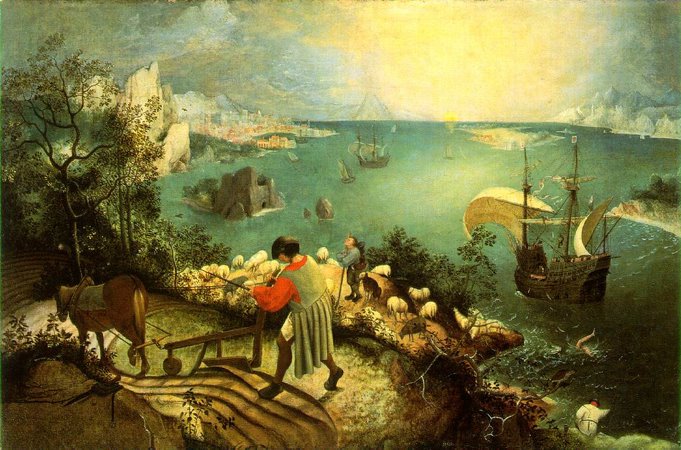
from Pictures from Brueghel
II Landscape with the Fall of Icarus
According to Brueghel
when Icarus fell
it was spring
a farmer was ploughing
his field
the whole pageantry
of the year was
awake tingling
with itself
sweating in the sun
that melted
the wings' wax
unsignificantly
off the coast
there was
a splash quite unnoticed
this was
Icarus drowning
William Carlos Williams 1965
will finish tomorrow (again... sorry!) Have a great night all!
Monday, August 15, 2005
Poem of the Week 8/15/2005: You Begin
You Begin
You begin this way:
this is your hand,
this is your eye,
this is a fish, blue and flat
on the paper, almost
the shape of an eye
This is your mouth, this is an O
or a moon, whichever
you like. This is yellow.
Outside the window
is the rain, green
because it is summer, and beyond that
the trees and then the world,
which is round and has only
the colors of these nine crayons.
This is the world, which is fuller
and more difficult to learn than I have said.
You are right to smudge it that way
with the red and then
the orange: the world burns.
Once you have learned these words
you will learn that there are more
words than you can ever learn.
The word hand floats above your hand
like a small cloud over a lake.
The word hand anchors
your hand to this table
your hand is a warm stone
I hold between two words.
This is your hand, these are my hands, this is the world,
which is round but not flat and has more colors
than we can see.
It begins, it has an end,
this is what you will
come back to, this is your hand.
Margaret Atwood 1978
"You Begin," one of my all time favorite poems, plays with language, feelings of childhood, nostalgia, and love, and the state of the world. Atwood gives the poem a rise and fall: the kind of circularity that makes me ache. That it is titled "You Begin" emphasizes hope, I think, which the inclusion of the child does as well. She builds to that point, and part of that building process serves to invest the reader in the poem. The "you" in the poem could be any "you," though it seems to be addressed to a child drawing on a page.
The first stanza is light and whimsical, with clear, direct statements. There is something about naming things that I love - identifying them against the backdrop of the world provides some surety that is comforting. We can see the narrator smiling when she notes that the drawn fish is, indeed, not a great illustration - "blue and flat - on the paper." But this is done lightly, and the speaker engages the child's imagination by providing "almost the shape of an eye." She does the same with the mouth - "an O / or a moon, whichever / you like." These lines give us early on the confusion between drawing and world, for the speaker connects the image of an open mouth with the drawn circle on the paper. She backs off with the next statement, "This is yellow.," though.
In the second stanza, the narrator seems to be entertained by this naming/imagining process. She leaves the paper and starts describing the world - the rain is "green / because it is summer, and beyond that / the trees and then the world." A sense of curiousity and sadness comes through in the lines "the world / which is round and has only / the colors of these nine crayons." It is as if the narrator is looking askance at this statement, conscious of an innocent way of looking at the world. Also, by now the repetition of the phrases "it is" and "this is" has become apparent. This sense of naming becomes more and more strange, and its declarativeness forces us into the present.
The narrator starts to realize the strangeness of this reductive way of describing the world, saying, "This is the world, which is fuller / and more difficult to learn than I have said." On the surface, we may read this as the fact that things inevitably become more complicated than our language can express. On a deeper level, it is an expression of smallness, I think, and a kind of helplessness in the face of the endless web of complexity and problems in the world: "the world burns." Indeed, the next lines reiterate this, for "Once you have learned these words, / you will learn that there are more /words than you can ever learn."
Here Atwood begins her discussion of language, my favorite part of the poem. Words position us within the world. They are labels, floating above things "like a small cloud over a lake." They triangulate us. Just as "the word hand anchors / your hand to this table," so words bring us into relation to one-another. They interact with objects; the narrator says "your hand is a warn stone / I hold between two words." Words hug us, surround us, connect us, define us. Humans are a relation of words.
A lot of recent theory wants to say that words are thin shells of the real things, that the word "hand" could never be so solid as my fingers that are typing this, or yours as they rest in your lap. But to call it (and every one like it) a hand brings our hands into relation, sitting as a signal for all of the hands in the world. Maybe the inexactitude theorists like Derrida see as an expression of meaningless is actually a freedom, an opportunity for the imagination to link hands. The thing is, words do mean something. If they didn't, we would be forever making sounds at one another and marks on pages that meant nothing.
Lines 30-32 take the narrator from words to the world. The naming process sketches the huge and complex world. Hm - there is a paradox here. Words bring us into relation in the particular, helping us understand and make sense of the world, but on a meta level, their open-endedness allows for intricacy.
The last stanza is a cry of love and finitude. Perhaps the unknownness of things does get to the speaker. Or perhaps she acknowledges it... perhaps she sees that meaning resides in the particular, in the individual. Though there seems to be an infinity of the world, this specific world has a beginning and an end, and finitude is what we come back to. Ultimately, importance rests in a single person, in one hand. If you think about it, any relation of something to anything else (a hand to the other hands in the world, this desk to the floor to the earth), starts with the thing. The center of a web of complexity is here, always in the finite, always in the particular...
Maybe that is why I like this poem so much - the idea the infinite rests in the particular, or at least that the particular gives us access to the infinite. My friend loves to say that language is a finite tool used for infinite means (I think he's quoting Noam Chomsky, or at least drawing from him), and this is what can make words so magical. They are paradoxical, constantly bringing us into relation with one-another, with the world, with ourselves, but those relations are endless. I love this poem for its circularity - it includes the entire realm of things in its hands (line 2 and line 35, the last line), it holds us like a warm stone between two words...
***** This is the original posting (with additions to my favorite poems. It is nice to have them listed, if for no other reason than to remind oneself of them)*******
This poem is my second repeat author (I told you to watch for Atwood), but I choose it now because it is one of my all time top five favorite poems in the world and it is my birthday. So I can do what I want for another hour and seven minutes! Hm! But I choose it for a birthday day because I believe that it is full of passion and hope and love: the kind of tenacious tenderness that exists only in the deepest bonds (and the greatest grief). The form is impeccable and the emotion exquisitely controlled. Its rhetorical complexity is astounding, not least thanks to its "economy of words" (a term one of my lit professors used to describe good poetry). I am exhausted now, but will close-read this poem for all of you tomorrow. There is so much going on that I want to give it the attention that it deserves. For now, I am going to settle into bed with my blanket and my 19 year old self and read my all time top five favorite poems. In case you are curious, here is a list in no particular order.
Wild Geese by Mary Oliver
Punishment by Seamus Heaney
You Begin by Margaret Atwood
Caedmon by Denise Levertov
Love Calls Us to the Things of This World by Richard Wilbur
The Illiterate by William Meredith
Sonnet 14 by John Donne
The Prelude by William Wordsworth (esp. parts of Book 13)
Sea of Faith by John Brehm
(additions since then):
The Rime of the Ancient Mariner by Samuel Taylor Coleridge
Kubla Khan by Coleridge
Mt. Blanc by Percy Bysshe Shelley
Ode to a Nightingale by John Keats
The Marriage of Heaven and Hell by William Blake
The Simple Truth by Philip Levine
Elegy for Jane by Theodore Roethke
Adam’s Dream by Edwin Muir
Okay, so that was more than five, but I started going and got all excited about the poems that I love. Incidentally, all have been PotWs, so you are free to look them up. Also, in order to make you all a special part of the Poem of the Week, and to remind you to read the poems, I am still going to email you every Monday with the poem text and a link to this blog. I hope that you are enjoying the new easier-to-read PotWs, and that you all have wonderful nights!
Love Sarah
You begin this way:
this is your hand,
this is your eye,
this is a fish, blue and flat
on the paper, almost
the shape of an eye
This is your mouth, this is an O
or a moon, whichever
you like. This is yellow.
Outside the window
is the rain, green
because it is summer, and beyond that
the trees and then the world,
which is round and has only
the colors of these nine crayons.
This is the world, which is fuller
and more difficult to learn than I have said.
You are right to smudge it that way
with the red and then
the orange: the world burns.
Once you have learned these words
you will learn that there are more
words than you can ever learn.
The word hand floats above your hand
like a small cloud over a lake.
The word hand anchors
your hand to this table
your hand is a warm stone
I hold between two words.
This is your hand, these are my hands, this is the world,
which is round but not flat and has more colors
than we can see.
It begins, it has an end,
this is what you will
come back to, this is your hand.
Margaret Atwood 1978
"You Begin," one of my all time favorite poems, plays with language, feelings of childhood, nostalgia, and love, and the state of the world. Atwood gives the poem a rise and fall: the kind of circularity that makes me ache. That it is titled "You Begin" emphasizes hope, I think, which the inclusion of the child does as well. She builds to that point, and part of that building process serves to invest the reader in the poem. The "you" in the poem could be any "you," though it seems to be addressed to a child drawing on a page.
The first stanza is light and whimsical, with clear, direct statements. There is something about naming things that I love - identifying them against the backdrop of the world provides some surety that is comforting. We can see the narrator smiling when she notes that the drawn fish is, indeed, not a great illustration - "blue and flat - on the paper." But this is done lightly, and the speaker engages the child's imagination by providing "almost the shape of an eye." She does the same with the mouth - "an O / or a moon, whichever / you like." These lines give us early on the confusion between drawing and world, for the speaker connects the image of an open mouth with the drawn circle on the paper. She backs off with the next statement, "This is yellow.," though.
In the second stanza, the narrator seems to be entertained by this naming/imagining process. She leaves the paper and starts describing the world - the rain is "green / because it is summer, and beyond that / the trees and then the world." A sense of curiousity and sadness comes through in the lines "the world / which is round and has only / the colors of these nine crayons." It is as if the narrator is looking askance at this statement, conscious of an innocent way of looking at the world. Also, by now the repetition of the phrases "it is" and "this is" has become apparent. This sense of naming becomes more and more strange, and its declarativeness forces us into the present.
The narrator starts to realize the strangeness of this reductive way of describing the world, saying, "This is the world, which is fuller / and more difficult to learn than I have said." On the surface, we may read this as the fact that things inevitably become more complicated than our language can express. On a deeper level, it is an expression of smallness, I think, and a kind of helplessness in the face of the endless web of complexity and problems in the world: "the world burns." Indeed, the next lines reiterate this, for "Once you have learned these words, / you will learn that there are more /words than you can ever learn."
Here Atwood begins her discussion of language, my favorite part of the poem. Words position us within the world. They are labels, floating above things "like a small cloud over a lake." They triangulate us. Just as "the word hand anchors / your hand to this table," so words bring us into relation to one-another. They interact with objects; the narrator says "your hand is a warn stone / I hold between two words." Words hug us, surround us, connect us, define us. Humans are a relation of words.
A lot of recent theory wants to say that words are thin shells of the real things, that the word "hand" could never be so solid as my fingers that are typing this, or yours as they rest in your lap. But to call it (and every one like it) a hand brings our hands into relation, sitting as a signal for all of the hands in the world. Maybe the inexactitude theorists like Derrida see as an expression of meaningless is actually a freedom, an opportunity for the imagination to link hands. The thing is, words do mean something. If they didn't, we would be forever making sounds at one another and marks on pages that meant nothing.
Lines 30-32 take the narrator from words to the world. The naming process sketches the huge and complex world. Hm - there is a paradox here. Words bring us into relation in the particular, helping us understand and make sense of the world, but on a meta level, their open-endedness allows for intricacy.
The last stanza is a cry of love and finitude. Perhaps the unknownness of things does get to the speaker. Or perhaps she acknowledges it... perhaps she sees that meaning resides in the particular, in the individual. Though there seems to be an infinity of the world, this specific world has a beginning and an end, and finitude is what we come back to. Ultimately, importance rests in a single person, in one hand. If you think about it, any relation of something to anything else (a hand to the other hands in the world, this desk to the floor to the earth), starts with the thing. The center of a web of complexity is here, always in the finite, always in the particular...
Maybe that is why I like this poem so much - the idea the infinite rests in the particular, or at least that the particular gives us access to the infinite. My friend loves to say that language is a finite tool used for infinite means (I think he's quoting Noam Chomsky, or at least drawing from him), and this is what can make words so magical. They are paradoxical, constantly bringing us into relation with one-another, with the world, with ourselves, but those relations are endless. I love this poem for its circularity - it includes the entire realm of things in its hands (line 2 and line 35, the last line), it holds us like a warm stone between two words...
***** This is the original posting (with additions to my favorite poems. It is nice to have them listed, if for no other reason than to remind oneself of them)*******
This poem is my second repeat author (I told you to watch for Atwood), but I choose it now because it is one of my all time top five favorite poems in the world and it is my birthday. So I can do what I want for another hour and seven minutes! Hm! But I choose it for a birthday day because I believe that it is full of passion and hope and love: the kind of tenacious tenderness that exists only in the deepest bonds (and the greatest grief). The form is impeccable and the emotion exquisitely controlled. Its rhetorical complexity is astounding, not least thanks to its "economy of words" (a term one of my lit professors used to describe good poetry). I am exhausted now, but will close-read this poem for all of you tomorrow. There is so much going on that I want to give it the attention that it deserves. For now, I am going to settle into bed with my blanket and my 19 year old self and read my all time top five favorite poems. In case you are curious, here is a list in no particular order.
Wild Geese by Mary Oliver
Punishment by Seamus Heaney
You Begin by Margaret Atwood
Caedmon by Denise Levertov
Love Calls Us to the Things of This World by Richard Wilbur
The Illiterate by William Meredith
Sonnet 14 by John Donne
The Prelude by William Wordsworth (esp. parts of Book 13)
Sea of Faith by John Brehm
(additions since then):
The Rime of the Ancient Mariner by Samuel Taylor Coleridge
Kubla Khan by Coleridge
Mt. Blanc by Percy Bysshe Shelley
Ode to a Nightingale by John Keats
The Marriage of Heaven and Hell by William Blake
The Simple Truth by Philip Levine
Elegy for Jane by Theodore Roethke
Adam’s Dream by Edwin Muir
Okay, so that was more than five, but I started going and got all excited about the poems that I love. Incidentally, all have been PotWs, so you are free to look them up. Also, in order to make you all a special part of the Poem of the Week, and to remind you to read the poems, I am still going to email you every Monday with the poem text and a link to this blog. I hope that you are enjoying the new easier-to-read PotWs, and that you all have wonderful nights!
Love Sarah
Monday, August 08, 2005
Poem of the Week 8/8/2005: Touch Me
Touch Me
Summer is late, my heart.
Words plucked out of the air
some forty years ago
when I was wild with love
and torn almost in two
scatter like leaves this night
of whistling wind and rain.
It is my heart that's late,
it is my song that's flown.
Outdoors all afternoon
under a gun-metal sky
staking my garden down,
I kneeled to the crickets trilling
underfoot as if about
to burst from their crusty shells;
and like a child again
marveled to hear so clear
and brave a music pour
from such a small machine.
What makes the engine go?
Desire, desire, desire.
The longing for the dance
stirs in the buried life.
One season only,
and it's done.
So let the battered old willow
thrash against the windowpanes
and the house timbers creak.
Darling, do you remember
the man you married? Touch me,
remind me who I am.
Stanley Kunitz 1990
Good evening lovely PotW contacts (I couldn't think of what else to call you)! A thought to begin: Stanley Kunitz was 85 when he wrote this poem; he was born in 1905. I think his age is crucial to understanding the poem, as it deals so directly with disintegration, age, and memory. Thinking of even a 60 year old man writing this alters the meaning a bit. And, again, I know I am mixing speaker and poet, but it at least provides a constant frame of reference. If you see the speaker's age (or even gender) differently, feel free to write back with your thoughts!
At any rate, Kunitz opens the text with two whole entities that crumble. "Summer," something clear and bright, begins the poem. However, he immedately disjoints this idea, telling us that it is late. The first line is also important because it nods towards the nostalgia that is present throughout this work. This is, I think, a love poem. It is perhaps a cry-out love poem, but Kunitz weaves the affection and desperation together throughout the work. Diction that includes "wild," "torn", "trilling," "my heart," "marveled," "brave," and "thrash" serves to heighten the passion and urgency of the call. Of course, the speaker's age may have something to do with this urgency.
"Touch Me"'s second image is that of a word being plucked, fruit-like, and then scattering in the wind. That established, lines 8 and 9 are key; Kunitz writes that "It is my heart that's late, / it is my heart that's flown." In other words, his heart, like a late summer, is something (potentially) ripe and bright and pure that has not come to fruit. His heart, too, is crumbling like chalk.
Just as the opening images of the poem are of loss/disintegration, the bulk of the poem is chock-full of death images. The sky is gun-colored, and he "stakes" his garden down as if it was going to escape somewhere. Furthermore, the poem's central metaphor, the garden crickets, typifies this cycle of destruction. Their presence within the poem, however, reveals somewhat more about the narrator's hopes and fears than do the other entropic elements. These crickets, the speaker notes, will certainly die soon. They have only one season to live (an observation perfectly aligned with the opening statement, "Summer is late, my heart."), and yet they trill away. They live thanks to a tri-pel-et chugging "desire, desire, desire." Evidently, Kunitz sees several imporant things about these crickets. Both their "crusty shells" and their short life span allow him to empathize with them; they are ephemeral shells, as is he. Secondly, they sing nonetheless. Their desire to live, to mate, to whatever, keeps them going.
For Kunitz, I think it's his desire for his wife's love, body, and soul. Or hers for him. Their shared desire. I love the howling quality of the final stanza - the wind and trees are beating at the windows, death is certainly out there, but he does not need to be a shell. He can be again if she will only touch him. Desire will anchor him to life and identity again, just as it did for the tiny unflappable crickets. Oh me I love this poem. It's quite beautiful. There are several ways to read the question "Darling do you remember / the man you married?". He could be assuming that she does, in which case the inquiry is a triumphant sound. On another note, it could be the tender wail of despair, born of he not knowing whether she *does* remember or not. Or maybe it's neither of those things - it's up to you to decide.
Before I go, I have a couple of notes. I wanted to mention something my dad told me about emotional memory that is part of the reason this poem is so explosive to me. He said that emotional memory has no sense of time, so if you get truly triggered, that's it! You're back exactly when you felt the first emotion, experiencing it again. This poem somehow makes me care for the speaker in very few words, because here, again, is a very real person. One who hurts and loves and fears... do any of you remember the "Flowers" by Wendy Cope edition of the PotW? I still believe that seeing someone's fears can make them empathetic. And this man seems so real and vulnerable. This love poem is tender because it fears death and entropy and old age and, most of all, a total loss of the speaker's desire for his wife.
And one more thing: I didn't mean to sound embittered and whiny in the last PotW - I was just feeling a little consumed after an extremely long night's work. Though I do like updating some of my friends/family who I haven't talked to in a long time about things. For now, I hope you enjoy the new blog format and I am done chatting your ears off. Thanks for reading, and Good Night!!!
Sarah
Summer is late, my heart.
Words plucked out of the air
some forty years ago
when I was wild with love
and torn almost in two
scatter like leaves this night
of whistling wind and rain.
It is my heart that's late,
it is my song that's flown.
Outdoors all afternoon
under a gun-metal sky
staking my garden down,
I kneeled to the crickets trilling
underfoot as if about
to burst from their crusty shells;
and like a child again
marveled to hear so clear
and brave a music pour
from such a small machine.
What makes the engine go?
Desire, desire, desire.
The longing for the dance
stirs in the buried life.
One season only,
and it's done.
So let the battered old willow
thrash against the windowpanes
and the house timbers creak.
Darling, do you remember
the man you married? Touch me,
remind me who I am.
Stanley Kunitz 1990
Good evening lovely PotW contacts (I couldn't think of what else to call you)! A thought to begin: Stanley Kunitz was 85 when he wrote this poem; he was born in 1905. I think his age is crucial to understanding the poem, as it deals so directly with disintegration, age, and memory. Thinking of even a 60 year old man writing this alters the meaning a bit. And, again, I know I am mixing speaker and poet, but it at least provides a constant frame of reference. If you see the speaker's age (or even gender) differently, feel free to write back with your thoughts!
At any rate, Kunitz opens the text with two whole entities that crumble. "Summer," something clear and bright, begins the poem. However, he immedately disjoints this idea, telling us that it is late. The first line is also important because it nods towards the nostalgia that is present throughout this work. This is, I think, a love poem. It is perhaps a cry-out love poem, but Kunitz weaves the affection and desperation together throughout the work. Diction that includes "wild," "torn", "trilling," "my heart," "marveled," "brave," and "thrash" serves to heighten the passion and urgency of the call. Of course, the speaker's age may have something to do with this urgency.
"Touch Me"'s second image is that of a word being plucked, fruit-like, and then scattering in the wind. That established, lines 8 and 9 are key; Kunitz writes that "It is my heart that's late, / it is my heart that's flown." In other words, his heart, like a late summer, is something (potentially) ripe and bright and pure that has not come to fruit. His heart, too, is crumbling like chalk.
Just as the opening images of the poem are of loss/disintegration, the bulk of the poem is chock-full of death images. The sky is gun-colored, and he "stakes" his garden down as if it was going to escape somewhere. Furthermore, the poem's central metaphor, the garden crickets, typifies this cycle of destruction. Their presence within the poem, however, reveals somewhat more about the narrator's hopes and fears than do the other entropic elements. These crickets, the speaker notes, will certainly die soon. They have only one season to live (an observation perfectly aligned with the opening statement, "Summer is late, my heart."), and yet they trill away. They live thanks to a tri-pel-et chugging "desire, desire, desire." Evidently, Kunitz sees several imporant things about these crickets. Both their "crusty shells" and their short life span allow him to empathize with them; they are ephemeral shells, as is he. Secondly, they sing nonetheless. Their desire to live, to mate, to whatever, keeps them going.
For Kunitz, I think it's his desire for his wife's love, body, and soul. Or hers for him. Their shared desire. I love the howling quality of the final stanza - the wind and trees are beating at the windows, death is certainly out there, but he does not need to be a shell. He can be again if she will only touch him. Desire will anchor him to life and identity again, just as it did for the tiny unflappable crickets. Oh me I love this poem. It's quite beautiful. There are several ways to read the question "Darling do you remember / the man you married?". He could be assuming that she does, in which case the inquiry is a triumphant sound. On another note, it could be the tender wail of despair, born of he not knowing whether she *does* remember or not. Or maybe it's neither of those things - it's up to you to decide.
Before I go, I have a couple of notes. I wanted to mention something my dad told me about emotional memory that is part of the reason this poem is so explosive to me. He said that emotional memory has no sense of time, so if you get truly triggered, that's it! You're back exactly when you felt the first emotion, experiencing it again. This poem somehow makes me care for the speaker in very few words, because here, again, is a very real person. One who hurts and loves and fears... do any of you remember the "Flowers" by Wendy Cope edition of the PotW? I still believe that seeing someone's fears can make them empathetic. And this man seems so real and vulnerable. This love poem is tender because it fears death and entropy and old age and, most of all, a total loss of the speaker's desire for his wife.
And one more thing: I didn't mean to sound embittered and whiny in the last PotW - I was just feeling a little consumed after an extremely long night's work. Though I do like updating some of my friends/family who I haven't talked to in a long time about things. For now, I hope you enjoy the new blog format and I am done chatting your ears off. Thanks for reading, and Good Night!!!
Sarah
Monday, August 01, 2005
Poem of the Week 8/1/2005: Kingfisher
Kingfisher
That kingfisher jewelling upstream
seems to leave a streak of itself
in the bright air. The trees
are all the better for its passing.
It's not a mineral eater, though it looks it.
It doesn't nip nicks out of the edges
of rainbows. - It dives
into the burly water, then, perched
on a Japanese bough, gulps
into its own incandescence
a wisp of minnow, a warrior stickleback.
- Or it vanishes into its burrow, resplendent
Samurai, returning home
to his stinking slum.
Norman MacCaig
Good Evening to my wonderful friends and family! How are you all? Had a pleasant night? I hope so! Mine was long and tiring, and I have to go right back to work bright and early tomorrow morning. This might seem like the worst time to launch into a Poem of the Week close-read, but it is, in fact, probably the best. There are things more refreshing than sleep for me, and reading poetry is one of them. Plus, if I don't do something like this after working so much, I begin to stop feeling... anything. Anything other than some form of bland resentment and mechanical movement. Sometimes I feel like all I do at work is move; it's purposeless. So reading a poem will be the best remedy for that. Plus, I miss the poem of the week!
I mention the pointless motion inherent server assistant-ing because it clarifies what "Kingfisher" does for me, and why. First and foremost, it rattles me. My job's mindlessness highlights the intensely original, vivid diction and imagery; who knew "jewel" was a verb? And what might it mean to jewel? Actually, "jewel" is a verb, but usually only for an actual jeweler. The kingfisher jewels by leaving "streak
[s] of itself," which implies that it is a jewel. Jeweling along could also be a pun on "tooling along." Just a thought. The following lines "The trees / are all the better for its passing" does several things. As an image, we can imagine that perhaps the flying bird has left strings of gems or even simply color across the forest. It also brings to light the lasting effect something truly beautiful can have. Sunsets, people, ruins, ocean, stars, kingfishers: these things stick with us. Perhaps beauty is over-rated, or can be, but why not let it be? I know that imagining a kingfisher nicking the edges of a rainbow enriches my life and my senses, so let's overrate it. Just for now.
Some people may not like the end of this poem; after the earth/air images preceding it, the thought of a "stinking slum" is not necessarily welcome. However, this may be MacCaig's way of grounding the beauty. Or perhaps his idea of true beauty is a grace and verve with a base, with a frame of reference. This isn't all he could be doing, however. Cynically, he could be trying to sour the entire poem, showing us that, in the end, beauty is a facade. It has no bearing on a life's core and distracts us from the way of things. And, alas, this can easily be true. But where would this poem be without the exquisite imagery? What I take from "Kingfisher" is that beauty is literally vital, but it requires some kind of ballast or reference point.
Thank you all for chugging along through my sentences (I know they get wordier as I get tireder), and I hope that you enjoyed the latest installment of the poem of the week! The next ones will certainly be actually on time.
Sarah
That kingfisher jewelling upstream
seems to leave a streak of itself
in the bright air. The trees
are all the better for its passing.
It's not a mineral eater, though it looks it.
It doesn't nip nicks out of the edges
of rainbows. - It dives
into the burly water, then, perched
on a Japanese bough, gulps
into its own incandescence
a wisp of minnow, a warrior stickleback.
- Or it vanishes into its burrow, resplendent
Samurai, returning home
to his stinking slum.
Norman MacCaig
Good Evening to my wonderful friends and family! How are you all? Had a pleasant night? I hope so! Mine was long and tiring, and I have to go right back to work bright and early tomorrow morning. This might seem like the worst time to launch into a Poem of the Week close-read, but it is, in fact, probably the best. There are things more refreshing than sleep for me, and reading poetry is one of them. Plus, if I don't do something like this after working so much, I begin to stop feeling... anything. Anything other than some form of bland resentment and mechanical movement. Sometimes I feel like all I do at work is move; it's purposeless. So reading a poem will be the best remedy for that. Plus, I miss the poem of the week!
I mention the pointless motion inherent server assistant-ing because it clarifies what "Kingfisher" does for me, and why. First and foremost, it rattles me. My job's mindlessness highlights the intensely original, vivid diction and imagery; who knew "jewel" was a verb? And what might it mean to jewel? Actually, "jewel" is a verb, but usually only for an actual jeweler. The kingfisher jewels by leaving "streak
[s] of itself," which implies that it is a jewel. Jeweling along could also be a pun on "tooling along." Just a thought. The following lines "The trees / are all the better for its passing" does several things. As an image, we can imagine that perhaps the flying bird has left strings of gems or even simply color across the forest. It also brings to light the lasting effect something truly beautiful can have. Sunsets, people, ruins, ocean, stars, kingfishers: these things stick with us. Perhaps beauty is over-rated, or can be, but why not let it be? I know that imagining a kingfisher nicking the edges of a rainbow enriches my life and my senses, so let's overrate it. Just for now.
Some people may not like the end of this poem; after the earth/air images preceding it, the thought of a "stinking slum" is not necessarily welcome. However, this may be MacCaig's way of grounding the beauty. Or perhaps his idea of true beauty is a grace and verve with a base, with a frame of reference. This isn't all he could be doing, however. Cynically, he could be trying to sour the entire poem, showing us that, in the end, beauty is a facade. It has no bearing on a life's core and distracts us from the way of things. And, alas, this can easily be true. But where would this poem be without the exquisite imagery? What I take from "Kingfisher" is that beauty is literally vital, but it requires some kind of ballast or reference point.
Thank you all for chugging along through my sentences (I know they get wordier as I get tireder), and I hope that you enjoyed the latest installment of the poem of the week! The next ones will certainly be actually on time.
Sarah
Poem of the Week 7/26/2005: Love-Letter Burning
Love-Letter-Burning
The archivist in us shudders at such cold-
blooded destruction of the word, but since
we're only human, we commit our sins
to the flames. Sauve qui peut: fear makes us bold.
Tanka was bolder: when the weather turned
from fair to frigid, he saw his way clear
to build a sacrificial fire
in which a priceless temple Buddha burned.
(The pretext? Simple: what he sought
was legendary Essence in the ask.
But if it shows up only in the flesh - ?
He grinned and said, Let's burn the lot!)
Believers in the afterlife perform
this purifying rite. At last
a match is struck: it's done. The past
will shed some light, but never keep us warm.
Daniel Hall 1990
**close-read coming soon!**
The archivist in us shudders at such cold-
blooded destruction of the word, but since
we're only human, we commit our sins
to the flames. Sauve qui peut: fear makes us bold.
Tanka was bolder: when the weather turned
from fair to frigid, he saw his way clear
to build a sacrificial fire
in which a priceless temple Buddha burned.
(The pretext? Simple: what he sought
was legendary Essence in the ask.
But if it shows up only in the flesh - ?
He grinned and said, Let's burn the lot!)
Believers in the afterlife perform
this purifying rite. At last
a match is struck: it's done. The past
will shed some light, but never keep us warm.
Daniel Hall 1990
**close-read coming soon!**
Monday, July 18, 2005
Poem of the Week 7/18/2005: The Pomegranate
The Pomegranate
The only legend I have ever loved is
the story of a daughter lost in hell.
And found and rescued there.
Love and blackmail are the gist of it.
Ceres and Persephone the names.
And the best thing about the legend is
I can enter it anywhere. And have.
As a child in exile in
a city of fogs and strange consonants,
I read it first and at first I was
an exiled child in the crackling dusk of
the underworld, the stars blighted. Later
I walked out in a summer twilight
searching for my daughter at bed-time.
When she came running I was ready
to make any bargain to keep her.
I carried her back past whitebeams
and wasps and honey-scented buddleias.
But I was Ceres then and I knew
winter was in store for every leaf
on every tree on that road.
Was inescapable for each one we passed.
And for me.
It is winter
and the stars are hidden.
I climb the stairs and stand where I can see
my child asleep beside her teen magazines,
her can of Coke, her plate of uncut fruit.
The pomegranate! How did I forget it?
She could have come home and been safe
and ended the story and all
our heart-broken searching but she reached
out a hand and plucked a pomegranate.
She put out her hand and pulled down
the French sound for apple and the noise of stone and the proof
that even in the place of death,
at the heart of legend, in the midst
of rocks full of unshed tears
ready to be diamonds by the time
the story was told, a child can be
hungry. I could warn her. There is still a chance.
The rain is cold. The road is flint-coloured.
The suburb has cars and cable television.
The veiled stars are above ground.
It is another world. But what else
can a mother give her daughter but such
beautiful rifts in time?
If I defer the grief I will diminish the gift.
The legend will be hers as well as mine. She will enter it. As I have.
She will wake up. She will hold
the papery flushed skin in her hand.
And to her lips. I will say nothing.
Eavan Boland 1994
Good evening Friends and Family! This is one of the first poems I read when I got my Norton Anthology of Poetry, and I loved it so much that I did a research project on Eavan Boland last semester. That means that I have some previous theories about Boland's work, and that this discussion will have some more biographical information than usual, but that does not in the least diminish this poem's power or beauty. I particularly love the last four lines, which are as full of tension and anguish as any lines I have ever read.
A bit of backstory on Boland will be helpful before I dive into this poem. Eavan Boland is a female Irish writer in the second half of the twentieth century. She grew up in England, where she felt as if she never had a country or nation as did the British. Boland deals with problems of representation and marginalization, both in being Irish and being an female Irish poet. Women Irish poets have been dreadfully under-represented in Irish literature for hundreds of years. With the help of such poets as Nuala ni Dhomhnaill (pronounced ni gau-na) and Boland, that trend is slowly changing, but the problem remains dire. An anthology called the Irish Literary Review appeared in 1992 that only incorporated two women poets in nearly one thousand pages of poetry. This fact incenses Boland, who contends that the Irish woman appears in Irish literature only as an emblem. She is either the sturdy washer-woman or the beloved, frail beauty. Boland sees that this (literal) subjugation of women cages real women. Boland is *very* aware of the problems of representation.
It may thus seem strange that she chooses the myth of Ceres and Persephone to illustrate a solution to this problem. After all, myth is perhaps the oldest form of written/aural representation that we have. She, however, states immeadately that this myth is useful because she "can enter it anywhere. And [has]". Boland is Persephone in her youth, learning that the world is not all springtime and flowers, experiencing winter in the form of a lonely English childhood. Throughout Boland's poetry, England appears as "a land of strange consonants," while Ireland is a land of vowels. Just in case you read more of her stuff. Ceres enters the picture when Boland inhabits her as a mother panicking over a lost daughter. Panicking, yes, but still aware that "winter was in store for every leaf... was inescapable for each one we passed/ And for me." In writing this, Boland demonstrates her acceptance that winter will come; despair and grief are inevitable. A character or person who can accept that something bad will happen actually creates room to live and to feel, something a female Irish emblem could never do.
The decision about whether to allow her daughter to eat the pomegranate, thus entering a world of pain and betrayal and fear, becomes the crux of the poem. All a parent wants is for her child to be happy and real, so it could be confusing that Boland chooses to say nothing. However, she would rightfully argue that a life lived in half-feeling, in total ignorance of the real world is worse than a life rife with sadness. Stagnancy is the worst feeling of all, so Boland keeps quiet. By speaking up, she would "defer the grief [and] diminish the gift." The gift is not only a life with a full emotional range, but the gift of being able to enter the myth. Boland keeps the myth itself alive by opening its doors to her daughter. Were she to warn "Persephone," she would have cut off the story's energy. It would simply become a dusty anecdote to be taken down and admired instead of a vivacious and relevant myth. Just as Boland does not want this for any person, so she does not want it for a story or form of representation.
I love many things about this poem, but what strikes me the most is how seamlessly Boland melds her story and that of the ancient myth. I distinctly remember being surprised when the pomegranate jumped out of the millennia-old story onto her daughter's plate. One minute everything was clear about who-was-who-when, and the next the tales got all mashed up. But I loved that - it brought both the poem and the Ceres/Persephone legend to life more powerfully than any storybook ever had or could. By living the story and then telling it honestly and painfully, Boland adds to our own emotional range. This is her goal, and it is one which I hope she will continue to puruse.
Sarah
The only legend I have ever loved is
the story of a daughter lost in hell.
And found and rescued there.
Love and blackmail are the gist of it.
Ceres and Persephone the names.
And the best thing about the legend is
I can enter it anywhere. And have.
As a child in exile in
a city of fogs and strange consonants,
I read it first and at first I was
an exiled child in the crackling dusk of
the underworld, the stars blighted. Later
I walked out in a summer twilight
searching for my daughter at bed-time.
When she came running I was ready
to make any bargain to keep her.
I carried her back past whitebeams
and wasps and honey-scented buddleias.
But I was Ceres then and I knew
winter was in store for every leaf
on every tree on that road.
Was inescapable for each one we passed.
And for me.
It is winter
and the stars are hidden.
I climb the stairs and stand where I can see
my child asleep beside her teen magazines,
her can of Coke, her plate of uncut fruit.
The pomegranate! How did I forget it?
She could have come home and been safe
and ended the story and all
our heart-broken searching but she reached
out a hand and plucked a pomegranate.
She put out her hand and pulled down
the French sound for apple and the noise of stone and the proof
that even in the place of death,
at the heart of legend, in the midst
of rocks full of unshed tears
ready to be diamonds by the time
the story was told, a child can be
hungry. I could warn her. There is still a chance.
The rain is cold. The road is flint-coloured.
The suburb has cars and cable television.
The veiled stars are above ground.
It is another world. But what else
can a mother give her daughter but such
beautiful rifts in time?
If I defer the grief I will diminish the gift.
The legend will be hers as well as mine. She will enter it. As I have.
She will wake up. She will hold
the papery flushed skin in her hand.
And to her lips. I will say nothing.
Eavan Boland 1994
Good evening Friends and Family! This is one of the first poems I read when I got my Norton Anthology of Poetry, and I loved it so much that I did a research project on Eavan Boland last semester. That means that I have some previous theories about Boland's work, and that this discussion will have some more biographical information than usual, but that does not in the least diminish this poem's power or beauty. I particularly love the last four lines, which are as full of tension and anguish as any lines I have ever read.
A bit of backstory on Boland will be helpful before I dive into this poem. Eavan Boland is a female Irish writer in the second half of the twentieth century. She grew up in England, where she felt as if she never had a country or nation as did the British. Boland deals with problems of representation and marginalization, both in being Irish and being an female Irish poet. Women Irish poets have been dreadfully under-represented in Irish literature for hundreds of years. With the help of such poets as Nuala ni Dhomhnaill (pronounced ni gau-na) and Boland, that trend is slowly changing, but the problem remains dire. An anthology called the Irish Literary Review appeared in 1992 that only incorporated two women poets in nearly one thousand pages of poetry. This fact incenses Boland, who contends that the Irish woman appears in Irish literature only as an emblem. She is either the sturdy washer-woman or the beloved, frail beauty. Boland sees that this (literal) subjugation of women cages real women. Boland is *very* aware of the problems of representation.
It may thus seem strange that she chooses the myth of Ceres and Persephone to illustrate a solution to this problem. After all, myth is perhaps the oldest form of written/aural representation that we have. She, however, states immeadately that this myth is useful because she "can enter it anywhere. And [has]". Boland is Persephone in her youth, learning that the world is not all springtime and flowers, experiencing winter in the form of a lonely English childhood. Throughout Boland's poetry, England appears as "a land of strange consonants," while Ireland is a land of vowels. Just in case you read more of her stuff. Ceres enters the picture when Boland inhabits her as a mother panicking over a lost daughter. Panicking, yes, but still aware that "winter was in store for every leaf... was inescapable for each one we passed/ And for me." In writing this, Boland demonstrates her acceptance that winter will come; despair and grief are inevitable. A character or person who can accept that something bad will happen actually creates room to live and to feel, something a female Irish emblem could never do.
The decision about whether to allow her daughter to eat the pomegranate, thus entering a world of pain and betrayal and fear, becomes the crux of the poem. All a parent wants is for her child to be happy and real, so it could be confusing that Boland chooses to say nothing. However, she would rightfully argue that a life lived in half-feeling, in total ignorance of the real world is worse than a life rife with sadness. Stagnancy is the worst feeling of all, so Boland keeps quiet. By speaking up, she would "defer the grief [and] diminish the gift." The gift is not only a life with a full emotional range, but the gift of being able to enter the myth. Boland keeps the myth itself alive by opening its doors to her daughter. Were she to warn "Persephone," she would have cut off the story's energy. It would simply become a dusty anecdote to be taken down and admired instead of a vivacious and relevant myth. Just as Boland does not want this for any person, so she does not want it for a story or form of representation.
I love many things about this poem, but what strikes me the most is how seamlessly Boland melds her story and that of the ancient myth. I distinctly remember being surprised when the pomegranate jumped out of the millennia-old story onto her daughter's plate. One minute everything was clear about who-was-who-when, and the next the tales got all mashed up. But I loved that - it brought both the poem and the Ceres/Persephone legend to life more powerfully than any storybook ever had or could. By living the story and then telling it honestly and painfully, Boland adds to our own emotional range. This is her goal, and it is one which I hope she will continue to puruse.
Sarah
Monday, July 11, 2005
Poem of the Week 7/11/2005: Punishment
Punishment*
I can feel the tug
of the halter at the nape
of her neck, the wind
on her naked front.
It blows her nipples
to amber beads,
it shakes the frail rigging
of her ribs.
I can see her drowned
body in the bog,
the weighing stone,
the floating rods and boughs.
Under which at first
she was a barked sapling
that is dug up
oak-bone, brain-firkin:* *small cask
her shaved head
like a stubble of black corn,
her blindfold a soiled bandage,
her noose a ring
to store
the memories of love.
Little adultress,
before they punished you
you were flaxen-haired,
undernourished, and your
tar-black face was beautiful.
My poor scapegoat,
I almost love you
but would have cast, I know,
the stones of silence.
I am the artful voyeur
of your brain's exposed
and darkened combs,
your muscles' webbing
and all your numbered bones:
I who have stood dumb
when your betraying sisters,
cauled in tar,**
wept by the railings,
who would connive
in civilized outrage
yet understand the exact
and tribal, intimate revenge.
Seamus Heaney 1975
* In 1951, the peat-stained body of a young girl who lived in the late first century was recovered from a bog in Windeby, Germany. As P.V. Glob describes her in "The Bog People" (a 1969 book), she "lat naked in the hole in the peat, a bandage over the eyes and a collar round the neck. The band across the eyes was drawn tight and had cut into the neck and the bast of the nose. We may feel sure that it had been used to close her eyees to this world. There was no mark of strangulation on the neck, so it had not been used for that purpose." Her hair "had been shaved off with a razor on the left side of the head.... When the brain was removed the convolutions and folds of the surface could be clearly seen [Glob reproduces a photograph of her brain].... This girl of only fourteen had had an inadequate winter diet.... To keep the young body under, some birch branches and a big stone were laid upon her." According to the Roman historian Tacitus (ca. 56-ca.120), the Germanic peoples punished adulterous women by shaving off their hair and then scourging them out of the village or killing them. IN more recent times, her "betraying sisters" (line 38) have sometimes been shaved, stripped, tarred, and handcuffed by the Irish Republican Army to the railings of Belfast in punishment for keeping company with British soldiers.
**Wrapped or enclosed. A caul is the inner fetal membrane that at birth, when it is unruptured, sometimes covers the infant's head.
Well, I gave everyone a nice, bright poem for the middle of summer....haaaaa... I hope that is alright. However, this is one of my all-time favorite poems by a Nobel Prize winner, Seamus Heaney. As the extremely long footnote indicates, this poem concerns one of the Bog People - thousand plus year old mummies excavated from (and often executed in) the bogs of Europe. My Longman Anthology of British Literature notes, of Heaney, that he found a metaphor for life and suffering in these people. Here are two websites about that - the second is admittedly more gruesome but a much clearer picture... I bet that whoever reads this will go to the site, unable to look away from the train wreck.
http://www.bogpeople.org
http://www.tornadohills.com/strange/bog_people.htm
That written, I have a confession to make. Heaney is a repeat author, and my first. Until now, I have tried to provide a different poet every week, so this is my first slip-up. I was close to breaking it with Margaret Atwood today, but you all, at least, have not read my Heaney poem as of yet. He was the third Poem of the Week ever, so did not fly out over the internet. "The Otter" was a printed poem, cut out and pasted on black construction paper, then taped to my dorm room door. I highly recommend it... I may send out those old PotW's sometime soon, because they are also some of my all-time favorite poems. So anyway. Expect repeats also by Margaret Atwood and ee cummings.
I picked Heaney (again) today because I wanted to do something great and comfortable for me. That is not to say that there aren't great poets I haven't covered yet (i.e. Keats, Milton, Poe, Browning, Tennyson, Petrarch, Coleridge, Pope, Blake, Pound, Eliot, St. Vincent Millay, Shakespeare!!!), but I love this poem. Ahhh seeing that list is making me rethink picking Heaney, but hey. I typed all of this already. So now I am finished filling your minds with prattle about my own personal battle.
What I love about this poem the most is its empathy, the presence of the narrator, the guilt, the tenderness, and the imagery. Thinking about it now, tenderness is probably one of the two most important components of this poem. This is indeed surprising, as the title itself is Punishment, and the body includes several gruesome ideas. A starving fourteen-year girl killed for adultery is not exactly tender. So the question is, why does it leave one with a deep feeling of tenderness?
The imagery and diction have a huge part to do with this. Heaney uses unusual images that basically allay the violence. He calls her ribs a "frail rigging" rather than a "bony cage" or something gorier. We get the idea that this is a tiny body, something delicate that requires a delicate image, lest it might break. This occurs even in the first line, when he writes, "I can feel the tug / of the halter at the nape / of her neck." Everything here is not as severe as it could be - the rope is a halter instead of a noose and it tugs, not pulls, on the very intimate, soft nape of her neck. We then learn that she is naked on her front, which is a very vulnerable state. He goes on to include the frail rigging line, which, with the other parts, directly establishes this girl's fragility. It's not just fragility, though, but the delicacy of a sleeping child. For me, the feeling is exactly what I feel when I think of my parents' childhoods or my (full) younger sister's. It's a complicated emotion - love, grief, joy and sadness kind of jumbled up together. If that makes any sense at all, which it very well may not.
The narrator certainly encourages this compassionate view, calling the girl "little," "poor," "barked sapling," "undernourished," and "beautiful." He again allays the violence by saying that he can see "the weighing stone"; this gives us merely the idea of pressure rather than direct violence. Heaney eventually employs apostrophe, addressing the girl directly. After calling her "my poor scapegoat," he seamlessly transitions to the second major piece of this poem: guilt.
The narrator (who I am mixing with Heaney: see my usual explanation for this) recognizes the connection between this two thousand year old tarred adultress and the women tarred and handcuffed to railings. And the sweet way he sees the bog girl allows him to find empathy for the modern women and feel guilty for his silence. He speaks as if he himself tortured these women, casting "stones of silence" and being an "artful voyeur." Then the question arises about whether part of his tender portrait of the girl is to assuage his guilt, or whether his almost-love for her comes from her fragility. Probably a little of both.
At any rate, I think that this poem is a step away from the artful voyeurism, because, in writing it, Heaney is literally no longer a voyeur. A voyeur simply watches, but this man *tells* the story. This point is important, as it reedems the narrator a bit. I recognise his courage in addressing the bog girl and in writing of his own silence. That is what I was talking about far above when I wrote that I like the presence of the narrator. This is a complex, flawed human being admitting something sad about himself and yet trying to reedem it. Perhaps another reason that he writes so sympathetically of this girl is that he feels a connection with her. That is, maybe he wants to treat her the way he wants to be treated. That statement could be a stretch, but maybe not as well. It's up to you.
Then of course there is the idea of revenge and how our society is simply repeating the primitve impulses to throw people into bogs (though we have apparently progressed to throwing bits of bog onto people). In other words, to punish. Perhaps writing the poem is a bit of a punishment for the narrator (or at least a penance) for staying silent about the girl's "betraying sisters." Anyway - we are rapidly approaching midnight in Boulder, CO, so I had better send this off! I hope that you enjoyed this poem as much as I did, and, of course, I welcome any responses. Have a wonderful night!
Sarah
I can feel the tug
of the halter at the nape
of her neck, the wind
on her naked front.
It blows her nipples
to amber beads,
it shakes the frail rigging
of her ribs.
I can see her drowned
body in the bog,
the weighing stone,
the floating rods and boughs.
Under which at first
she was a barked sapling
that is dug up
oak-bone, brain-firkin:* *small cask
her shaved head
like a stubble of black corn,
her blindfold a soiled bandage,
her noose a ring
to store
the memories of love.
Little adultress,
before they punished you
you were flaxen-haired,
undernourished, and your
tar-black face was beautiful.
My poor scapegoat,
I almost love you
but would have cast, I know,
the stones of silence.
I am the artful voyeur
of your brain's exposed
and darkened combs,
your muscles' webbing
and all your numbered bones:
I who have stood dumb
when your betraying sisters,
cauled in tar,**
wept by the railings,
who would connive
in civilized outrage
yet understand the exact
and tribal, intimate revenge.
Seamus Heaney 1975
* In 1951, the peat-stained body of a young girl who lived in the late first century was recovered from a bog in Windeby, Germany. As P.V. Glob describes her in "The Bog People" (a 1969 book), she "lat naked in the hole in the peat, a bandage over the eyes and a collar round the neck. The band across the eyes was drawn tight and had cut into the neck and the bast of the nose. We may feel sure that it had been used to close her eyees to this world. There was no mark of strangulation on the neck, so it had not been used for that purpose." Her hair "had been shaved off with a razor on the left side of the head.... When the brain was removed the convolutions and folds of the surface could be clearly seen [Glob reproduces a photograph of her brain].... This girl of only fourteen had had an inadequate winter diet.... To keep the young body under, some birch branches and a big stone were laid upon her." According to the Roman historian Tacitus (ca. 56-ca.120), the Germanic peoples punished adulterous women by shaving off their hair and then scourging them out of the village or killing them. IN more recent times, her "betraying sisters" (line 38) have sometimes been shaved, stripped, tarred, and handcuffed by the Irish Republican Army to the railings of Belfast in punishment for keeping company with British soldiers.
**Wrapped or enclosed. A caul is the inner fetal membrane that at birth, when it is unruptured, sometimes covers the infant's head.
Well, I gave everyone a nice, bright poem for the middle of summer....haaaaa... I hope that is alright. However, this is one of my all-time favorite poems by a Nobel Prize winner, Seamus Heaney. As the extremely long footnote indicates, this poem concerns one of the Bog People - thousand plus year old mummies excavated from (and often executed in) the bogs of Europe. My Longman Anthology of British Literature notes, of Heaney, that he found a metaphor for life and suffering in these people. Here are two websites about that - the second is admittedly more gruesome but a much clearer picture... I bet that whoever reads this will go to the site, unable to look away from the train wreck.
http://www.bogpeople.org
http://www.tornadohills.com/strange/bog_people.htm
That written, I have a confession to make. Heaney is a repeat author, and my first. Until now, I have tried to provide a different poet every week, so this is my first slip-up. I was close to breaking it with Margaret Atwood today, but you all, at least, have not read my Heaney poem as of yet. He was the third Poem of the Week ever, so did not fly out over the internet. "The Otter" was a printed poem, cut out and pasted on black construction paper, then taped to my dorm room door. I highly recommend it... I may send out those old PotW's sometime soon, because they are also some of my all-time favorite poems. So anyway. Expect repeats also by Margaret Atwood and ee cummings.
I picked Heaney (again) today because I wanted to do something great and comfortable for me. That is not to say that there aren't great poets I haven't covered yet (i.e. Keats, Milton, Poe, Browning, Tennyson, Petrarch, Coleridge, Pope, Blake, Pound, Eliot, St. Vincent Millay, Shakespeare!!!), but I love this poem. Ahhh seeing that list is making me rethink picking Heaney, but hey. I typed all of this already. So now I am finished filling your minds with prattle about my own personal battle.
What I love about this poem the most is its empathy, the presence of the narrator, the guilt, the tenderness, and the imagery. Thinking about it now, tenderness is probably one of the two most important components of this poem. This is indeed surprising, as the title itself is Punishment, and the body includes several gruesome ideas. A starving fourteen-year girl killed for adultery is not exactly tender. So the question is, why does it leave one with a deep feeling of tenderness?
The imagery and diction have a huge part to do with this. Heaney uses unusual images that basically allay the violence. He calls her ribs a "frail rigging" rather than a "bony cage" or something gorier. We get the idea that this is a tiny body, something delicate that requires a delicate image, lest it might break. This occurs even in the first line, when he writes, "I can feel the tug / of the halter at the nape / of her neck." Everything here is not as severe as it could be - the rope is a halter instead of a noose and it tugs, not pulls, on the very intimate, soft nape of her neck. We then learn that she is naked on her front, which is a very vulnerable state. He goes on to include the frail rigging line, which, with the other parts, directly establishes this girl's fragility. It's not just fragility, though, but the delicacy of a sleeping child. For me, the feeling is exactly what I feel when I think of my parents' childhoods or my (full) younger sister's. It's a complicated emotion - love, grief, joy and sadness kind of jumbled up together. If that makes any sense at all, which it very well may not.
The narrator certainly encourages this compassionate view, calling the girl "little," "poor," "barked sapling," "undernourished," and "beautiful." He again allays the violence by saying that he can see "the weighing stone"; this gives us merely the idea of pressure rather than direct violence. Heaney eventually employs apostrophe, addressing the girl directly. After calling her "my poor scapegoat," he seamlessly transitions to the second major piece of this poem: guilt.
The narrator (who I am mixing with Heaney: see my usual explanation for this) recognizes the connection between this two thousand year old tarred adultress and the women tarred and handcuffed to railings. And the sweet way he sees the bog girl allows him to find empathy for the modern women and feel guilty for his silence. He speaks as if he himself tortured these women, casting "stones of silence" and being an "artful voyeur." Then the question arises about whether part of his tender portrait of the girl is to assuage his guilt, or whether his almost-love for her comes from her fragility. Probably a little of both.
At any rate, I think that this poem is a step away from the artful voyeurism, because, in writing it, Heaney is literally no longer a voyeur. A voyeur simply watches, but this man *tells* the story. This point is important, as it reedems the narrator a bit. I recognise his courage in addressing the bog girl and in writing of his own silence. That is what I was talking about far above when I wrote that I like the presence of the narrator. This is a complex, flawed human being admitting something sad about himself and yet trying to reedem it. Perhaps another reason that he writes so sympathetically of this girl is that he feels a connection with her. That is, maybe he wants to treat her the way he wants to be treated. That statement could be a stretch, but maybe not as well. It's up to you.
Then of course there is the idea of revenge and how our society is simply repeating the primitve impulses to throw people into bogs (though we have apparently progressed to throwing bits of bog onto people). In other words, to punish. Perhaps writing the poem is a bit of a punishment for the narrator (or at least a penance) for staying silent about the girl's "betraying sisters." Anyway - we are rapidly approaching midnight in Boulder, CO, so I had better send this off! I hope that you enjoyed this poem as much as I did, and, of course, I welcome any responses. Have a wonderful night!
Sarah
Monday, July 04, 2005
Poem of the Week 7/4/2005: Star-gazer
Star-gazer
Forty-two years ago (to me if to no one else
The number is of some interest) it was a brilliant starry night
And the westward train was empty and had no corridors
So darting from side to side I could catch the unwonted sight
Of those almost intolerably bright
Holes, punched in the sky, which excited me partly because
Of their Latin names and partly because I had read in the textbooks
How very far off they were, it seemed their light
Had left them (some at least) long years before I was.
And this remembering now I mark that what
Light was leaving some of them at least then,
Forty-two years ago, will never arrive
In time for me to catch it, which light when
It does get here may find that there is not
Anyone left alive
To run from side to side in a late night train
Admiring it and adding noughts in vain.
Louis MacNeice 1967
Happy Fourth of July friends and family! I could have chosen a grumpy political poem for this week, but I think that I am going to follow my MLK Jr. day track and add positive thoughts to a national holiday. It is important to know for this poem that MacNeice was born in 1907, so he was eighteen "forty two years ago". It's another celestial poem for me...surprise. There is a lot I could say about this poem, but I want to say how much this poem is resonating with me right now. It distills the excitement and openness of a fresh adulthood without losing sight of its ephemerality. I find it interesting how there are two consciousnesses at work here; that of the young eighteen year old and that of the sixty year old looking back. So I enjoyed seeing myself from that space. The night tonight was completely dark and beautiful, and I wanted to find a poem that felt the same way. Some things to notice: ephermality vs. infinity, unintrusive rhyme, the visual form, the somewhat unsual diction, parentheses, repetition, and the character of MacNeice (who is almost certainly the narrator.) I would keep writing if I was more awake. So I am going to go enjoy the night in a different way: by sleeping. Goodnight!
Love,
Sarah
Forty-two years ago (to me if to no one else
The number is of some interest) it was a brilliant starry night
And the westward train was empty and had no corridors
So darting from side to side I could catch the unwonted sight
Of those almost intolerably bright
Holes, punched in the sky, which excited me partly because
Of their Latin names and partly because I had read in the textbooks
How very far off they were, it seemed their light
Had left them (some at least) long years before I was.
And this remembering now I mark that what
Light was leaving some of them at least then,
Forty-two years ago, will never arrive
In time for me to catch it, which light when
It does get here may find that there is not
Anyone left alive
To run from side to side in a late night train
Admiring it and adding noughts in vain.
Louis MacNeice 1967
Happy Fourth of July friends and family! I could have chosen a grumpy political poem for this week, but I think that I am going to follow my MLK Jr. day track and add positive thoughts to a national holiday. It is important to know for this poem that MacNeice was born in 1907, so he was eighteen "forty two years ago". It's another celestial poem for me...surprise. There is a lot I could say about this poem, but I want to say how much this poem is resonating with me right now. It distills the excitement and openness of a fresh adulthood without losing sight of its ephemerality. I find it interesting how there are two consciousnesses at work here; that of the young eighteen year old and that of the sixty year old looking back. So I enjoyed seeing myself from that space. The night tonight was completely dark and beautiful, and I wanted to find a poem that felt the same way. Some things to notice: ephermality vs. infinity, unintrusive rhyme, the visual form, the somewhat unsual diction, parentheses, repetition, and the character of MacNeice (who is almost certainly the narrator.) I would keep writing if I was more awake. So I am going to go enjoy the night in a different way: by sleeping. Goodnight!
Love,
Sarah
Sunday, June 26, 2005
Poem of the Week 6/26/2005: Centaur
Centaur
The first typeface I loved
was Centaur, cut by Bruce Rogers
in 1914. It had animal bones,
and reminded me of skinny-dipping at night,
baptized in star water so cold
I suddenly became another
animal from the waist down.
In our family, we knew all about the Minotaur,
Cyclops, and centaurs.
My father read to me about the man-horses,
so I had an inkling
of their danger,
and thereafter leaned toward the horse part
and away from the man.
Chase Twichell 2005
Hallo darling friends and family! Another Monday is come and almost gone, so with it I give you this Poem of the Week. I read this poem sitting in Borders with one of my friends, and I went back to copy it out of the Kenyon Review because I loved it so much. What originally caught my eye was the line "star water," and I later realized that my favorite imagery synthesizes the everyday with the cosmic (does anybody remember Dufault's fountain of planets? Beautiful!). Not exactly relevant to the poem I guess, but isn't it exciting to discover something about yourself? I always find so; even the trivial things are invigorating. It's the same with learning things about other people. And I think that I like the small details almost more than the big ones, because people often ignore the small details. One can always overkill on this, of course, but that doesn't make the details irrelevant. Oh look at me chatting away when there is a poem to work on! Though this tangent does remind one of poetry's personal nature. The Poem of the Week (and all poetry I guess) is a very intimate part of me, so to cut that out of my close readings would starve the analysis.
Just a little justification.
Perhaps it is and perhaps it is not coincidental to note that the poem is also distinctly personal. The title, "Centaur," connotes something quite special for this speaker; I for one did not expect it to be a typeface. Also, Twichell (who is, by the way, a woman) writes later that her family knew about centaurs, but the poem is only about one. This centaur is probably the typeface or the speaker herself. But, then, we ask, what is a centaur? Or, more precisely, what does it mean to be a centaur for Twichell? It is clearly more than a typeface; this small, personalizing detail sserves more as a springboard into the true metaphor. I find it interesting that she chooses typeface, which is really a way of writing, as the opening image, for it's like a second layer of words. We have the visual words on the page, and then we have a means for constructing words within those lines. Just as a poem shakes itself into being when read, this poem's central metaphor clip clops out of that typeface when recollected.
She feels like a centaur because the water agitates her lower-body nerves just so. Twichell seems to say, then, that a strong, seizing physical sensation like skinny dipping can turn us into animals. Or perhaps it simply reminds us of our animal bodies, exposing the animal by peeling away the cerebral layers. Some of you may have noticed that she is animal from "waist down." This connotes sexuality, of course, though Twichell does not follow on this track. I think that the idea of being part animal means, both here and in life, that humans have an instinctual, powerful, noble side along with our delicate hands and quick brains. Simple, but easy to forget.
Twichell, having established the metaphor, leaves it for a moment, giving us more personal history. She provides the Minotaur and the Cyclops as other mythical beasts. I enjoyed imagining her family life as these two partial-humans. Instead of saying that "In our family, we knew / all about the Minotaur, / [and] Cyclops," she could have said, "my family was familiar with bull-headedness and short-
sightnedness." It could also mean that her family was well-read and connected with the past, but I like the more personal response.
Near the end of the poem, the speaker talks of centaurs' apparently inherent danger. Because she chooses to stick with the animal over the man, it seems that she believes this danger comes from man. This part of the poem invites us to think whatever we want about the dangers of man and the positive aspects of an animal. For me, the greatest peril of being a man (against which there is advantage in being animal) is our cerebrality; we forget to simply feel sometimes for one reason or another. Work is tiring, kids are draining, we don't laugh anymore... we fear feeling. That is something to which a horse would not be sensitive in my imagination. It is all about freedom from fear and societal constructs and binary opposites. Of course, there are any number of ways to look at the danger idea - man could be dangerous because his heart can break. Perhaps it is safer to be an animal and procreate without feeling. That interpretation calls back the sexuality in line 8. Man's danger could come from being so destructive. It struck me a little bit ago that animal could also be a metonym for nature, so the poem could be an ecological statement. The dangers of being a centaur could actually have to do with the tension between man and animal, too. Perhaps they are not reconciliable, so one has to choose? Maybe that is the tragedy.
I wrote at the beginning of this poem, "perhaps it is and perhaps it is not coincidental that this poem is very personal." I mean that it isn't a coincidence that I am going off on personal tangents for this particular poem. A personal poem evokes personal responses, and I hope that you think about what is human and animal and neither in yourself. I hope that you can respond personally to this poem by thinking about it - that is how to interact with literature and possibly learn something about yourself along the way. Sometimes articulating something is better than just knowing it; that is what poetry can do for me. It has a way of forcing me to pinpoint and spell out whatever I am feeling.
On a final note, I know that I mixed up the speaker and Chase Twichell time and again here, but it helps me to think of a poem's speaker as the author most of the time. There are of course countless poems wherein it is obvious that the speaker and author are separate, but I believe that this is not one of them. I don't know enough about the different schools of poetry yet to sort out the Confessional poets. With time, with time. For this time, I hope that you enjoyed this poem and good night!
Sarah
The first typeface I loved
was Centaur, cut by Bruce Rogers
in 1914. It had animal bones,
and reminded me of skinny-dipping at night,
baptized in star water so cold
I suddenly became another
animal from the waist down.
In our family, we knew all about the Minotaur,
Cyclops, and centaurs.
My father read to me about the man-horses,
so I had an inkling
of their danger,
and thereafter leaned toward the horse part
and away from the man.
Chase Twichell 2005
Hallo darling friends and family! Another Monday is come and almost gone, so with it I give you this Poem of the Week. I read this poem sitting in Borders with one of my friends, and I went back to copy it out of the Kenyon Review because I loved it so much. What originally caught my eye was the line "star water," and I later realized that my favorite imagery synthesizes the everyday with the cosmic (does anybody remember Dufault's fountain of planets? Beautiful!). Not exactly relevant to the poem I guess, but isn't it exciting to discover something about yourself? I always find so; even the trivial things are invigorating. It's the same with learning things about other people. And I think that I like the small details almost more than the big ones, because people often ignore the small details. One can always overkill on this, of course, but that doesn't make the details irrelevant. Oh look at me chatting away when there is a poem to work on! Though this tangent does remind one of poetry's personal nature. The Poem of the Week (and all poetry I guess) is a very intimate part of me, so to cut that out of my close readings would starve the analysis.
Just a little justification.
Perhaps it is and perhaps it is not coincidental to note that the poem is also distinctly personal. The title, "Centaur," connotes something quite special for this speaker; I for one did not expect it to be a typeface. Also, Twichell (who is, by the way, a woman) writes later that her family knew about centaurs, but the poem is only about one. This centaur is probably the typeface or the speaker herself. But, then, we ask, what is a centaur? Or, more precisely, what does it mean to be a centaur for Twichell? It is clearly more than a typeface; this small, personalizing detail sserves more as a springboard into the true metaphor. I find it interesting that she chooses typeface, which is really a way of writing, as the opening image, for it's like a second layer of words. We have the visual words on the page, and then we have a means for constructing words within those lines. Just as a poem shakes itself into being when read, this poem's central metaphor clip clops out of that typeface when recollected.
She feels like a centaur because the water agitates her lower-body nerves just so. Twichell seems to say, then, that a strong, seizing physical sensation like skinny dipping can turn us into animals. Or perhaps it simply reminds us of our animal bodies, exposing the animal by peeling away the cerebral layers. Some of you may have noticed that she is animal from "waist down." This connotes sexuality, of course, though Twichell does not follow on this track. I think that the idea of being part animal means, both here and in life, that humans have an instinctual, powerful, noble side along with our delicate hands and quick brains. Simple, but easy to forget.
Twichell, having established the metaphor, leaves it for a moment, giving us more personal history. She provides the Minotaur and the Cyclops as other mythical beasts. I enjoyed imagining her family life as these two partial-humans. Instead of saying that "In our family, we knew / all about the Minotaur, / [and] Cyclops," she could have said, "my family was familiar with bull-headedness and short-
sightnedness." It could also mean that her family was well-read and connected with the past, but I like the more personal response.
Near the end of the poem, the speaker talks of centaurs' apparently inherent danger. Because she chooses to stick with the animal over the man, it seems that she believes this danger comes from man. This part of the poem invites us to think whatever we want about the dangers of man and the positive aspects of an animal. For me, the greatest peril of being a man (against which there is advantage in being animal) is our cerebrality; we forget to simply feel sometimes for one reason or another. Work is tiring, kids are draining, we don't laugh anymore... we fear feeling. That is something to which a horse would not be sensitive in my imagination. It is all about freedom from fear and societal constructs and binary opposites. Of course, there are any number of ways to look at the danger idea - man could be dangerous because his heart can break. Perhaps it is safer to be an animal and procreate without feeling. That interpretation calls back the sexuality in line 8. Man's danger could come from being so destructive. It struck me a little bit ago that animal could also be a metonym for nature, so the poem could be an ecological statement. The dangers of being a centaur could actually have to do with the tension between man and animal, too. Perhaps they are not reconciliable, so one has to choose? Maybe that is the tragedy.
I wrote at the beginning of this poem, "perhaps it is and perhaps it is not coincidental that this poem is very personal." I mean that it isn't a coincidence that I am going off on personal tangents for this particular poem. A personal poem evokes personal responses, and I hope that you think about what is human and animal and neither in yourself. I hope that you can respond personally to this poem by thinking about it - that is how to interact with literature and possibly learn something about yourself along the way. Sometimes articulating something is better than just knowing it; that is what poetry can do for me. It has a way of forcing me to pinpoint and spell out whatever I am feeling.
On a final note, I know that I mixed up the speaker and Chase Twichell time and again here, but it helps me to think of a poem's speaker as the author most of the time. There are of course countless poems wherein it is obvious that the speaker and author are separate, but I believe that this is not one of them. I don't know enough about the different schools of poetry yet to sort out the Confessional poets. With time, with time. For this time, I hope that you enjoyed this poem and good night!
Sarah
Monday, June 20, 2005
Poem of the Week 6/20/2005: Night Feeding
Night Feeding
Deeper than sleep but not so deep as death
I lay there sleeping and my magic head
remembered and forgot. On first cry I
remembered and forgot and did believe.
I knew love and I knew evil:
woke to the burning song and the tree burning blind,
despair of our days and the calm milk-giver who
knows sleep, knows growth, the sex of fire and grass,
and the black snake with gold bones.
Black sleeps, gold burns; on second cry I woke
fully and gave to feed and fed on feeding.
Gold seed, green pain, my wizards in the earth
walked through the house, black in the morning dark.
Shadows grew in my veins, my bright belief,
my head of dreams deeper than night and sleep.
Voices of all black animals crying to drink, cries of all birth arise, simple as we,
found in the leaves, in clouds and dark, in dream,
deep as this hour, ready again to sleep.
Muriel Rukeyser 1951
Hello friends and family! I read this poem among the dying embers of a spectacular sunset, the latest in a series of great, sky-covering sunsets gracing Boulder's skies of late, so I simply paid attention to this poem's imagery and feel rather than its message. Otherwise, I might have chosen an easier one. Alas it will have to be incomplete. This, O best beloved, is quite a complicated poem (who caught the Rudyard Kipling nod?). I have read it at least five times and it is only now beginning to take its shape for me. As in some of the old school PotWs, I think that I am just going to point out some things I have noticed in this poem. As in James Joyce's Ulysses, the poem's tangible action is simple, even boring. A baby wakes a dreaming woman who feeds him and goes back to bed, "ready again to sleep." Rukeyser does not make things this easy for us, though. The difficult and perhaps most brilliant thing about "Night Feeding" is that it reads like a dream. The images cycle and recycle, never settling on a pattern or meaning. It is as if the broken ideas are what matters rather than the poem's universe, for the different ideas and images seem to dance around the real ones. What these real ones are, we have to imagine for ourselves. We do see that love, evil, gold, black, snake, sleep/deep, and (fantastically) dream itself shuffle about. Black sleeps, black is a snake, and animals are black within the poem. In the same way, gold burns, is bones and is a seed. Rukeyser plays with "black" and "snake" implicitly, as sleep, death and even deep often connote darkness or black. Then, too, the poem (and the speaker's consciousness) seem almost like a snake ingesting its tail. The end returns to the beginning, and we realize that the body exists as a digestion (or is it a regurgitation) of itself.
Within this jumble, though, there rests a grain or two of sense. The diction is decidedly Biblical, what with the snake, the burning tree (which, while nodding at the Old Testament burning bush, could also be a metaphor for the destruction of Eden), a woman who knows the "despair" of our days, a mother perhaps of "all birth," and the voices of all of the animals. I propose that the narrator's sleep at the beginning of the poem resembles Eve's innocence in Eden, which a child's cry begins to shatter. Eden, a dream, breaks down as one into a more frenzied and mixed up jumble of what was. The animals are despairing, the earth is despairing, and we live for our children, shown by the line "gave to feed and fed on feeding." This poem is dark and cynical, showing a version of motherhood that rerun's Eve's. This leads to deeper questions about our own originality. Are we just replaying things over and over? Milan Kundera in Immortality suggests that we do not perform gestures because no gesture is unique. With uncountable billions of human beings to have passed across the earth, nothing can be simply ours. So a gesture is more individual than an individual - they inhabit us when we perform them. So this poem asks whether we are just replaying the garden of Eden tragedy over and over. We are born into a state of innocence, it crumbles, and we eventually return to the garden/innocence/death. This is what meta-
narratives are all about anyway! Umbrella-stories attempting to explain our lives and struggles. The Bible is full of meta-narratives, beliefs aside. I could actually keep going for a long time, but I myself am tumbling into the deep of sleep, and bid you goodnight!
And to those of you to whom I owe emails, please accept my apology and my promise that they will arrive post-haste.
Sarah
Deeper than sleep but not so deep as death
I lay there sleeping and my magic head
remembered and forgot. On first cry I
remembered and forgot and did believe.
I knew love and I knew evil:
woke to the burning song and the tree burning blind,
despair of our days and the calm milk-giver who
knows sleep, knows growth, the sex of fire and grass,
and the black snake with gold bones.
Black sleeps, gold burns; on second cry I woke
fully and gave to feed and fed on feeding.
Gold seed, green pain, my wizards in the earth
walked through the house, black in the morning dark.
Shadows grew in my veins, my bright belief,
my head of dreams deeper than night and sleep.
Voices of all black animals crying to drink, cries of all birth arise, simple as we,
found in the leaves, in clouds and dark, in dream,
deep as this hour, ready again to sleep.
Muriel Rukeyser 1951
Hello friends and family! I read this poem among the dying embers of a spectacular sunset, the latest in a series of great, sky-covering sunsets gracing Boulder's skies of late, so I simply paid attention to this poem's imagery and feel rather than its message. Otherwise, I might have chosen an easier one. Alas it will have to be incomplete. This, O best beloved, is quite a complicated poem (who caught the Rudyard Kipling nod?). I have read it at least five times and it is only now beginning to take its shape for me. As in some of the old school PotWs, I think that I am just going to point out some things I have noticed in this poem. As in James Joyce's Ulysses, the poem's tangible action is simple, even boring. A baby wakes a dreaming woman who feeds him and goes back to bed, "ready again to sleep." Rukeyser does not make things this easy for us, though. The difficult and perhaps most brilliant thing about "Night Feeding" is that it reads like a dream. The images cycle and recycle, never settling on a pattern or meaning. It is as if the broken ideas are what matters rather than the poem's universe, for the different ideas and images seem to dance around the real ones. What these real ones are, we have to imagine for ourselves. We do see that love, evil, gold, black, snake, sleep/deep, and (fantastically) dream itself shuffle about. Black sleeps, black is a snake, and animals are black within the poem. In the same way, gold burns, is bones and is a seed. Rukeyser plays with "black" and "snake" implicitly, as sleep, death and even deep often connote darkness or black. Then, too, the poem (and the speaker's consciousness) seem almost like a snake ingesting its tail. The end returns to the beginning, and we realize that the body exists as a digestion (or is it a regurgitation) of itself.
Within this jumble, though, there rests a grain or two of sense. The diction is decidedly Biblical, what with the snake, the burning tree (which, while nodding at the Old Testament burning bush, could also be a metaphor for the destruction of Eden), a woman who knows the "despair" of our days, a mother perhaps of "all birth," and the voices of all of the animals. I propose that the narrator's sleep at the beginning of the poem resembles Eve's innocence in Eden, which a child's cry begins to shatter. Eden, a dream, breaks down as one into a more frenzied and mixed up jumble of what was. The animals are despairing, the earth is despairing, and we live for our children, shown by the line "gave to feed and fed on feeding." This poem is dark and cynical, showing a version of motherhood that rerun's Eve's. This leads to deeper questions about our own originality. Are we just replaying things over and over? Milan Kundera in Immortality suggests that we do not perform gestures because no gesture is unique. With uncountable billions of human beings to have passed across the earth, nothing can be simply ours. So a gesture is more individual than an individual - they inhabit us when we perform them. So this poem asks whether we are just replaying the garden of Eden tragedy over and over. We are born into a state of innocence, it crumbles, and we eventually return to the garden/innocence/death. This is what meta-
narratives are all about anyway! Umbrella-stories attempting to explain our lives and struggles. The Bible is full of meta-narratives, beliefs aside. I could actually keep going for a long time, but I myself am tumbling into the deep of sleep, and bid you goodnight!
And to those of you to whom I owe emails, please accept my apology and my promise that they will arrive post-haste.
Sarah
Subscribe to:
Posts (Atom)